Need help?
Do you have a question about the Titan RentSpray 400 and is the answer not in the manual?
Details the dangers of high-pressure paint streams piercing skin and tissues, leading to serious injury or amputation.
Discusses risks associated with inhaling or contacting harmful paints, solvents, or insecticides, causing nausea, fainting, or poisoning.
Covers the risks of solvent and paint fumes exploding or igniting, causing property damage and severe injury.
Warns against using materials like bleach or chlorine, which are incompatible with aluminum, and can cause damage or injury.
Provides general safety guidelines including reading instructions, following codes, using authorized parts, and maintaining equipment.
Explains the importance of proper grounding to reduce electrical shock risk and provides detailed instructions for safe connection.
Outlines the necessary steps to perform before plugging in the power cord, ensuring proper assembly and preparation.
Instructs on flushing test fluid from a new sprayer using mineral spirits before applying paint.
Guides users on ensuring fluid compatibility with paint and flushing the system with the appropriate solvent before painting.
Provides step-by-step instructions for the painting process, including setup, flushing, and achieving the correct spray pattern.
Explains how to hold the gun, move it at a steady rate, and adjust distance for even coverage and desired spray patterns.
Offers advice for practicing spraying techniques to achieve better control and results.
Details how to clean the spray tip, including reversing it for clogs and avoiding sharp instruments.
Offers essential guidelines and precautions before starting any repair or servicing, including consulting the manual and ensuring ventilation.
Provides step-by-step instructions for replacing the PRIME/SPRAY valve assembly using the appropriate kit.
Guides users through the process of removing, cleaning, and reinstalling the pump filter housing and filter.
Details the procedure for safely removing and installing the motor assembly, including disconnecting wires and mounting screws.
Explains how to replace the motor brushes, including removing the motor cover and fan shroud.
Provides instructions for replacing gears in the gear box housing, including motor removal and inspection of gears.
Details the steps for replacing the transducer assembly, including removing the front cover and pump manifold.
Guides users on servicing the fluid section, focusing on cleaning and potentially reversing or replacing valve seats.
Explains how to access and service the inlet and outlet valves and seats without full disassembly.
Provides detailed instructions for repacking the fluid section, including removing the foot valve assembly and replacing packings.
Lists potential causes and solutions for the sprayer failing to start or operate.
Addresses issues related to the sprayer not priming, including valve position, air leaks, and clogged filters.
Provides troubleshooting steps for problems with pressure build-up or maintenance.
Explains causes and solutions for fluid leaks occurring at the upper part of the fluid section.
Details reasons for excessive surging at the spray gun and how to correct them.
Offers guidance on resolving issues related to an inconsistent or poor spray pattern.
Addresses problems where the unit is not delivering sufficient power, including pressure adjustment and voltage supply.
Lists the components and part numbers for the main assembly of the sprayer.
Details the parts included in the motor assembly, such as the motor, fan shroud, screws, and motor brush kit.
Lists the components of the suction set assembly, including the siphon tube, return hose, and inlet screen.
Identifies various labels used on the sprayer, such as logo labels, warning labels, and prime/spray labels.
Provides a detailed breakdown of the parts comprising the gear box assembly.
Lists the components and part numbers for the stand assembly, including legs, cord wrap, and drip cup.
Details the various parts of the fluid section assembly, including packings, valves, and filter components.
Explains how to select the appropriate airless spray tip based on orifice size and fan width for different materials.
Details the benefits and availability of Liquid Shield Plus for cleaning and protecting spray systems.
Describes the specialized lubricant for pistons, designed to prevent material adhesion and protect upper seals.
 General
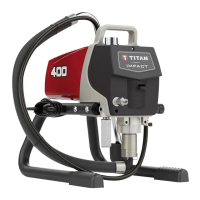
| Type | Airless Paint Sprayer |
|---|---|
| Maximum Operating Pressure | 3000 PSI |
| Maximum Flow Rate | 0.47 GPM |
| Power Source | Electric |
| Hose Length | 50 feet |
| Motor Type | DC |

 To Next Page