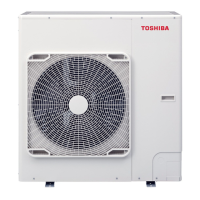
Outdoor Unit
Installation Manual
– 12 –
6 Air purging
■ Airtight test
After completing the refrigerant piping work, perform an airtight test. Connect a nitrogen gas cylinder and
pressurize the pipes with nitrogen gas as follows to conduct the airtight test.
■ Air purge
Gas leak check
Step 1 ... Pressurize to 0.5 MPa (5 kg/cm
2
G) for 5 minutes or longer.
Step 2 ... Pressurize to 1.5 MPa (15 kg/cm
2
G) for 5 minutes or longer.
Step 3 ... Pressurize to 4.15 MPa (42 kg/cm
2
G) <HWT-40, 60 model> for 24 hours.
Pressurize to 4.6 MPa (46 kg/cm
2
G) <HWT-80, 110, 140 model> for 24 hours.
(However, note that when the ambient temperature differs during pressurization and after 24 hours, the pressure
will change by approximately 0.01 MPa (0.1 kg/cm
2
G) per 1°C, so this should be compensated.)
If the pressure drops in steps 1 through 3, check the connections for leakage.
Check for leaks with foaming liquid, etc., take steps to fix the leaks such as brazing the pipes again and tightening
the flare nuts, and then perform the airtight test again.
* After the airtight test is completed, evacuate the nitrogen gas.
Major leaks can be discovered.
Micro leaks can be
discovered.
Low pressure gauge High pressure gauge
Gauge manifold
V
L
V
H
Nitrogen gas
Pressure reducing
valve
Charge port
CAUTION
Never use oxygen, flammable gas, or noxious
gas for the airtight test.
With respect to the preservation of the terrestrial
environment, adopt “Vacuum pump” to purge air
(Evacuate air in the connecting pipes) when installing the
unit.
• Do not discharge the refrigerant gas to the atmosphere
to preserve the terrestrial environment.
• Use a vacuum pump to discharge the air (nitrogen, etc.)
that remains in the set. If air remains, the capacity may
decrease.
For the vacuum pump, be sure to use one with a backflow
preventer so that the oil in the pump does not backflow
into the pipe of the Air to Water Heat Pump when the
pump stops.
(If oil in the vacuum pump is put in an Air to Water Heat
Pump including R32, it may cause trouble with the
refrigeration cycle.)
Compound pressure gauge
Pressure gauge
Gauge manifold valve–101 kPa
(–76 cmHg)
Charge hose
(For R32 or
R410A only)
Charge port
(Valve core
(Setting pin))
Handle Low
Handle High
(Keep fully closed)
Charge hose
(For R32 or R410A only)
Packed valve at gas side
Vacuum
pump
Vacuum pump
adapter for backflow
prevention
(For R32 or R410A
only)
23-EN
24-EN



 To Next Page
 Loading...