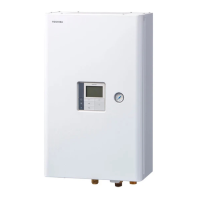
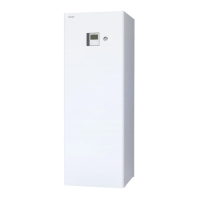
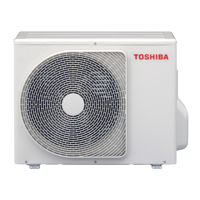
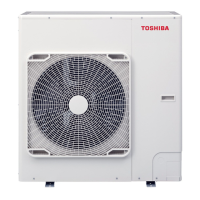
Outdoor Unit
Installation Manual
– 19 –
14 Troubleshooting
You can perform failure diagnosis of the Outdoor Unit with the LEDs on the P.C. board of the Outdoor Unit in
addition to using the check codes displayed on the wired remote controller of the Hydro Unit.
Use the LEDs and check codes for various checks. Details of the check codes displayed on the wired remote
controller of the Hydro Unit are described in the Installation Manual of the Hydro Unit.
■ LED Displays and Check Codes
No. Trouble description
LED display
D800 D801 D802 D803 D804 D805
1 Normal
2
Discharge temp. sensor (TD)
trouble
3
Heat exchanger temp. sensor (TE)
trouble
4
Heat exchanger temp. sensor (TL)
trouble
5
Outside air temp. sensor (TO)
trouble
6 Suction temp. sensor (TS) trouble
7 Heat sink temp. sensor (TH) trouble
8 Miss-mounting of sensor (TE, TS)
9 EEPROM trouble
10 Compressor break down
11 Compressor lock
12 Current detection circuit trouble
13 Case thermostat operation
14 Unset model type of P.C.board
15 MCU communication trouble
16 Discharge temp. trouble
17 High pressure SW operation
18 Power supply trouble
19 Heat sink overheat trouble
20 Gas leak detection
21 4-way valve inverse trouble
22 High pressure protective operation
23 Fan system trouble
24
Short-circuit of compressor drive
element
25 Position detection circuit trouble
26 High pressure sensor (Pd) trouble
27
Combination failure between the
Hydro Unit
: ON, : OFF, : Rapid flashing (5 times/sec)
15 Appendix
■Existingpiping
Work instructions
The existing R410A piping can be reused for our R32
product installations.
WARNING
Confirmingtheexistenceofscratchesordentson
theexistingpipesandconfirmingthereliabilityof
the pipe strength are conventionally referred to the
localsite.
Ifthespecifiedconditionscanbecleared,itis
possibletoupdateexistingR22andR407Cpipesto
thoseforR32models.
Basicconditionsneededtoreuseexisting
pipes
Check and observe the presence of three conditions in
the refrigerant piping works.
1. Dry (There is no moisture inside of the pipes.)
2. Clean (There is no dust inside of the pipes.)
3. Tight (There are no refrigerant leaks.)
Restrictionsforuseofexistingpipes
Inthefollowingcases,theexistingpipesshould
notbereusedastheyare.Cleantheexistingpipes
orexchangethemwithnewpipes.
1. When a scratch or dent is heavy, be sure to use new
pipes for the refrigerant piping works.
2. When the existing pipe thickness is thinner than the
specified “Pipe diameter and thickness,” be sure to
use new pipes for the refrigerant piping works.
• The operating pressure of R32 is high. If there is a
scratch or dent on the pipe or a thinner pipe is
used, the pressure strength may be inadequate,
which may cause the pipe to break in the worst
case.
* Pipe diameter and thickness (mm)
Reference
outside diameter
(mm)
Wall thickness
(mm)
Material
Φ6.4 0.8 –
Φ12.7 0.8 –
Φ15.9 1.0 –
• In case the pipe diameter is Φ12.7 mm dia or less
and the thickness is less than 0.7 mm, be sure to
use new pipes for the refrigerant piping works.
<HWT-80,110,140>
<HWT-40,60>
LED
LED
(D800 to D805)
(D800 to D805)
SW02
SW01
SW01
SW02
3. When the Outdoor Unit was left with the pipes
disconnected, or the gas leaked from the pipes and
the pipes were not repaired and refilled.
• There is the possibility of rain water or air,
including moisture, entering the pipe.
4. When refrigerant cannot be recovered using a
refrigerant recovery unit.
• There is the possibility that a large quantity of dirty
oil or moisture remains inside the pipes.
5. When a commercially available dryer is attached to
the existing pipes.
• There is the possibility that copper green rust has
been generated.
6. When the existing Air to Water Heat Pump is
removed after refrigerant has been recovered.
Check if the oil is judged to be clearly different from
normal oil.
• The refrigerator oil is copper rust green in color:
There is the possibility that moisture has mixed
with the oil and rust has been generated inside the
pipe.
• There is discolored oil, a large quantity of residue,
or a bad smell.
• A large quantity of shiny metal dust or other wear
residue can be seen in the refrigerant oil.
7. When the Air to Water Heat Pump has a history of
the compressor failing and being replaced.
• When discolored oil, a large quantity of residue,
shiny metal dust, or other wear residue or mixture
of foreign matter is observed, trouble will occur.
8. When temporary installation and removal of the Air
to Water Heat Pump are repeated such as when
leased, etc.
9. If the type of refrigerator oil of the existing Air to
Water Heat Pump is other than the following oil
(Mineral oil), Suniso, Freol-S, MS (Synthetic oil),
alkyl benzene (HAB, Barrel-freeze), ester series,
PVE only of ether series.
• The winding-insulation of the compressor may
deteriorate.
NOTE
The above descriptions are results have been confirmed
by our company and represent our views on our Air to
Water Heat Pump, but do not guarantee the use of the
existing pipes of Air to Water Heat Pump that have
adopted R32 or R410A in other companies.
37-EN
38-EN



 To Next Page
 Loading...