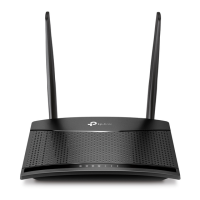
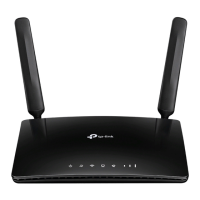
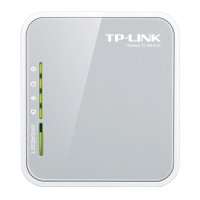
TL-MR3020 Portable 3G/4G Wireless N Router
Appendix D: Glossary
- 802.11n builds upon previous 802.11 standards by adding MIMO (multiple-input
tput). MIMO ow for increased
ghput via sp y exploiting the spatial
perhaps thro The Enhanced Wireless
rtium (EWC) [3 n development
process and promote -generation
wireless local area networking (WLA
he 802.11 g
direct-sequence spread sed radio
spectrum at 2.4GHz, and WEP encryp referred to
Fi networks.
ation for wireless networking at 54 Mbps using direct-sequence
ectrum (DSSS) technology, using OFDM modulation and operating in the
spectr d backward compatibility with IEEE 802.11b devices,
and WEP encryption fo
Dom ning a fixed host and
domain name to a dyna
atically configure the
r.
DMZ (Demilitarized Zo lows one local host to be exposed to the
Internet for a special-pu t gaming or videoconferencing.
DNS (Domain Name Sy that translates the names of websites into
IP addresses.
- A descriptive name for an address or group of addresses on the Internet.
DSL (Digital Subscriber or received over
onal phon
ISP (Internet Service Pr e Internet.
MTU (Maximum Trans largest packet that can be
transmitted.
NAT (Network Address Translation) - NAT technology translates IP addresses of a local area
network to a different IP address for the Internet.
PPPoE (Point to Point Protocol over Ethernet) - PPPoE is a protocol for connecting remote
hosts to the Internet over an always-on connection by simulating a dial-up connection.
802.11n
multiple-ou
uses multiple transmitter and receiver antennas to all
data throu
diversity,
atial multiplexing and increased range b
ugh coding schemes like Alamouti coding.
Conso ] was formed to help accelerate the IEEE 802.11
a technology specification for interoperability of next
N) products.
802.11b - T
b standard specifies a wireless networking at 11 Mbps usin
-spectrum (DSSS) technology and operating in the unlicen
tion for security. 802.11b networks are also
as Wi-
802.11g - specific
spread-sp
unlicensed radio um at 2.4GHz, an
r security.
DDNS (Dyn
amic ain Name System) - The capability of assig
mic Internet IP Address.
DHCP (Dynamic Host Configuration Protocol) - A protocol that autom
TCP/IP parameters for the all the PC(s) that are connected to a DHCP serve
ne) - A Demilitarized Zone al
rpose service such as Interne
s
tem) - An Internet Service
Domain Name
Line) - A technolog
y that allows data to be sent
existing traditi e lines.
ovider) - A company that provides access to th
mission Unit) - The size in bytes of the
-244-






 To Next Page