OPERATION
25
SLIPPERY SURFACES
Skidding or slidingcan cause a loss of control. Skidding or slidingcan cause a rolloverif
tires have lost traction, thenregain traction suddenly. Whenoperating on slippery sur-
faces, travelatreduced speed to help maintain control of the vehicle.
When operating in conditions such as ice, water, muddy trails, loose gravel or freezing temperatures, follow these
guidelines:
• Do not operate on excessively rough, slippery, or loose terrain.
• Slow down before entering potentially slippery areas.
• Maintain a high level of alertness, carefully evaluate the path of travel, and avoid quick, sharp turns.
• Correct a skid by turning the steering wheel in the direction of the skid. Never apply the brakes during a skid.
DRIVING UPHILL
When driving up a hill, follow these guidelines:
• Drive straight up the hill.
• Avoid excessively steep hills.
• Keep both feet on the floor or a pedal.
• Check the terrain before driving up a hill. Do not try to climb hills that have excessively slippery or loose surfaces.
• Drive at a steady rate of acceleration and speed.
• Do not drive over the crest of a hill at high speeds. An obstacle, sharp drop, another person, or another vehicle
could be on the other side of the hill.
• Do not attempt to drive up a hill that is beyond your skill level.
TRAVERSING HILLSIDES
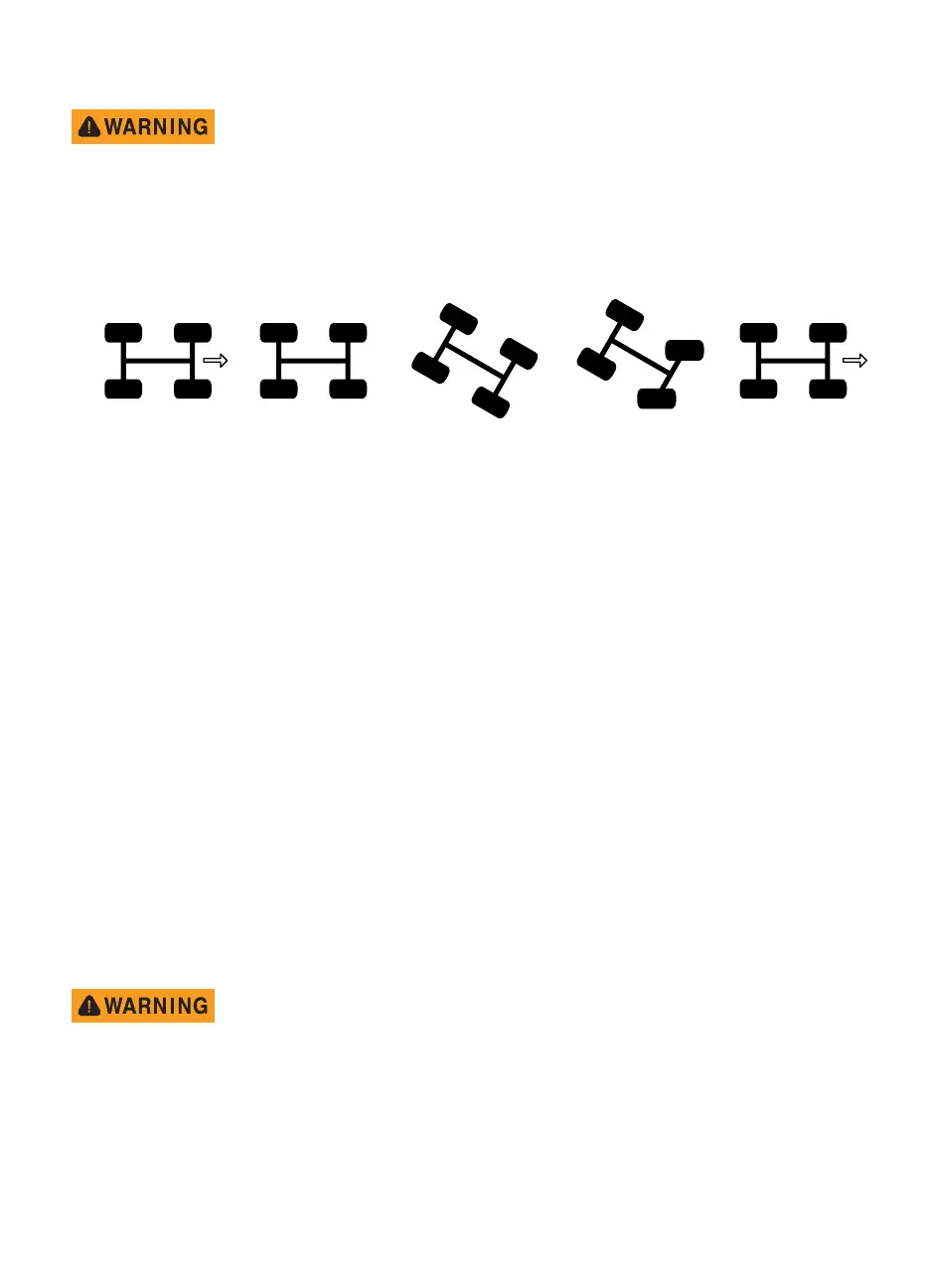
Traversing a hillside is not recommended. Improper procedure can cause a loss of control or a rollover. Avoid crossing
the side of a hill unless absolutely necessary. If traversing a hillside is unavoidable, check the terrain and determine if
it can be accomplished safely. Do not proceed if the terrain is beyond the vehicle or driver’s ability.
If traversing a hillside is unavoidable, follow these guidelines:
• Drive slowly.
• Use extreme caution.
• Avoid crossing the side of a hill that has a slippery surface.
• Avoid crossing the side of a steep hill.
• When traversing a hillside that has soft terrain, it may be necessary to steer slightly uphill to keep the vehicle travel-
ing in a straight line.
• If you feel that you are losing control of the vehicle, steer downhill if possible to regain control.
DRIVING DOWNHILL
When carryingcargoortowing a trailer, the weightofthe loadwill increase the braking
distance required to slow or stop the vehicle. Not allowing for increased brakingdis-
tance under a loadcan cause an accident or injury.
When driving down a hill, follow these guidelines:
• Avoid excessively steep hills.
• Check the terrain carefully before descending any hill.
• Never drive down hills with excessively slippery or loose surfaces.
• Drive slowly.
• Drive straight down the hill. Avoid descending the hill at an angle that could cause the vehicle to lean sharply to one
side.
• Apply light and constant pressure to the brakes to maintain slow speed and control of the vehicle.


 To Next Page