12
© March 2003 Tractel. All rights reserved.
15. MAINTENANCE
15.1 A Travsafe
®
traveller requires little maintenance other than periodic cleaning and inspection (see below section 16).
However, for correct operation it is recommended that it is always kept in good condition, clean with no plaster,
concrete, cement or paint splashes, etc. The maintenance of the traveller is limited to keeping it clean and lightly
oiled (spraying). The wire ropes should be lubricated at least once every six months using an aerosol spray
lubricant such as KERNITE-K-AHT (silicon based oil).
16. INSPECTION BEFORE USE
16.1 All equipment must be inspected visually before each use and periodically by a qualified person. If damage is
found as described below (see 16.3 to 16.6), remove the item from service immediately and replace it. If any
damage or questionable conditions are apparent that are not described below, remove the item from service
immediately and call Tractel Ltd. for advice. The Travsafe
®
sytem must be inspected as required by applicable
industry and workplace safety regulations, but not less frequently than once every 12 months.
16.2 Failure to remove equipment that has been damaged or is in questionable condition could lead to serious or fatal
injury. A detailed record of inspection should be maintained. See page 15 for suggested record sheet.
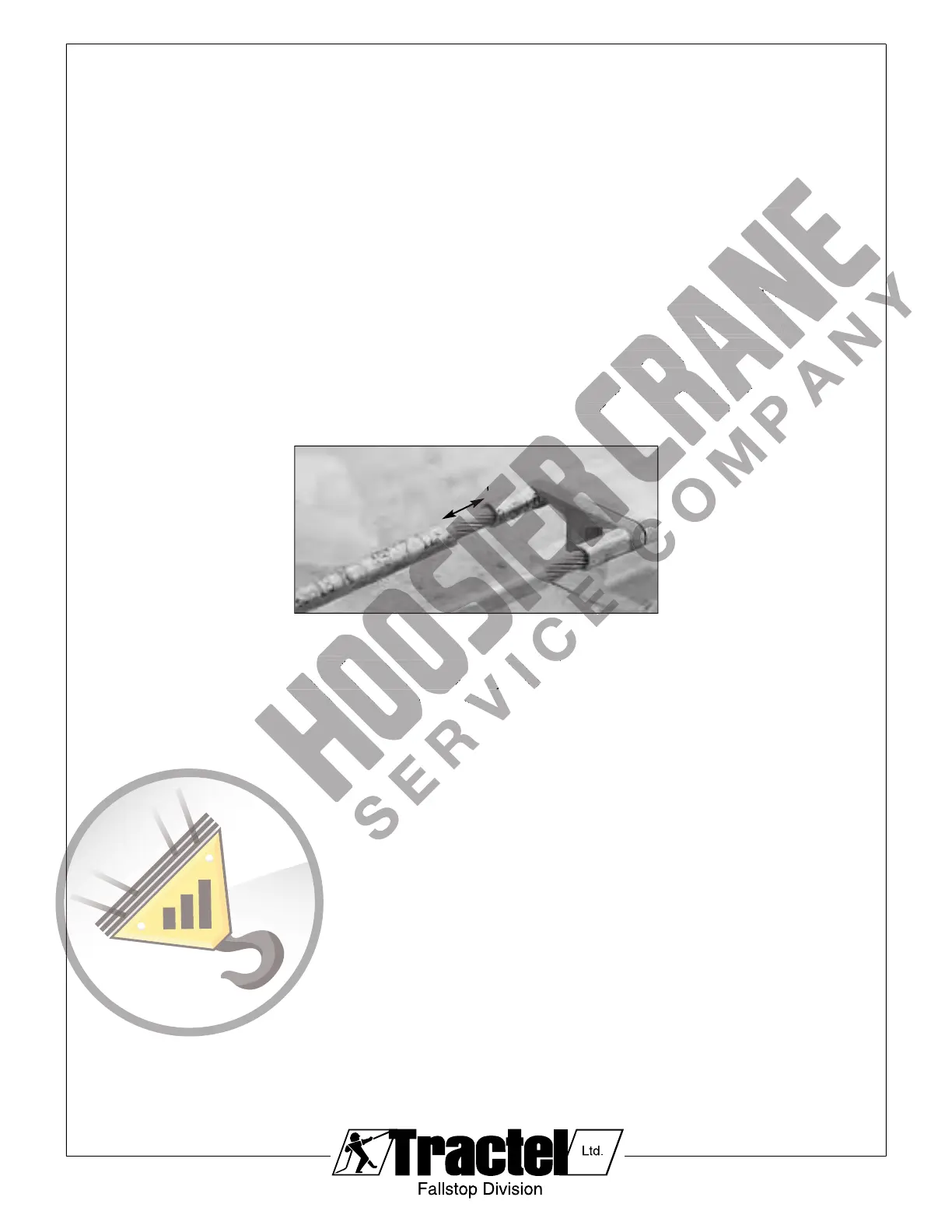
16.3 Shock absorbing sleeve
Check the position of the shock-absorbing sleeves, a distance of 1 in. (25 mm) between sleeves should be present,
to ensure that the fall arrest system has not been subject to a significant force (figure 15). Shock-absorbing
sleeves at intermediate anchors (and corners) should be tight against the anchor (figure 13).
1 in. (25 mm)
fig. 15
to ensure that the fall arrest system has not been subject to a significant force (
sleeves at intermediate anchors (and corners) should be tight against the anchor (
Check the position of the shock-absorbing sleeves, a distance of 1 in. (25 mm) between sleeves should be present,
to ensure that the fall arrest system has not been subject to a significant force (
Check the position of the shock-absorbing sleeves, a distance of 1 in. (25 mm) between sleeves should be present,
16.2 Failure to remove equipment that has been damaged or is in questionable condition could lead to serious or fatal
Check the position of the shock-absorbing sleeves, a distance of 1 in. (25 mm) between sleeves should be present,
to ensure that the fall arrest system has not been subject to a significant force (
sleeves at intermediate anchors (and corners) should be tight against the anchor (
Check the position of the shock-absorbing sleeves, a distance of 1 in. (25 mm) between sleeves should be present,
to ensure that the fall arrest system has not been subject to a significant force (
sleeves at intermediate anchors (and corners) should be tight against the anchor (
Check the position of the shock-absorbing sleeves, a distance of 1 in. (25 mm) between sleeves should be present,
to ensure that the fall arrest system has not been subject to a significant force (
sleeves at intermediate anchors (and corners) should be tight against the anchor (
16.2 Failure to remove equipment that has been damaged or is in questionable condition could lead to serious or fatal
injury. A detailed record of inspection should be maintained. See page 15 for suggested record sheet.
sytem must be inspected as required by applicable
industry and workplace safety regulations, but not less frequently than once every 12 months.
16.2 Failure to remove equipment that has been damaged or is in questionable condition could lead to serious or fatal
injury. A detailed record of inspection should be maintained. See page 15 for suggested record sheet.
16.1 All equipment must be inspected visually before each use and periodically by a qualified person. If damage is
found as described below (see 16.3 to 16.6), remove the item from service immediately and replace it. If any
damage or questionable conditions are apparent that are not described below, remove the item from service
sytem must be inspected as required by applicable
16.2 Failure to remove equipment that has been damaged or is in questionable condition could lead to serious or fatal
16.1 All equipment must be inspected visually before each use and periodically by a qualified person. If damage is
found as described below (see 16.3 to 16.6), remove the item from service immediately and replace it. If any
damage or questionable conditions are apparent that are not described below, remove the item from service
sytem must be inspected as required by applicable
oiled (spraying). The wire ropes should be lubricated at least once every six months using an aerosol spray
to ensure that the fall arrest system has not been subject to a significant force (
sleeves at intermediate anchors (and corners) should be tight against the anchor (
to ensure that the fall arrest system has not been subject to a significant force (
to ensure that the fall arrest system has not been subject to a significant force (
sleeves at intermediate anchors (and corners) should be tight against the anchor (
Check the position of the shock-absorbing sleeves, a distance of 1 in. (25 mm) between sleeves should be present,
to ensure that the fall arrest system has not been subject to a significant force (
Check the position of the shock-absorbing sleeves, a distance of 1 in. (25 mm) between sleeves should be present,
to ensure that the fall arrest system has not been subject to a significant force (
Check the position of the shock-absorbing sleeves, a distance of 1 in. (25 mm) between sleeves should be present,
Check the position of the shock-absorbing sleeves, a distance of 1 in. (25 mm) between sleeves should be present,
16.2 Failure to remove equipment that has been damaged or is in questionable condition could lead to serious or fatal
16.2 Failure to remove equipment that has been damaged or is in questionable condition could lead to serious or fatal16.2 Failure to remove equipment that has been damaged or is in questionable condition could lead to serious or fatal16.2 Failure to remove equipment that has been damaged or is in questionable condition could lead to serious or fatal
16.2 Failure to remove equipment that has been damaged or is in questionable condition could lead to serious or fatal
16.2 Failure to remove equipment that has been damaged or is in questionable condition could lead to serious or fatal
Check the position of the shock-absorbing sleeves, a distance of 1 in. (25 mm) between sleeves should be present,
to ensure that the fall arrest system has not been subject to a significant force (
sleeves at intermediate anchors (and corners) should be tight against the anchor (
Check the position of the shock-absorbing sleeves, a distance of 1 in. (25 mm) between sleeves should be present,Check the position of the shock-absorbing sleeves, a distance of 1 in. (25 mm) between sleeves should be present,Check the position of the shock-absorbing sleeves, a distance of 1 in.(25 mm) between sleeves should be present,
Check the position of the shock-absorbing sleeves, a distance of 1 in. (25 mm) between sleeves should be present,
to ensure that the fall arrest system has not been subject to a significant force (to ensure that the fall arrest system has not been subject to a significant force (to ensure that the fall arrest system has not been subject to a significant force (
to ensure that the fall arrest system has not been subject to a significant force (
sleeves at intermediate anchors (and corners) should be tight against the anchor (
Check the position of the shock-absorbing sleeves, a distance of 1 in. (25 mm) between sleeves should be present,
to ensure that the fall arrest system has not been subject to a significant force (
sleeves at intermediate anchors (and corners) should be tight against the anchor (
Shock absorbing sleeveShock absorbing sleeveShock absorbing sleeve
Check the position of the shock-absorbing sleeves, a distance of 1 in. (25 mm) between sleeves should be present,
to ensure that the fall arrest system has not been subject to a significant force (to ensure that the fall arrest system has not been subject to a significant force (to ensure that the fall arrest system has not been subject to a significant force (
to ensure that the fall arrest system has not been subject to a significant force (
to ensure that the fall arrest system has not been subject to a significant force (to ensure that the fall arrest system has not been subject to a significant force (to ensure that the fall arrest system has not been subject to a significant force (
to ensure that the fall arrest system has not been subject to a significant force (
to ensure that the fall arrest system has not been subject to a significant force (
sleeves at intermediate anchors (and corners) should be tight against the anchor (
Check the position of the shock-absorbing sleeves, a distance of 1 in. (25 mm) between sleeves should be present,
to ensure that the fall arrest system has not been subject to a significant force (
sleeves at intermediate anchors (and corners) should be tight against the anchor (
Check the position of the shock-absorbing sleeves, a distance of 1 in. (25 mm) between sleeves should be present,
to ensure that the fall arrest system has not been subject to a significant force (to ensure that the fall arrest system has not been subject to a significant force (to ensure that the fall arrest system has not been subject to a significant force (
to ensure that the fall arrest system has not been subject to a significant force (
to ensure that the fall arrest system has not been subject to a significant force (
sleeves at intermediate anchors (and corners) should be tight against the anchor (
16.2 Failure to remove equipment that has been damaged or is in questionable condition could lead to serious or fatal
injury. A detailed record of inspection should be maintained. See page 15 for suggested record sheet.
16.2 Failure to remove equipment that has been damaged or is in questionable condition could lead to serious or fatal16.2 Failure to remove equipment that has been damaged or is in questionable condition could lead to serious or fatal16.2 Failure to remove equipment that has been damaged or is in questionable condition could lead to serious or fatal
16.2 Failure to remove equipment that has been damaged or is in questionable condition could lead to serious or fatal
16.2 Failure to remove equipment that has been damaged or is in questionable condition could lead to serious or fatal
injury. A detailed record of inspection should be maintained. See page 15 for suggested record sheet.
sytem must be inspected as required by applicable
industry and workplace safety regulations, but not less frequently than once every 12 months.
16.2 Failure to remove equipment that has been damaged or is in questionable condition could lead to serious or fatal
injury. A detailed record of inspection should be maintained. See page 15 for suggested record sheet.
sytem must be inspected as required by applicable
industry and workplace safety regulations, but not less frequently than once every 12 months.
16.2 Failure to remove equipment that has been damaged or is in questionable condition could lead to serious or fatal16.2 Failure to remove equipment that has been damaged or is in questionable condition could lead to serious or fatal16.2 Failure to remove equipment that has been damaged or is in questionable condition could lead to serious or fatal
16.2 Failure to remove equipment that has been damaged or is in questionable condition could lead to serious or fatal
16.2 Failure to remove equipment that has been damaged or is in questionable condition could lead to serious or fatal16.2 Failure to remove equipment that has been damaged or is in questionable condition could lead to serious or fatal16.2 Failure to remove equipment that has been damaged or is in questionable condition could lead to serious or fatal
16.2 Failure to remove equipment that has been damaged or is in questionable condition could lead to serious or fatal
16.2 Failure to remove equipment that has been damaged or is in questionable condition could lead to serious or fatal
injury. A detailed record of inspection should be maintained. See page 15 for suggested record sheet.
16.1 All equipment must be inspected visually before each use and periodically by a qualified person. If damage is
found as described below (see 16.3 to 16.6), remove the item from service immediately and replace it. If any
damage or questionable conditions are apparent that are not described below, remove the item from service
sytem must be inspected as required by applicable
16.2 Failure to remove equipment that has been damaged or is in questionable condition could lead to serious or fatal
16.1 All equipment must be inspected visually before each use and periodically by a qualified person. If damage is
16.1 All equipment must be inspected visually before each use and periodically by a qualified person. If damage is
16.1 All equipment must be inspected visually before each use and periodically by a qualified person. If damage is
16.1 All equipment must be inspected visually before each use and periodically by a qualified person. If damage is
found as described below (see 16.3 to 16.6), remove the item from service immediately and replace it. If any
damage or questionable conditions are apparent that are not described below, remove the item from service
sytem must be inspected as required by applicable
16.2 Failure to remove equipment that has been damaged or is in questionable condition could lead to serious or fatal16.2 Failure to remove equipment that has been damaged or is in questionable condition could lead to serious or fatal16.2 Failure to remove equipment that has been damaged or is in questionable condition could lead to serious or fatal
16.2 Failure to remove equipment that has been damaged or is in questionable condition could lead to serious or fatal
16.1 All equipment must be inspected visually before each use and periodically by a qualified person. If damage is
found as described below (see 16.3 to 16.6), remove the item from service immediately and replace it. If any
damage or questionable conditions are apparent that are not described below, remove the item from service
sytem must be inspected as required by applicable
16.1 All equipment must be inspected visually before each use and periodically by a qualified person. If damage is
16.1 All equipment must be inspected visually before each use and periodically by a qualified person. If damage is
16.1 All equipment must be inspected visually before each use and periodically by a qualified person. If damage is
16.1 All equipment must be inspected visually before each use and periodically by a qualified person. If damage is
16.1 All equipment must be inspected visually before each use and periodically by a qualified person. If damage is
found as described below (see 16.3 to 16.6), remove the item from service immediately and replace it. If any
damage or questionable conditions are apparent that are not described below, remove the item from service
sytem must be inspected as required by applicablesytem must be inspected as required by applicablesytem must be inspected as required by applicablesytem must be inspected as required by applicable
sytem must be inspected as required by applicable
oiled (spraying). The wire ropes should be lubricated at least once every six months using an aerosol spray
oiled (spraying). The wire ropes should be lubricated at least once every six months using an aerosol sprayoiled (spraying). The wire ropes should be lubricated at least once every six months using an aerosol sprayoiled (spraying). The wire ropes should be lubricated at least once every six months using an aerosol spray
oiled (spraying). The wire ropes should be lubricated at least once every six months using an aerosol spray


 To Next Page
 Loading...