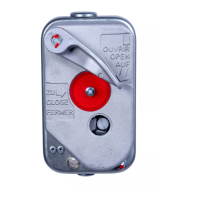
The Blocstop™ BS fall arrest device is an additional safety device designed to stop a load in the event of a fall when used with a TIRFOR® or TIRAK™ fall arrest wire rope. It is a quasi-machine as defined by machinery directive 2006/42/CE and is intended for use in lifting and pulling installations for materials and equipment. The device is sized for a usability factor of 4, and each unit undergoes functional testing at its working load limit prior to shipment.
Function Description:
The Blocstop™ BS fall arrest device is primarily composed of a system of self-clamping jaws (item g, fig. 1) housed within a zinc-plated steel casing. It connects via its shackle (item e, fig. 1) to an anchor point (item 8, fig. 21) using a sling.
When the wire rope (item b, fig. 1) moves through the device in the pulling direction (indicated by arrow c, fig. 1), the jaws automatically open, allowing the rope to slide freely. Conversely, if the wire rope moves in the opposite direction, the jaws immediately close and clamp the wire rope with a force proportional to the load, similar to the TIRFOR® principle.
For controlled descent of the load, the device can be manually unlocked by pulling on the stirrup (item d, fig. 1) in the direction of the arrow. This unlocking operation is only possible when there is no load on the fall arrest device. A return spring keeps the stirrup in its resting position against the device.
Important Technical Specifications:
The Blocstop™ BS fall arrest devices are available in several models with varying capacities and wire rope specifications:
| Model |
WLL* (kg) |
W (kg) |
Øc (mm) |
St |
R (kg) |
| 15.301 |
800 |
2 |
8.3 |
5 x 19 |
4,800 |
| 20.300 |
800 |
3.7 |
8.3 |
5 x 19 |
4,800 |
| 20.303 |
1,000 |
3.7 |
9.5 |
5 x 19 |
6,400 |
| 20.304 |
1,600 |
3.7 |
10.2 |
5 x 26 |
8,000 |
| 20.301 |
1,600 |
3.7 |
11.5 |
5 x 26 |
9,600 |
| 35.304 |
3,000 |
8.2 |
14.3 |
5 x 26 |
16,000 |
| 35.30 |
3,200 |
8.2 |
16.3 |
5 x 31 |
19,200 |
WLL: Working Load Limit for material's lifting and pulling.
W: Weight of fall arrest device.
Øc: Wire rope diameter.
R: Minimum tensile strength of wire ropes.
St: Structure of wire ropes.
The wire ropes, ordered separately, are supplied on a reel with a safety hook at one end (item A, fig. 16) or with a sleeved and thimbled end (item B, fig. 16) upon request.
Dimensions (in mm):
| Fig. |
a |
b |
c |
d |
Øe |
o |
g |
h |
i |
j |
k |
l |
l* |
m |
m* |
r |
Øs |
| 24 |
161 |
167 |
209 |
91 |
12 |
74 |
64 |
38 |
20 |
14 |
42.5 |
39 |
100 |
33 |
39 |
19 |
12.2 |
| 25 |
203 |
210 |
252 |
121 |
12 |
74 |
74 |
38 |
19.5 |
25 |
55 |
50 |
145 |
45.5 |
52.5 |
19 |
12.2 |
|
290 |
297.5 |
375.5 |
140 |
22 |
115 |
90 |
60.5 |
22 |
28 |
60 |
12.7 |
157 |
90 |
84 |
27.5 |
22.2 |
l: Position of stirrup used to unlock fall arrest device.
Usage Features:
- Installation: The device must be installed on special fall arrest wire ropes. The fastening means for the fall arrest device must ensure a breaking strength at least four times the nominal capacity of the Blocstop™ BS. Before installation, ensure the device is in good condition, with no impact marks or deformation, the stirrup rotates freely, markings are legible, and entry/exit holes are clean.
- Wire Rope Preparation: Only TRACTEL® recommended special wire ropes should be used. Regular checks of the wire rope condition are crucial, ensuring wear is less than 10% of its nominal diameter and no deformation or damage. The wire rope should always be lightly greased with multi-purpose greases, avoiding those with molybdenum disulfide or graphite additives.
- Operation: When lifting or pulling a load, the jaws open slightly, allowing the wire rope to pass freely. Ensure the wire rope always slides freely. If not, check the ballast weight positioning.
- Controlled Descent: To lower or release a load, the unlock stirrup (item d, fig. 1) must be manually raised and held in the up position throughout the descent. The device cannot be unlocked under load. If inadvertent locking occurs, slightly raising the load can release the device.
- Automatic Locking: The device locks automatically in case of a hoist failure or rupture of the lifting/pulling wire rope. Releasing the stirrup in an emergency will immediately engage the lock.
- Prohibited Uses: Do not secure the device by unauthorized means, use damaged wire ropes, exceed the working load limit, operate without prior checks, use for purposes other than intended, or modify the device. Avoid using in explosive or highly corrosive environments, or outside the temperature range of -10°C to +50°C.
Maintenance Features:
- Periodic Inspection:
- Fall arrest device: Annual functional check, cleaning, and lubrication by TRACTEL® or an approved repair agent.
- Wire ropes: Weekly inspection by a technician, checking for wear (<10% of Øc) and damage as per the lifting system manual.
- Locking function (BS): Daily check by a technician. During a descent maneuver with the hoist, the fall arrest device must hold the load.
- Stirrup operation (BS): Daily check by a technician. During a descent maneuver with the hoist while holding the unlock stirrup up, the fall arrest wire rope must slide freely. This check should be performed at a maximum height of 0.5 m.
- Shackle on fall arrest device (BS): Daily check by a technician for the presence of the cotter pin.
- Post-Fall Inspection: After a fall arrest event, a technician must inspect the lifting installation.
- Removal and Storage: Before removal, ensure there is no load on the device. The suspended platform or load must be on the ground. Follow the lifting system's decommissioning recommendations. Clean and lubricate the device before storage.
- Malfunctions: A detailed table of malfunctions, diagnostics, and corrective actions is provided. Common issues include the wire rope not sliding freely (due to damage, jaw mechanism failure, incorrect ballast weight, or obstructed holes) and the device not locking (due to worn jaws, broken stirrup pin/return spring, or worn/seized roller). In most cases, corrective actions involve stopping the maneuver, placing the load on the ground, inspecting/replacing the wire rope, cleaning the device, or sending it for inspection/repair.

 Need help?
 General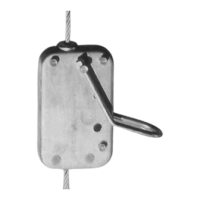

 To Next Page