8
EN
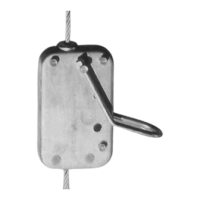
– insert the lifting wire rope (item 4, g. 21)
through the hole (item a, g. 1) of the fall
arrest device and have the wire rope come out
through the exit hole (item f, g. 1),
– run the lifting wire rope through a spacer tube
(item 9, g. 21). This piece is placed between
the TIRFOR
®
and the fall arrest device to
serve as a stop for the fall arrest device when
the cable moves in the device in the pulling
direction (item c, g. 1),
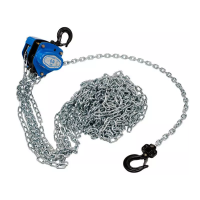
– run the wire rope through the TIRFOR
®
and
engage the TIRFOR
®
(see TIRFOR
®
manual).
IMPORTANT: The length of the spacer (item
9, g. 1) must be sucient to not interfere with
movement of the unlock stirrup of the fall arrest
device (item d, g. 1).
5.4. Preparation of wire ropes
DANGER: The fall arrest wire ropes are
special wire ropes. Use of any wire rope other
than those recommended by TRACTEL
®
can
result in a serious malfunction when the fall
arrest system is used.
Make sure that the wire rope lengths are
compliant with the recommendations of the
lifting system installation manual.
Regularly check the condition of the fall arrest
wire rope. In particular, check that:
• the wear of the wire rope is <10% of its nominal
diameter Øc (g. 20),
• the wire rope does not show any deformation
or damage as detailed in the manual for the
lifting device.
IMPORTANT: Check that the fall arrest wire
rope is always lightly greased. Only multiple
purpose o-the-shelf greases should be used.
Do not use lubricants containing molybdenum
disulde or graphite additives.
6. Utilisation
NOTE: Protect the fall arrest devices
against soiling. Take the necessary measures
to prevent foreign matter from getting into
the unit with the fall arrest wire rope. This
recommendation applies in particular in those
cases where concrete may be projected or
synthetic resins sprayed, or others.
Deposits of this kind can result in malfunctions
representing a safety hazard for the operators.
Utilisation of the fall arrest device is identical
when used on either a load lifting and pulling
wire rope (g. 21).
Once you have completed the necessary checks
as detailed in §5.1, you can proceed to use the
system.
IMPORTANT: When lifting or pulling a
load, i.e. when the wire rope moves into the fall
arrest device, the jaws open slightly, creating no
resistance to passage of the wire rope. Always
make sure that the wire rope slides freely in
the unit. If this is not the case, check that the
ballast weight is correctly positioned. If so,
replace the fall arrest device by an equivalent
serviceable device and return the defective unit
to TRACTEL
®
or to an approved repair agent for
overhaul.
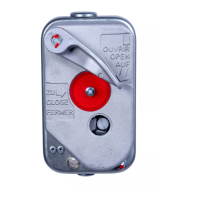
IMPORTANT: To lower or release the load,
the fall arrest device must be unlocked manually
by raising the stirrup (item d, g. 1) and holding
it in the up position throughout the lowering
operation (g. 23). In the event of a hoist failure
or rupture of the lifting or pulling wire rope,
simply release the stirrup; the fall arrest device
unlocks immediately. In the event of danger, you
will instinctively release the stirrup as a natural
self-protection response.
IMPORTANT: Since the fall arrest device
cannot be unlocked under load, the unlock stirrup
must be raised before lowering or releasing the
load. If by operator inadvertence, the fall arrest
device locks, the device can be unlocked by
slightly bringing up the load in order to release
the fall arrest device from the load.
7. Removal and storage
DANGER: Make sure there is no load on
the fall arrest device before you proceed to
remove it. The suspended platform or load must
be set on the ground.


 To Next Page
 Loading...