EasyManua.ls Logo

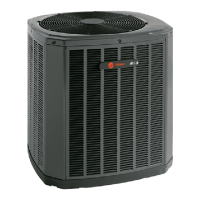
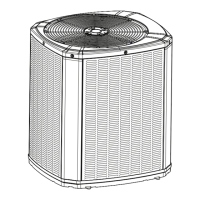
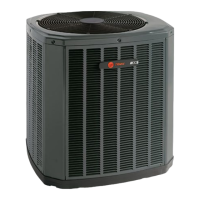
Trane 4TTX6018J - User Manual

Trane 4TTX6018J
24 pages
Print Icon
To Next Page IconTo Next Page
Loading...
18-AC100D1-5D-EN
ALL phases of this installation must comply with NATIONAL, STATE AND LOCAL CODES.
IMPORTANT — This Document is customer property and is to remain with this unit. Please return to service informa-
tion pack upon completion of work.
Condensing Units
These instructions do not cover all variations in systems or provide for every possible contingency to be met in connection with
the installation. Should further information be desired or should particular problems arise which are not covered sufficiently for the
purchaser’s purposes, the matter should be referred to your installing dealer or local distributor.
The manufacturer recommends installing only approved matched indoor and outdoor systems. All of the manufacture’s split
systems are A.H.R.I. rated only with TXV/EEV indoor systems. Some of the benefits of installing approved matched indoor and
outdoor split systems are maximum efficiency, optimum performance and the best overall system reliability.
4TTX6018–061
Installer’s Guide
Table of Contents
Section 1. Safety ..................................................................................... 2
Section 2. Unit Location Considerations ............................................. 3
Section 3. Unit Preparation.................................................................... 4
Section 4. Setting the Unit ..................................................................... 5
Section 5. Refrigerant Line Considerations ......................................... 5
Section 6. Refrigerant Line Routing ..................................................... 6
Section 7. Refrigerant Line Brazing ...................................................... 7
Section 8. Refrigerant Line Leak Check ............................................... 9
Section 9. Evacuation ............................................................................ 9
Section 10. Service Valves .................................................................. 10
Section 11. Electrical - Low Voltage ................................................... 10
Section 12. Electrical - High Voltage .................................................. 12
Section 13. Start Up.............................................................................. 12
Section 14. System Charge Adjustment............................................. 13
Section 15. Checkout Procedures and Troubleshooting .................. 17
Section 16. Refrigeration Circuits........................................................21

Question and Answer IconNeed help?

Do you have a question about the Trane 4TTX6018J and is the answer not in the manual?

Overview

This document is an installer's guide for Trane Condensing Units, specifically models 4TTX6018-061. It provides comprehensive instructions for the installation, startup, and maintenance of these units, emphasizing compliance with national, state, and local codes.

Function Description:

The Trane Condensing Units are outdoor components of a split-system air conditioning or heat pump system. They are designed to work in conjunction with approved matched indoor evaporator coils and/or air handlers to provide efficient cooling and, in some cases, heating for residential and commercial applications. The guide highlights that all of Trane's split systems are AHRI rated only with TXV/EEV indoor systems, ensuring maximum efficiency, optimum performance, and overall system reliability.

Important Technical Specifications:

  • Refrigerant Type: R-410A. This refrigerant operates at 50 to 70% higher pressures than R-22, requiring R-410A approved service equipment.
  • Compressor Oil: POE oil, which readily absorbs moisture. Systems should remain sealed whenever possible, and if open to the atmosphere for more than 4 hours, the compressor oil must be replaced. Driers should always be changed when opening the system for component replacement.
  • Refrigerant Piping Limits:
    • Maximum total length of refrigerant lines (outdoor to indoor unit, including lift): 150 feet.
    • Maximum vertical change (lift): 50 feet.
  • Factory Charge: Units are factory charged with the system charge required for the outdoor condensing unit, ten (10) feet of tested connecting line, and the smallest rated indoor evaporative coil match. Proper system charge must always be verified via subcooling (TXV/EEV) or superheat (fixed orifice) per the unit nameplate.
  • Low Voltage Wiring:
    • 18 AWG: Max. 150 Ft.
    • 16 AWG: Max. 225 Ft.
    • 14 AWG: Max. 300 Ft.
  • Unit Dimensions and Weight (Examples):
    • 4TTX6018J: 35 x 30 x 33 inches, 172 lbs.
    • 4TTX6061J: 52 x 34 x 37 inches, 301 lbs. (Note: Weights are estimated).

Usage Features:

  • Location Considerations:
    • Top discharge area must be unrestricted for at least five (5) feet above the unit.
    • Three (3) feet clearance must be provided in front of the control box (access panels) and any other side requiring service.
    • Avoid locating near bedrooms due to operational sounds.
    • Minimum 12 inches clearance from any wall or surrounding shrubbery for adequate airflow.
    • Must be far enough away from any structure to prevent roof runoff water from pouring directly on the unit.
    • For roof mounting, the roof must support the unit's weight, and isolation is recommended to alleviate sound/vibration transmission.
    • Coastal installations (within one mile of salt water) require the addition of BAYSEAC001 (Seacoast Kit).
  • Refrigerant Line Installation:
    • Vapor Line must always be insulated.
    • Liquid Line and Vapor Line must not come into direct (metal to metal) contact.
    • Precautions must be taken to prevent noise within the building structure due to vibration transmission from refrigerant lines (e.g., isolation hangers, insulating lines running through walls/sills, isolating from ductwork, minimizing 90° turns).
    • Existing refrigerant lines can be reused if all joints are brazed (not soldered), the indoor coil and lines are the correct size, and lines are free of leaks, acid, and oil.
  • Electrical Connections:
    • High voltage power supply must match the equipment nameplate and comply with national, state, and local codes.
    • A separate disconnect switch must be installed at the outdoor unit.
    • Flexible electrical conduit is recommended for high voltage connections to prevent noise transmission.
    • The outdoor unit must be grounded per code requirements.
    • Low voltage hook-up diagrams are provided for various indoor unit types (TEM 3, 4, 6, 8; TAM 4, 7, 9; Furnace; Variable Speed Furnace).

Maintenance Features:

  • Safety Precautions: Emphasizes the importance of electrical and mechanical experience for repair, warning against personal injury or property damage from improper work. Highlights the danger of live electrical components and the need to follow safety precautions.
  • Refrigerant Handling: Strict warnings regarding R-410A pressures and the use of approved service equipment. Caution against venting refrigerant gases into the atmosphere.
  • Brazing: Detailed steps for brazing refrigerant lines, including deburring, cleaning, purging with dry nitrogen, wrapping valve bodies with wet rags to prevent heat damage, and installing filter driers with correct directional flow. Precautions to avoid heat damage to the basepan during brazing are noted.
  • Leak Check: After brazing, lines and evaporator coil must be pressurized to 150 PSIG with dry nitrogen and checked for leaks using a soapy solution.
  • Evacuation: System must be evacuated until the micron gauge reads no higher than 350 microns, and remain stable for one minute, before opening service valves.
  • Service Valve Operation: Specific instructions for opening gas and liquid service valves, emphasizing caution when opening the liquid line service valve to prevent abrupt release of charge.
  • System Charge Adjustment:
    • Subcooling (in cooling mode) is the recommended charging method above 55°F ambient outdoor temperature.
    • Detailed steps for determining required refrigerant line length and lift, using charging charts to find the final subcooling value, measuring liquid line temperature and pressure, and adjusting refrigerant level.
    • The Weigh-In Method is provided as an alternative for initial installation or when power/operating conditions are not suitable for subcooling method.
    • System must operate for a minimum of 20 minutes to stabilize before accurate measurements.
  • Checkout Procedures: A checklist for final unit inspection, including verifying factory tubing position, tight wiring connections, proper airflow setting, outdoor fan operation, indoor coil drain line function, unobstructed registers/grilles, and installed return air filter.
  • Troubleshooting: Comprehensive troubleshooting charts and flowcharts are provided for common system faults, including refrigerant circuit issues (e.g., head pressure, suction pressure, floodback, frosting), electrical problems (e.g., compressor/fan won't start, compressor hums, IOL cycling, blower won't start), and defrost issues (e.g., won't initiate, terminates on time, icing up). Specific guidance for diagnosing contactor and compressor issues is included.
  • Compressor Dome Temperature: Caution against touching the top of the scroll compressor due to high temperatures.

Trane 4TTX6018J Specifications

General IconGeneral
BrandTrane
Model4TTX6018J
CategoryHeat Pump
LanguageEnglish

Related product manuals