TRANE
R
and the belts will break or turn over
shortly after installation.
• Take up sleck until belts fit snugly.
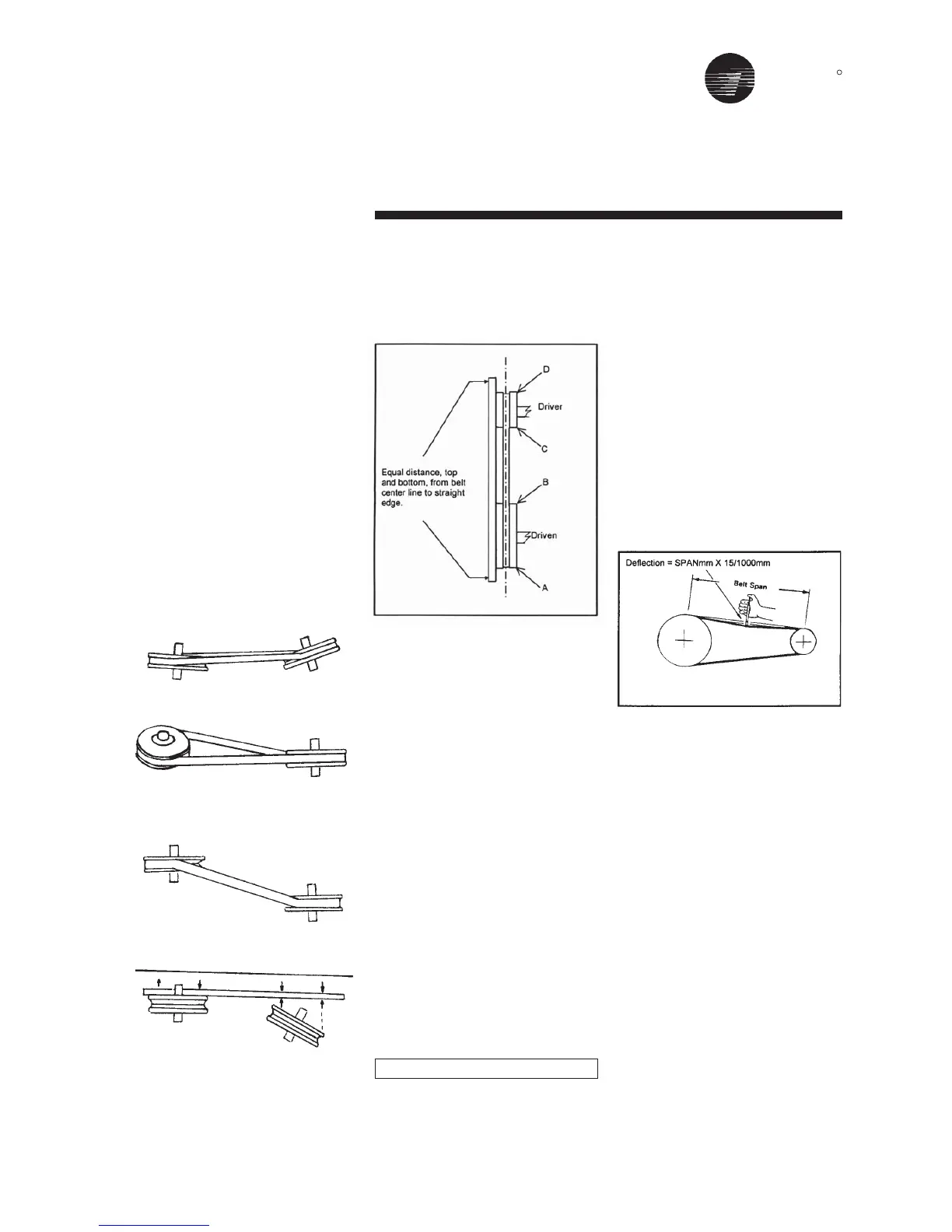
6. Check pulley alignment.
• Place a straight edge across
pulleys faces to correct alignment.
• Check parallel position of shafts
and correct alignment or grooves.
• Note: Mount pulleys as close to
bearing as possible.
31
Figure 16
Sheave Alignment
Fan Belt Tension
Note: Fan belt tension should be
checked at least twice during the first
day of operation, since there is a rapid
decrease in tension until belts are run
in.
Proper belt tensioning is required to
ensure maximum bearing and drive
component life and is based on fan
brake horsepower requirement.
Belt Tension Measurement
Check the belt tension as follows:
Measure the span length mm of the
drive. With a belt tensioner at the
center of the span. apply a force K
(perpendicular to the span) large
enough to deflect the belt 15mm per 1
meter of span. Refer to figure 17.
The deflection force for the belt should
be within the minimum and maximum
force shown in the Table 3. When the
tension drops to the minimum value,
readjust to the maximum value.
To measure belt tension, use a belt
tensioner as shown in Figure 18.
Determine actual deflection by
depressing one belt with the belt
tensioner and measuring the
deflection relative to the other belts or
to belt line. Adjust the belt tension to
the correct force (Newton) and tighten
all setscrews to the proper torques.
Figure 17
Belt Tension Measurement
Maintenance
Note: Store belts in a cool, dry place
out of direct sunlight.
Types of sheave and shaft misalignment
Horizonal Angular
Vertical Angular
Parrallel
Align with straightedge along
sheave faces
DEFLECTION = SPAN mm X 15/1000mm


 To Next Page