Need help?
Do you have a question about the Trane 5 Series and is the answer not in the manual?
Essential safety warnings for hazardous voltage, live electrical components, and refrigerant handling.
Information on chemicals known to cause cancer or reproductive harm.
CFM values for various static pressures, speed taps, and voltages across different models.
Required minimum airflow for electric heaters with specific indoor units.
Electrical specs for heater models: capacity, amps per circuit, minimum/maximum protection.
Detailed electrical schematic showing connections for the GAM5 air handler unit.
Describes sequences for cooling, heating, and continuous fan operations.
Subcooling values for matching indoor and outdoor units for optimal performance.
Adjusting speed taps for two-stage AC models based on external static pressure.
Flowchart for diagnosing TXV issues in cooling mode, focusing on superheat and subcooling.
Diagnostic steps for constant torque motors not running or having electrical problems.
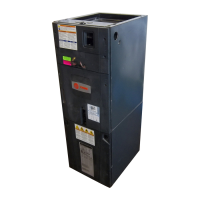
This document outlines the service and operational characteristics of the GAM5 Series Convertible Air Handlers, designed for residential heating and air conditioning applications. These units are available in 1-1/2 to 5-ton capacities and come with either a Black Epoxy Coil or a Standard Coil. The manual provides essential information for installation, maintenance, and troubleshooting, emphasizing safety and proper operational procedures.
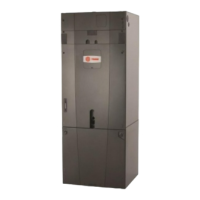
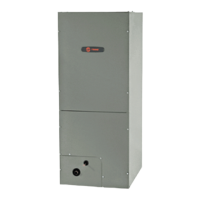
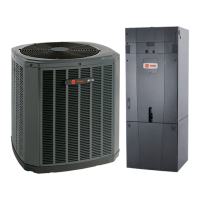
The GAM5 Series Convertible Air Handlers are integral components of a central heating and air conditioning system. They are designed to circulate conditioned air throughout a building, working in conjunction with an outdoor unit (either a heat pump or an air conditioner) and, optionally, an electric heater. The air handler's primary function is to draw in return air, filter it, condition it (either cool or heat), and then distribute it through the ductwork.
The units are equipped with a multi-speed blower motor, allowing for various airflow rates to match different heating and cooling demands. This flexibility ensures optimal comfort and energy efficiency. The airflow performance tables detail the CFM (Cubic Feet per Minute) at different external static pressures and speed tap settings for both 230V and 208V operations. This allows installers to select the appropriate speed tap to achieve the required airflow for a given system design.
The air handlers support both single-stage and two-stage heating and cooling operations, depending on the paired outdoor unit and thermostat. In single-stage operation, the blower runs at a constant speed (typically high speed for cooling/heating, and a lower speed for continuous fan operation). For two-stage systems, the unit can operate at different speeds to provide more precise temperature control and enhanced dehumidification.
When an electric heater is installed (BAYEA series heaters only), the air handler integrates its operation to provide supplemental or primary heating. The wiring data for various heater models specifies the electrical requirements, including kW, BTUH, heater amps per circuit, minimum circuit ampacity, and maximum overload protection for both 240V and 208V applications.
The GAM5 Series air handlers are designed for versatile installation, supporting upflow, downflow, and horizontal configurations. However, specific airflow limitations apply to downflow and horizontal applications, particularly when airflow exceeds 2000 CFM, to prevent water blow-off from the coil.
The units incorporate a continuous fan speed tap (Tap 1) for single-stage systems, which runs the blower at a lower speed when only a "G" signal is received from the comfort control. For two-stage systems, airflow adjustment is required, and Speed Tap 1 is not typically used. The manual provides minimum heater airflow CFM tables, indicating the recommended air speed tap settings for various heater models, both with and without a heat pump. These settings are crucial for ensuring safe and efficient operation of the electric heater.
The sequence of operation section details how the air handler responds to different control signals from the thermostat for continuous fan, single-stage heat pump (cooling/heating), two-stage heat pump (cooling/heating), single-stage cooling, two-stage cooling, and electric heating modes. This information is vital for proper thermostat wiring and system setup.
For optimal performance, the subcooling adjustment section provides specific subcooling targets (typically 8 degrees Fahrenheit) for various indoor and outdoor unit combinations. This ensures the refrigerant charge is correct, which is critical for system efficiency and longevity. For certain 16-18 SEER HP matches, a subcooling of 9 degrees Fahrenheit is specified.
Safety is a paramount concern for maintenance. The manual includes prominent warnings about hazardous voltage and pressurized refrigerant. Technicians are instructed to disconnect all electrical power before servicing and to recover refrigerant to relieve pressure before opening the system. Only individuals with adequate electrical and mechanical experience should attempt repairs.
The troubleshooting guide for the indoor TXV (Thermostatic Expansion Valve) in cooling mode provides a step-by-step flowchart to diagnose common issues related to superheat and subcooling. This includes checks for proper airflow, liquid line temperature, indoor temperature, and TXV functionality. This systematic approach helps technicians identify and resolve problems efficiently.
The constant torque motor troubleshooting guide helps diagnose issues with the blower motor. It outlines checks for the motor's power supply (230 VAC or 208 VAC), fan control signals (24VAC), and the mechanical integrity of the blower wheel and bearings. The guide also mentions a 90-second "OFF" delay on the fan control, which can be adjusted if needed.
Regular maintenance includes ensuring the blower wheel, indoor, and outdoor coils are clean. The manual also advises against prolonged exposure of air handler front panels to POE (Polyolester) lubricants, recommending immediate washing with soapy water if contact occurs. This helps prevent panel damage.
The unit is certified to UL 1995, and its interior cabinet wall meets UL94-5VA Flame Class, UL723 Steiner Tunnel (for 25/50 Flame/Smoke), and UL746C (for exposure to ultraviolet light, water exposure, and immersion) standards, indicating robust construction and safety compliance.
 General
| Refrigerant | R-410A |
|---|---|
| Stages | Variable Speed |
| Configuration | Horizontal or Vertical |
| Cooling Capacity | 1.5 to 5 Tons |
| Airflow | Up to 2000 CFM |
| Voltage | 208/230V |

 To Next Page