
 Need help?
Do you have a question about the Trane TEM4A0C43M41SB and is the answer not in the manual?
Warnings regarding hazardous voltage, grounding, and live electrical components.
Cautions for pressurized refrigerant, vapors, sharp edges, and user safety.
Ensuring child supervision and awareness of chemical exposure warnings.
Procedures for unpacking, inspecting, and selecting an appropriate location with clearances.
Guidelines for ductwork installation and proper setup of the condensate drain system.
Details on refrigerant piping, metering device (TXV), and blower configuration.
Instructions for electrical wiring, air filter installation, and thermostat setup.
Explanation of unit operation modes, defrost, and system checkout.
Recommendations for periodic maintenance and final system checkout procedures.
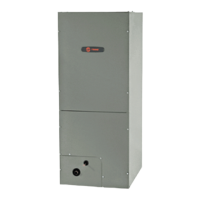
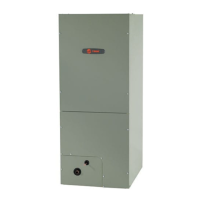
The device described in this manual is a convertible air handler, designed for residential heating, ventilating, and air-conditioning (HVAC) applications. It is a versatile unit capable of operating in multiple positions, including upflow, downflow, horizontal left, and horizontal right configurations, making it adaptable to various installation environments such as closets, utility rooms, alcoves, basements, crawlspaces, or attics. This flexibility in installation position is a key feature, allowing for integration into diverse home layouts.
The primary function of the air handler is to circulate air throughout a building as part of a split HVAC system, working in conjunction with an outdoor unit (either an air conditioning unit or a heat pump). It facilitates both cooling and heating operations, providing conditioned air to maintain desired indoor temperatures. For heating, the unit can operate with a heat pump or with field-installed electric resistance heaters, offering supplementary heat when needed.
Key usage features of this air handler include its robust construction and efficient design. The exterior is made of galvanized steel with a painted finish, and the cabinet is fully insulated to meet an R4.2 value, contributing to energy efficiency and reduced heat loss or gain. It incorporates sturdy polycarbonate drain pans, which are factory-installed and configured for upflow and horizontal left applications, simplifying initial setup for these common orientations. The unit operates on 208/230 VAC and 60 Hz, 1 Phase power, with provisions for 208 VAC operation by adjusting the low voltage transformer.
A multi-speed direct drive blower is a central component, allowing for various airflows to be achieved. The unit is shipped with factory-set cooling and heating speed taps, but airflow performance tables are provided for additional speed tap adjustments, enabling customization of airflow to specific system requirements. It is equipped with a factory-installed R-410A thermal expansion valve, which is crucial for efficient refrigerant metering in both air conditioning and heat pump modes. The coil is an all-aluminum design, contributing to durability and heat transfer efficiency.
For optimal performance and safety, specific installation guidelines are provided. The unit requires proper condensate drainage, with primary and auxiliary condensate drains featuring 3/4" NPT connections. A properly designed trap is essential for condensate drainage, and the manual details the necessary height differences to ensure effective operation under negative static pressure conditions. Ductwork must be installed and insulated according to relevant codes, and an air filter is required before air enters the evaporator coil to protect internal components from dirt and dust.
The air handler is designed for compatibility with standard HP or AC single-stage heating/cooling thermostats with electric heat. The sequence of operation for both cooling (AC and heat pump) and heating (heat pump and electric heat only) is clearly outlined, explaining how the thermostat signals trigger the blower motor, compressor contactor, and electric heat contactors. Supplemental heat during defrost cycles can be integrated to prevent cold air discharge.
Maintenance features emphasize regular inspection and cleaning to ensure long-term reliability and performance. The system air filter(s) should be inspected, cleaned, or replaced at least monthly. Periodic maintenance, at least annually, by trained professional service personnel is recommended. This includes testing and inspection of electrical and refrigerant components, as well as cleaning the heat transfer surface. The blower motor is permanently lubricated, reducing the need for routine lubrication.
The manual also includes detailed instructions for coil conversion, allowing the unit to be reconfigured for downflow or horizontal right applications. This involves removing panels, fasteners, and brackets, rotating the coil assembly, and reinstalling components in the new orientation. Specific attention is given to the horizontal drain pan orientation and the proper positioning of water diverter brackets, which vary by unit tonnage. These conversion steps highlight the unit's adaptability to different installation needs.
Safety warnings are prominently featured throughout the manual, covering hazardous voltage, pressurized refrigerant, sharp edges, and hazardous vapors. These warnings underscore the importance of qualified personnel for installation and servicing, adherence to lockout/tagout procedures, proper grounding, and caution when handling components. The unit is also noted to meet minimum leakage requirements for Florida and California building codes, reflecting a commitment to environmental and structural integrity. The manufacturer recommends installing only AHRI-approved, matched indoor and outdoor systems for maximum efficiency, optimum performance, and best overall system reliability.
 General
| Brand | Trane |
|---|---|
| Model | TEM4A0C43M41SB |
| Category | Air Handlers |
| Language | English |


 To Next Page