ENGLISH
28
www.trapp.com.br
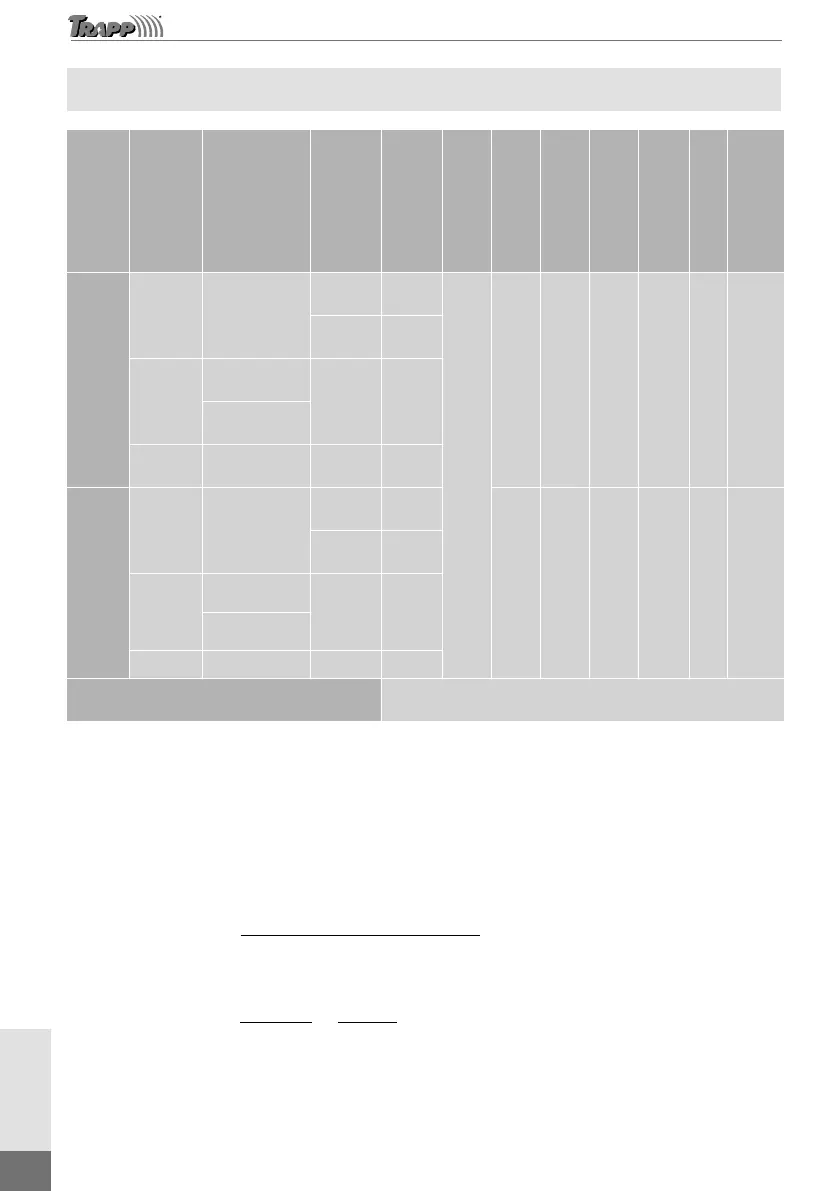
Technical Characteristics
Model
Type of
motor
Power
Voltage
(V)
Motor
Disk pulley diameter
(mm)
Quantity
of poles
Types of
belts
Quantity
of belts
Disk rotation
(rpm)
Quantity
of blades
Production
kg/h
ES-500
ES-550
Electric 5 and 7,5 cv
1)
220/440
Mono-
phase
220
2 B-85 2 1,600 3
1,400 /
5,000
220/380
Three-
phase
Gasoline
13.5 to 16 HP
(Briggs & Stratton)
– –
15 HP a 17HP
(TRAPP / Lifan)
Diesel
7 to 8 HP
– –
ES-600
ES-650
Electric 7.5 and 10 cv
1)
220/440
Mono-
phase
3 B-81 3 1,600 3
2,000 /
7,000
220/380
Three-
phase
Gasoline
13.5 to 16 HP
(Briggs & Stratton)
– –
15 HP a 17HP
(TRAPP / Lifan)
Diesel
8 to 10 HP
– –
Environmental conditions limits:
Temperature: 40 °C
Air relative humidity: 80%
Note: 1) The machines come out from the factory without switch (on/off) and electric motor connection, being at the
customer’s discretion connecting it in the desired voltage, as available in the region. The motor connection
scheme is made available in the motor itself, so that the customer may proceed with the connection.
Note:
TRAPP makes no warranty for the motor being damaged due to reversed or wrong connection, as described in the manual.
To dene the pulley to be used on the motor, proceed in the following matter: disk pulley diameter
multiplied by disk rotation and divided by the specied rotation on the motor plate.
Formula: Disk pulley diameter x Disk Rotation -> (chart above)
Motor rotation
Example: If the motor is 2 poles (3,545 rpm):
215x1,600 344,000 97 mm (motor pulley’s diameter)= =
3,545 3,545
Note:
Rounding the diameter of the pulley, should be used a pulley with diameter 100 mm.


 To Next Page