3-14
Resources Maintenance Riding Quick start Safety
Braking
Before riding, make sure you know which
brake lever controls which brake (front or
rear), as these may be set up specic to
market regulations.
Apply both brakes at the same time.
The front brake provides more stopping
power than the rear, so do not use it too
forcefully or too abruptly. Gradually add
pressure to both brakes until you slow to
the desired speed or stop.
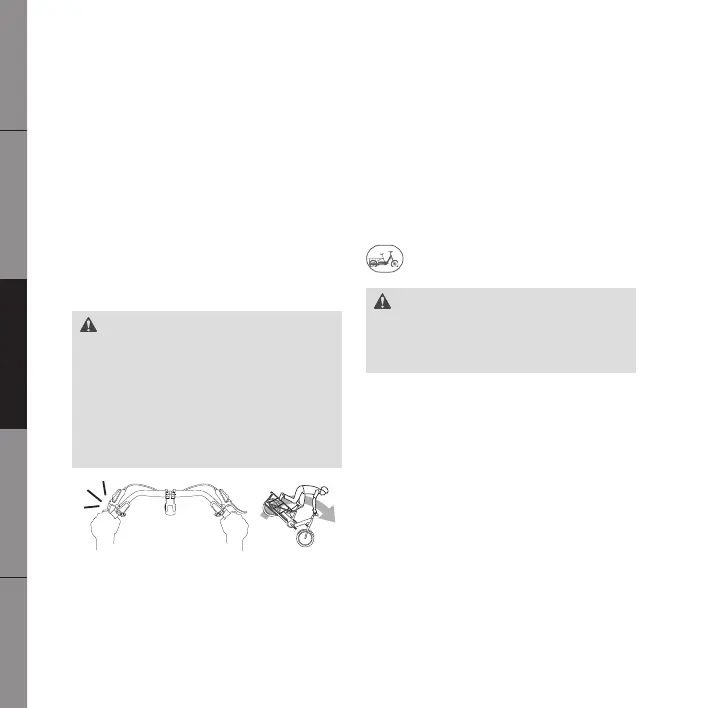
WARNING: Using the front brake only
could cause passengers and/or cargo to
pitch forward. Brake force applied to the
front wheel suddenly or too fully could lift
the rear wheel off the ground or cause the
front wheel to slide out from under you.
This will decrease your control and cause
you to fall.
Note: Your brakes may be set up with the
front brake on the right.
Shifting gears
The gears on your bicycle allow you to
pedal comfortably in different conditions
— like riding up a hill, pedaling into a head-
wind, or riding fast on at terrain. Select
the gear that is most comfortable for the
conditions; a gear that lets you pedal at a
constant rate. Use the proper technique
for your bike.
Rear cargo: derailleur
WARNING: Improper derailleur shifting
technique could cause your chain to jam
or come off, causing you to lose control
and fall.
A derailleur moves your chain from one
gear to another. You shift gears by chang-
ing the position of a shift lever (also called
a shifter), which controls the derailleur.
Shift gears only when the pedals and
chain are moving forward.
Decrease the force on the pedals as you
shift gears. Reduced chain tension helps
the chain shift gears quickly and smoothly,
which decreases chain, derailleur, and
gear wear.



 To Next Page