9
D01-068en201913 Manual TpH
Calibration
Calibration
Malfunction &
Maintenance
Malfunction &
Maintenance
Introduction
Introduction
General
Information
General
Information
FAQ
FAQ Technical Data
Technical Data
Warranty
Warranty
Customer
Service
Customer
Service
Contact
Contact
Keyword Index
Keyword Index
Accessories
Accessories
Use Commissioning
TpH // Use
4 Use
The TpH sensor can be operated with all TriOS controllers. Instructions for correct installation can be found in the relevant
controller manual.
4.1 Normal operation
The sensor is ready for commissioning as soon as the installation of accessories is complete, it is connected to your control
device and the conguration is complete.
Remove the black protective cap by holding the sensor vertically downwards and unscrewing the cap. The sensor is supplied
with a lled protective cap containing a solution of pH4 buer and potassium chloride. Therefore, the sensor does not need to
be activated in order to achieve optimum measurements. Please note the minimum immersion depth up to the ring.
The sensor is now immersed in the measuring medium. The black sensor head should be completely surrounded by the medi-
um. Otherwise, measurement uctuations may occur.
Before a measurement, all air bubbles under the membrane must rst be removed by light shaking.
As soon as the sensor is connected to the power supply, it starts to measure. This is indicated by the green light in the upper
sensor area. To obtain stable and safe measurements, please wait for temperature stabilisation after introducing the sensor
into the measuring environment.
The TpH sensor should be calibrated at regular intervals. The intervals depend on the respective application. If the TpH is
used in the highly alkaline range, the calibration intervals should be as close as possible. For information on calibration, see
Chapter 5.
The TpH are classied as consumables and therefore have a limited service life, depending on the user's application. Under
normal conditions, the typical life span is about one year. The service life of the TpH can be extended by regular cleaning.
4.2 Bypass Installation
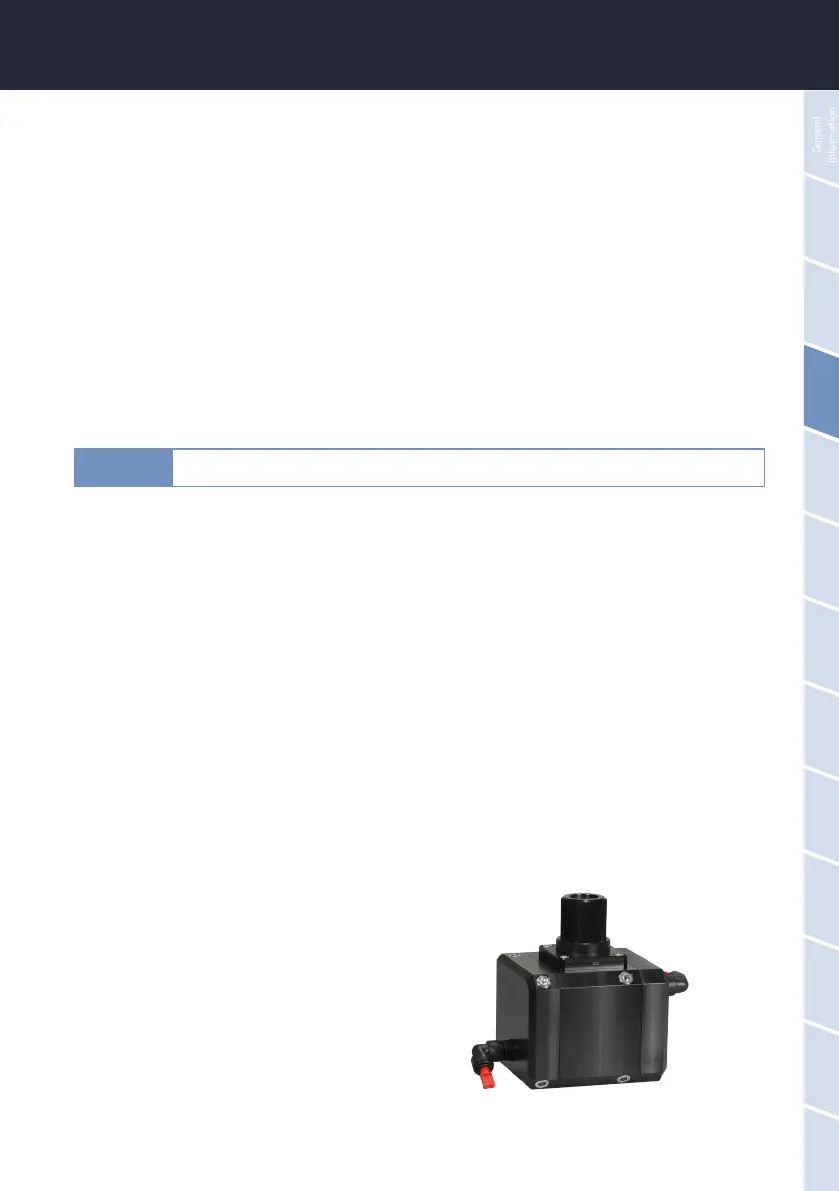
A suitable TriOS ow cell is available to integrate the sensor into a bypass installation. The ow cell is designed according to a
modular system and makes it possible to adapt or extend the system as required.
If the sensor is dry, it must rst be conditioned in pH4 buer for 24 hours.
NOTICE


 To Next Page