EasyManua.ls Logo

Troy-Bilt Storm 2620 - User Manual

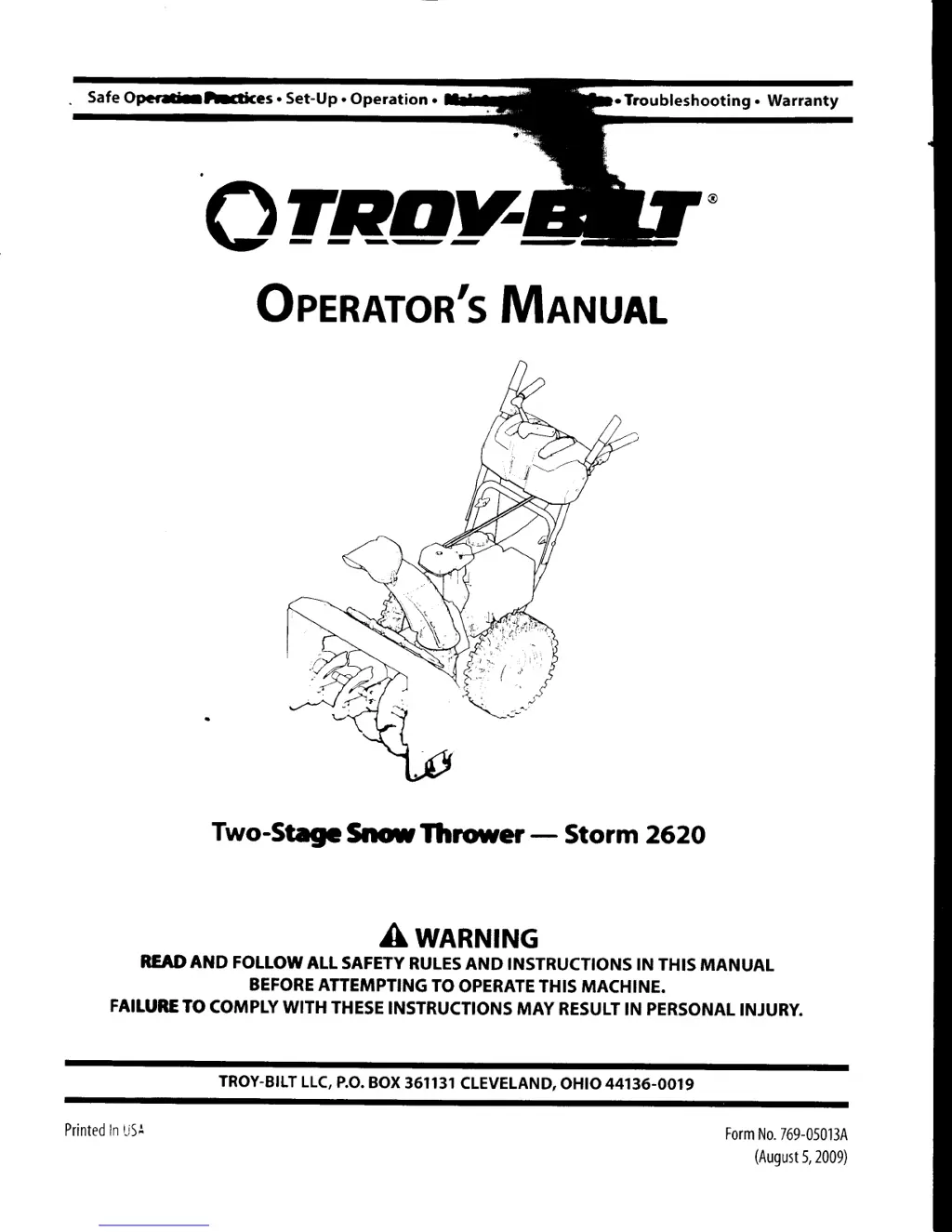
Troy-Bilt Storm 2620
31 pages
Print Icon
To Next Page IconTo Next Page
Loading...
Safe
OpcrtEces.
Set-Up.
Operation
.
.
Troubleshooting
.
Warranty
OTRgvE
OpeRAToR's
MANUAL
Two-Stagc
SnilThruwer
-
Storm 2620
AwnnNlNG
REAT'
AND FOLTOW
Att
SAFETY
RULES
AND INSTRUCTIONS
IN
THIS MANUAL
BEFORE ATTEMPTING
TO
OPERATE THIS
MACHINE.
FAITURETO
COMPLY
WITH
THESE
INSTRUCTIONS
MAY RESULT
IN PERSONAL
INJURY.
Printed in U5l
TROY-BILT
LLC,
p.O.
BOX
351131
CLEVELAND,
OH|O 44136-0019
Form
No. 769-050134
(August
5, 2009)

Questions and Answers

  • J
    jenniferdavisAug 21, 2025
    Why is my Troy-Bilt Storm 2620 Snow Blower not moving?
    • Y
      Yolanda NortonAug 21, 2025
      If your Troy-Bilt snow blower isn't propelling itself, the drive control cable may need adjustment; refer to the Maintenance & Adjustments section. Alternatively, the drive belt might be loose or damaged, or the friction wheel could be worn; in either case, refer to the Service section for replacement.
  • R
    Ryan LeeAug 23, 2025
    Why my Troy-Bilt Storm 2620 Snow Blower engine running erratically?
    • S
      Stacey LarsenAug 25, 2025
      An erratic engine in your Troy-Bilt Snow Blower, characterized by inconsistent RPM (hunting or surging), can stem from several causes. It might be running on CHOKE, in which case you should move the choke lever to the RUN position. Stale fuel could also be the culprit; try filling the tank with clean, fresh gasoline. Another possibility is water or dirt in the fuel system, requiring you to drain the fuel tank and refill it with fresh fuel. In some cases, the carburetor may be out of adjustment or the engine may be over-governed, both of which necessitate contacting an authorized Service Center.
  • M
    Michael MilesAug 26, 2025
    What to do if my Troy-Bilt Snow Blower unit fails to discharge snow?
    • W
      Wesley BradleyAug 26, 2025
      If your Troy-Bilt snow blower fails to discharge snow, it could be due to a clogged chute assembly. Immediately stop the engine, disconnect the spark plug wire, and clean the chute assembly and inside of the auger housing with a clean-out tool or a stick. A foreign object lodged in the auger could also be the problem; in that case, stop the engine, disconnect the spark plug wire, and remove the object with a clean-out tool or a stick. Other potential causes include an auger control cable in need of adjustment (refer to the Auger Control Test), a loose or damaged auger belt (refer to the Maintenance & Adjustments section), or sheared shear pins, which would need to be replaced with new ones.
  • B
    brownjeremiahAug 27, 2025
    Why Troy-Bilt Snow Blower has loss of power?
    • C
      carsonmanuelAug 27, 2025
      Loss of power in your Troy-Bilt Snow Blower can be attributed to a loose spark plug wire; connect and tighten it. Another potential cause is a plugged gas cap vent hole. Remove any ice and snow from the gas cap, ensuring the vent hole is clear.
  • R
    Robert Carey MDAug 30, 2025
    What to do if Troy-Bilt Storm 2620 Snow Blower has excessive vibration?
    • A
      Amber BarkerAug 30, 2025
      If your Troy-Bilt Snow Blower experiences excessive vibration, immediately stop the engine and disconnect the spark plug wire. Tighten all bolts and nuts. If the vibration continues, have the unit serviced by an authorized Service Center.
  • G
    gabriellapattersonAug 31, 2025
    What to do if Troy-Bilt Snow Blower unit fails to propel itself?
    • N
      Natalie AnthonySep 1, 2025
      If your Troy-Bilt Snow Blower unit fails to propel itself, the drive control cable may need adjustment; refer to the Maintenance & Adjustments section to adjust it. Alternatively, the drive belt may be loose or damaged, or the friction wheel may be worn, in which case you should contact an authorized Service Center.
  • G
    gregdavisSep 3, 2025
    How to fix Troy-Bilt Storm 2620 Snow Blower chute that fails to easily rotate 180 degrees?
    • J
      Jeremiah RileySep 3, 2025
      If the chute on your Troy-Bilt Snow Blower fails to easily rotate 180 degrees, it might be assembled incorrectly. Disassemble the chute control and reassemble it as directed in the Assembly section.
  • C
    corey62Sep 5, 2025
    Why is my Troy-Bilt Storm 2620 Snow Blower engine running erratically?
    • S
      Samantha GlennSep 5, 2025
      An erratic engine in your Troy-Bilt Snow Blower could be due to several reasons: * The engine might be running on CHOKE – move the choke lever to the RUN position. * Stale fuel could be the culprit – replace it with clean, fresh gasoline. * There might be water or dirt in the fuel system – drain the tank and refill with fresh fuel. * If these steps don't work, the carburetor may be out of adjustment or the engine over-governed, and you should contact an authorized Service Center.
  • B
    Brandon Palmer MDSep 7, 2025
    What to do if my Troy-Bilt Storm 2620 Snow Blower won't throw snow?
    • R
      rickbutlerSep 7, 2025
      If your Troy-Bilt snow blower isn't discharging snow, here's what to check: 1. Immediately stop the engine and disconnect the spark plug wire before inspecting or performing maintenance. 2. The chute assembly might be clogged; clean it and the inside of the auger housing with a clean-out tool or stick. 3. A foreign object could be lodged in the auger; remove it with a clean-out tool or stick. 4. Also, check the shear pins and replace them if they are sheared. For other issues, refer to the Auger Control Test or the Maintenance & Adjustments section for the auger belt.
  • A
    adamsmadelineSep 9, 2025
    Why does my Troy-Bilt Snow Blower lose power?
    • R
      Raymond MendozaSep 9, 2025
      Loss of power in your Troy-Bilt snow blower can occur if the spark plug wire is loose; connect and tighten it. Another possible cause is a plugged gas cap vent hole; remove any ice or snow and ensure the vent hole is clear.

Summary

To The Owner

Thank You

Expresses gratitude for purchasing the snow thrower and emphasizes reading the manual.

Record Product Information

Instructs the owner to record model and serial numbers for future reference and support.

Customer Support Contact

Provides contact information and methods for customer support and assistance.

Important Safe Operation Practices

General Safety Warnings and Symbols

Highlights key safety symbols (DANGER, WARNING) and California Proposition 65.

Pre-Operation Training and Preparation

Details essential training and site preparation steps before operating the machine.

Safe Operation Guidelines

Safe Handling of Gasoline

Provides critical safety instructions for handling and storing gasoline.

Operational Safety Rules

Outlines essential safety rules and precautions during machine operation.

Continued Safe Operation

Clearing a Clogged Discharge Chute

Details the safe procedure for clearing a clogged snow thrower chute.

Engine and Machine Modifications Warning

Warns against modifying the engine and advises on spark arrestor use.

Safety Symbols Explained

Symbol Descriptions and Meanings

Explains the meaning and importance of various safety symbols used in the manual.

Assembly & Set-Up Procedures

Handle Assembly Steps

Provides step-by-step instructions for assembling the snow thrower's handle.

Chute Assembly and Controls Setup

Details the assembly of the chute and connection of control mechanisms.

Component Securing and Tire Pressure

Covers securing components, shear pins, and initial tire pressure checks.

Chute Clean-Out Tool Installation

Instructions for installing the chute clean-out tool accessory.

Pre-Operation Procedures

Fueling and Oil Level Checks

Critical pre-start checks for fuel level and engine oil.

Auger Control Adjustment

Procedure for adjusting the auger control cable for proper engagement.

Adjustments and Fine-Tuning

Skid Shoe and Chute Angle Settings

Adjusting skid shoes for terrain and chute angle for snow direction.

Controls and Features Overview

Primary Controls Identification

Identifies and describes the shift lever, choke control, and ignition key.

Engine and Operational Controls

Describes throttle, primer, auger, and drive controls for operation.

Snow Thrower Component Identification

Identifies major components like augers, chute, and skid shoes.

Chute Operation and Clearing

Chute Directional Control

Explains how to change the direction of snow discharge.

Using the Chute Clean-Out Tool

Details the safe procedure for using the clean-out tool to clear clogs.

Operation Procedures

Starting the Engine

Provides detailed procedures for starting the snow thrower's engine.

Electric Starter Operation

Instructions for safely using the electric starter system.

Engaging and Stopping the Machine

Recoil Starter Operation

Instructions for starting the engine using the manual recoil starter.

Stopping the Engine and Engaging Controls

Procedures for stopping the engine and engaging drive/auger controls.

Replacing Shear Pins

Guide for replacing shear pins to protect auger and gearbox.

Maintenance and Adjustments

Shave Plate and Skid Shoe Maintenance

Instructions for checking and replacing wear items like shave plates and skid shoes.

Tire Pressure and Lubrication

Covers checking tire pressure and lubricating the gear shaft.

Component Maintenance and Tuning

Wheel and Auger Shaft Maintenance

Procedures for cleaning and lubricating wheel axles and auger shafts.

Shift Cable Adjustment

How to adjust the shift cable for proper speed range engagement.

Drive Control and Chute Rod Adjustments

Drive Control Cable Adjustment

Ensuring proper drive engagement by adjusting the drive control cable.

Chute Control Rod Adjustment

Procedure for adjusting the chute control rod for precise direction.

Off-Season Storage Guidelines

Instructions for preparing the snow thrower for long-term storage.

Engine Maintenance

Engine Oil Change and Recommendations

Critical procedures for changing engine oil and selecting the correct type.

Engine Servicing and Storage

Spark Plug Maintenance

Instructions for inspecting, cleaning, gapping, and replacing the spark plug.

Engine Cleaning and Storage

Procedures for cleaning the engine exterior and preparing for storage.

Service and Repairs

Auger Belt Replacement

Step-by-step guide for removing and replacing the auger drive belt.

Drive Belt Replacement

Drive Belt Replacement Procedure

Instructions for removing and replacing the main drive belt.

Friction Wheel Service

Friction Wheel Removal and Replacement

Procedure for removing and replacing the friction wheel for drive issues.

Troubleshooting Common Issues

Engine Starting and Running Problems

Diagnosing and resolving issues related to engine starting and erratic running.

Performance and Discharge Issues

Troubleshooting problems with power loss, propulsion, and snow discharge.

Replacement Parts Information

Key Component Part Numbers

Lists key components with their corresponding part numbers for ordering.

Attachments and Accessories

Available Optional Equipment

Lists optional attachments and accessories available for the snow thrower.

Warranty and Service Information

Emission Control System Warranty

Details the warranty coverage for the engine's emission control system.

Owners Warranty Responsibilities

Outlines the owner's responsibilities to maintain warranty coverage.

Warranty Terms and Service Details

Warranty Service and Part Usage Terms

Specifies terms for warranty service, part usage, and limitations.

Obtaining Warranty Service

Locating Service Dealers and Contacts

Provides information on how to find authorized service dealers and contact information.

Warranty Legal Rights and Limitations

Explains legal rights, state variations, and limitations of the warranty.

Troy-Bilt Storm 2620 Specifications

General IconGeneral
Engine BrandTroy-Bilt
Engine Displacement208cc
Clearing Width26 inches
Chute ControlCrank
Chute Rotation200 degrees
Product TypeTwo-Stage Snow Blower
Drive TypeSelf-propelled
Number of Speeds6 Forward / 2 Reverse
Auger Diameter12 inches
Impeller Diameter12 inches
Engine Type4-Cycle OHV
Drive SystemFriction Disc
Warranty2-Year Limited
Start TypeElectric and Recoil
Intake Height21 inches
Auger TypeSteel
Tire Size13 in x 4 in
Clearing Depth21 inches
Fuel Tank Capacity2 quarts

Related product manuals