Core Modules 19
3. Operating Principle
The system permits a customer-specific arrangement of individual measuring modules. Registration
of activity using sensor frames, calorimetric measurement, registration of drinking and feeding
behavior or body weight, as well as determining the activity by using infrared sensor or a voluntary
wheel are possible.
For activity measurements via sensor frames, the animal cage is inserted in frames containing
light beams. No calibrations are needed for the light beams. Depending on the system configuration,
activity in the X and/or Z, X and Y, or X, Y and Z direction can be registered. An infrared sensor is
located every 5mm (0.20inch); this consists of an IR emitter and an IR receiver.
If the animal moves in one of the three spatial axes - providing that the system has the max. number
of light beams - and if one of the light beams is interrupted that was previously uninterrupted, then the
system will register a count. This means that interruptions that are linked with a movement will be
registered only. Permanently interrupted light beams will not be taken into account.
Movements that are repeated at short intervals, e.g., tail flicking, can be ignored by defining a
refractory period, i.e. if short-term movements are detected within this defined period, then no count
will be registered.
The operator can define a part of the light beams as the 'center'. This allows the measurement area to
be adapted to suit animal cages with different sizes as well as the definition of two different
measuring ranges (central and peripheral).
The calorimetry measuring module can be configured to run with up to eight special animal cages
per Calorimetry Control Unit. Each cage is continuously provided with fresh air from an air pump via
the Control Unit. For a 16-place system, one Master Control Unit and one Slave Unit are required,
which each have eight connections for the air supply (to the cages) and the temperature sensors.
The Master Control Unit also contains the standard sensors for O2 and CO2 measurement in addition
to the ports for data transmission with the PC. For high speed O2/CO2 measurements, a separate
measuring Unit is required. Master and Slave Control Unit are connected to each other via a further
data cable. With the help of a Sample Switch Unit, air samples are taken in defined intervals from the
animal cages and are being analyzed.
The samples are transferred to the Master Control Unit, where O2 as well as CO2 gas concentrations
are measured. The sample concentrations are compared to a fresh air reference.
With the help of temperature sensors, the temperature in the test cage can be measured and
registered during the specified experiment time.
Moisture that could be deposited on the O2 and CO2 sensors is removed from the sample flow by an
Air Drying Unit.
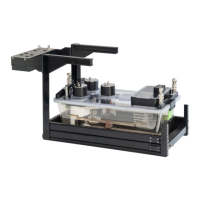
The drinking and feeding behavior of test animals as well as their body weight can be measured
with high precise sensors located on the cage lids. The removal of liquid or food pellets from the
dispensers is registered by the weight sensors and the alterations are registered by the software.
Limit values for the range, in which removals are to be registered can be entered here; values that
are too high, e.g., those caused by the animal lifting the dispenser, will then no longer be registered.
By using a trial monitor, the amount removed during the trial can be followed; this makes it easier to
recognize the necessity of refilling the dispenser.
info@TSE-Systems.com www.TSE-Systems.com


 To Next Page