EasyManua.ls Logo

Tyco DN40 - User Manual

Tyco DN40
29 pages
Print Icon
To Next Page IconTo Next Page
Loading...
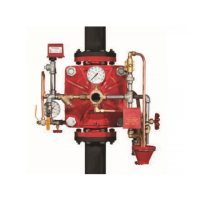
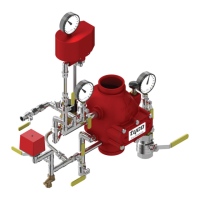
DV-5 Deluge Valves, Diaphragm Style
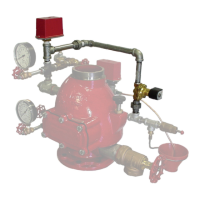
FM Approved European Conformity Valve Trim
Page 1 of 26 DECEMBER 2016 TFP1335
Worldwide
Contacts
www.tyco-fire.com
General
Description
The DV-5 Deluge Valves are diaphragm
type valves used as “automatic water
control valves” in deluge fire protection
systems. When properly trimmed, the
DV-5 Valves are also able to provide
actuation of fire alarms upon system
operation.
The diaphragm style design of the DV-5
Valve allows external resetting, pro-
viding for easy resetting of a deluge
system without having to open a valve
handhole cover to manually reposition
a clapper and/or latch mechanism.
Simply re-pressurizing the diaphragm
chamber resets the valve.
The DV-5 also features internal and
external coating of the valve to provide
corrosion resistance. The external
corrosion resistance of the RILSAN
coating permits the use of the DV-5 in
corrosive atmospheres associated with
many types of industrial processing
plants and outdoor installations.
NOTICE
The DV-5 Deluge Valves described
herein must be installed and main-
tained in compliance with this docu-
ment, as well as with the applicable
standards of the Approval agency, in
addition to the standards of any other
authorities having jurisdiction. Failure
to do so may impair the performance
of these devices.
The owner is responsible for main-
taining their fire protection system
and devices in proper operating con-
dition. Contact the installing contrac-
tor or product manufacturer with any
questions.
Technical
Data
Approvals
FM Approved when trimmed as
described in this technical data sheet
for European Conformity applications.
DV-5 Deluge Valve
Components for the DN40 thru DN200
DV-5 Deluge Valves are shown in
Figure 1. The DV-5 Valves are for verti-
cal installations, and they are rated for
use at a maximum service pressure of
17, 2 ba r.
The take-out dimensions are shown in
Figure 2, and the flanged connections
are available drilled per ANSI, ISO, AS,
and JIS specifications (Ref. Table A).
The DV-5 Valves are provided with
ISO 7-1 threaded ports that will
readily accept the trim arrangements
described in this technical data sheet.
Pressure Loss
Refer to Graph A
End Connections Available and Weights
End Connection Nominal Valve Size
Inlet Outlet DN40 DN50 DN80 DN100 DN150 DN200
Thread Thread 4,1 kg 5,4 kg N/A N/A N/A N/A
Groove Groove 3,6 kg 4,5 kg 14,1 kg 27,7 kg 44,9 kg 68,1 kg
Flange Groove N/A N/A 17,7 kg 33,6 kg 48,5 kg 77,8 kg
Flange Flange N/A N/A 21,3 kg 36,3 kg 52,3 kg 87, 5 kg

Other manuals for Tyco DN40

Question and Answer IconNeed help?

Do you have a question about the Tyco DN40 and is the answer not in the manual?

Overview

The Tyco DV-5 Deluge Valve is a diaphragm-style automatic water control valve designed for use in deluge fire protection systems. When properly trimmed, these valves can also actuate fire alarms upon system operation.

Function Description:

The DV-5 Deluge Valve operates based on water pressure within its diaphragm chamber. When the valve is set for service, this chamber is pressurized via trim connections from the inlet side of the system's stop valve. This pressure holds the diaphragm closed against the water supply pressure. Actuation occurs when a detection device (e.g., a solenoid valve in an electric actuation trim or a wet pilot sprinkler) opens, releasing water from the diaphragm chamber. This release happens faster than water can be replenished through a 3.2 mm restriction within the Automatic Shut-Off Valve (ASV-1) in the diaphragm chamber supply connection. The rapid pressure drop in the diaphragm chamber reduces the force holding the diaphragm closed, allowing the water supply pressure to force the diaphragm open. This permits water to flow into the system piping and through the alarm port to actuate system alarms.

Important Technical Specifications:

  • Valve Sizes: Available in DN40, DN50, DN80, DN100, DN150, and DN200.
  • Maximum Service Pressure: Rated for use at a maximum service pressure of 17.2 bar.
  • Installation: Designed for vertical installations.
  • Corrosion Resistance: Features internal and external RILSAN polyamide 11 coating (per ASTM A536-77, Grade 65-45-12) on the body and handhole cover, making it suitable for corrosive atmospheres in industrial processing plants and outdoor installations.
  • Diaphragm: Made of nylon fabric reinforced natural rubber (per ASTM D2000).
  • Diaphragm Cover Fasteners: Galvanized carbon steel.
  • End Connections: Available in Thread x Thread (ISO 7-1), Groove x Groove, Flange x Groove, and Flange x Flange. Flanged connections are drilled per ANSI, ISO, AS, and JIS specifications.
  • Threaded Ports: Provided with ISO 7-1 threaded ports for trim arrangements.
  • Pilot Sprinklers (Wet Pilot Actuation): Minimum 80 K-factor orifice approved automatic sprinklers.
  • Manual Control Stations: Model MC-1 (TFP1382).
  • Dry Pilot Actuator: Model DP-1 (TFP1380), rated for a maximum pilot service pressure of 3.4 bar and maximum water supply service pressure of 17.2 bar.
  • Solenoid Valve (Electric Actuation): P/N 52-287-1-124 (TFP2180), rated for 17.2 bar pressure, 24 VDC voltage, 22 Watts power consumption, and 0.83 Amps current draw. FM approval is contingent on using this specific solenoid valve in non-hazardous locations.
  • Automatic Shut-Off Valve (ASV-1): Provided with electric actuation trim to prevent inadvertent closing of the DV-5 during a fire event by automatically closing after the solenoid valve de-energizes.
  • Air Maintenance Devices (Dry Pilot Actuation): Model AMD-1 (pressure reducing type), AMD-2 (compressor control type), or AMD-3 (nitrogen maintenance device) are used to automatically maintain pressure in the dry pilot actuation system.
  • Pressure Relief Valve (Dry Pilot Actuation): Factory set to relieve at approximately 3.1 bar, adjustable.
  • Low Pressure Alarm Switch (Dry Pilot Actuation): Optional, set to alarm at approximately 0.4 bar below minimum pilot line service pressure and fire alarm at approximately 1.0 bar below minimum pilot line service pressure.

Usage Features:

  • External Resetting: The diaphragm-style design allows for easy resetting of the deluge system by simply re-pressurizing the diaphragm chamber, eliminating the need to open a valve handhole cover or manually reposition a clapper/latch mechanism.
  • Trim Options: The valve can be configured with Wet Pilot Actuation, Dry Pilot Actuation, or Electric Actuation trims, each designed for specific detection system types.
  • Wet Pilot Line: Requires minimum DN15 steel pipe, maintained at a minimum temperature of 4°C. Internally galvanized pipe and cast iron fittings are recommended.
  • Dry Pilot Line: Pressurized with air or nitrogen, requires minimum DN15 steel pipe, and should be provided with low point drains for condensate. Internally galvanized pipe and cast iron fittings are recommended. The dew point of the air pressure must be maintained below the lowest ambient temperature to prevent water accumulation and ice buildup.
  • Installation Criteria: Nipples, fittings, and devices must be clean and free of scale and burrs. Pipe thread sealant should be used sparingly. Check valves, strainers, and globe valves must be installed with correct flow arrows. Adequate provision for drain water disposal is required.
  • Diaphragm Supply Connection: The diaphragm supply valve must be connected to the inlet side of the system's stop valve for easy setting.
  • Inspector's Test Connection: Required for both Wet and Dry Pilot Actuation systems.

Maintenance Features:

  • Regular Inspections: Procedures and inspections must be performed according to recognized standards and any impairment corrected immediately.
  • Temperature Maintenance: The DV-5 Valve, associated trim, and wet pilot lines must be maintained at a minimum temperature of 4°C. Heat tracing is not permitted as it can cause hardened mineral deposits.
  • Diaphragm Chamber Pressure Verification: The ability of the diaphragm to hold pressure must be verified by temporarily closing the diaphragm supply valve and observing the diaphragm gauge for any pressure drop. Leaks must be corrected.
  • Internal Valve Inspection: Recommended every five years during the annual operational test, or more frequently if conditions warrant. The interior must be cleaned and inspected for wear and damage. Damaged or worn parts must be replaced.
  • Diaphragm Replacement: Recommended every ten years, or more frequently if inspections indicate wear and tear.
  • Diaphragm Cover Fastener Tightening: When reinstalling the diaphragm cover, bolts must be uniformly and securely tightened using a cross-draw sequence to appropriate torque values (specified in Table C for different valve sizes). LOCTITE No. 242 (or equivalent) is recommended for bolt threads.
  • Diaphragm Orientation: Crucial for proper valve operation; the diaphragm tab must be oriented perpendicular to the valve body centerline.
  • V-Ring: Factory-attached to the diaphragm in DN100, DN150, and DN200 valves. If detached during inspection, it must be reinstalled concentrically between the diaphragm and diaphragm cover. Adhesives, lubricants, or other substances should not be applied to the diaphragm, V-ring, or valve body.
  • Strainer Cleaning: The diaphragm supply strainer (Q) should be cleaned by removing the clean-out plug and strainer basket.
  • Pilot Sprinkler Replacement: Operated pilot sprinklers in wet and dry pilot actuation systems must be replaced after activation.
  • Low Water Supply Pressure Monitoring: For systems prone to interrupted water supply, installing a low water supply pressure switch with appropriate alarms is recommended.
  • Weekly Test: Includes opening the alarm test valve to verify the alarm signal from the waterflow switch and the sound of the water motor alarm, followed by draining the alarm line.

Tyco DN40 Specifications

General IconGeneral
BrandTyco
ModelDN40
CategoryControl Unit
LanguageEnglish

Related product manuals