IM 25.000AA UA (B/6-00)
CHLORINE HANDLING MANUAL
PAGE 8
WARNING: NEVER LIFT CYLINDERS BY THE
VALVE PROTECTING HOOD. THE HOOD MAY
SEPARATE FROM THE CYLINDER, CAUSING THE
CYLINDER TO FALL.
Never lift cylinders by sling or magnetic devices. If lifting is
necessary, use a specially designed cradle. Contact your
chlorine supplier for recommendations or information.
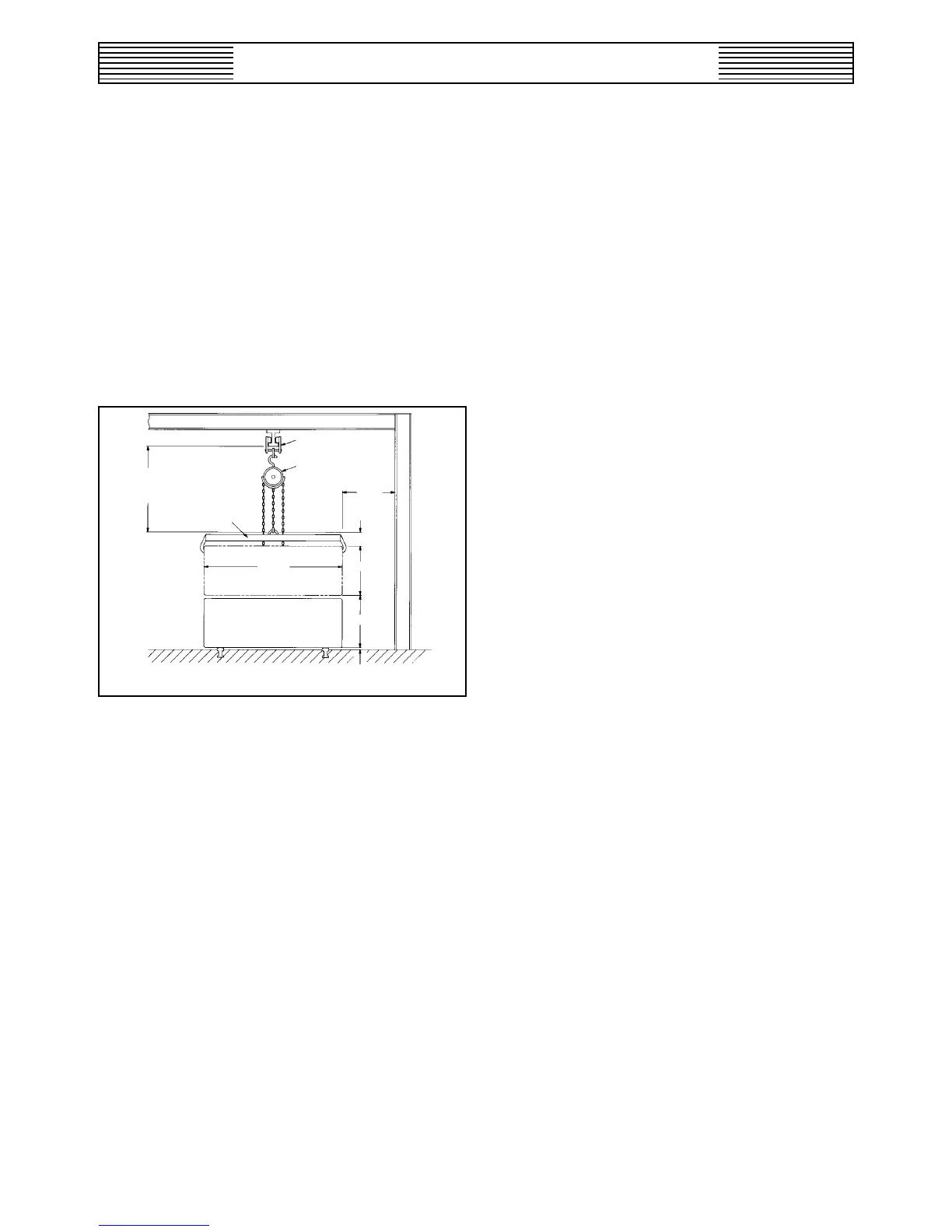
When moving ton containers, due consideration must be
given to the fact that the liquid in the container represents a
live load in addition to the dead load of the container and the
liquid. The most accepted way of moving ton containers is by
overhead conveyor and lifting beam (see Figure 11).
Figure 11 – Ton Container Handling
THIS DIMENSION
DETERMINED BY
REQUIREMENTS OF
LIFTING DEVICE
OVERHEAD MONORAIL
HOIST
(4000 LB. MIN.)
2’-7”
CLEARANCE
LIFTING BAR
13”
2’-6”
2’-8”
1/2”±
6’-10”
Rails or roller conveyors have also been used. Fork lift trucks,
in addition to having adequate capacity, must have the con-
tainers restrained and be sufficiently stable to prevent tip-
ping.
3.7 USING CONTAINERS
If containers have been stored in an area other than that in
which they will be used, they should be allowed to stabilize
at the new temperature before being used. Containers should
always be used in the order in which they are received to
avoid unnecessarily long storage and possible difficulty with
valves that have not been opened or closed for too long a
period.
WARNING: CYLINDERS ARE NORMALLY USED IN
AN UPRIGHT POSITION FOR GAS WITHDRAWAL.
TO AVOID SEVERE PERSONAL INJURY OR EQUIP-
MENT DAMAGE, SUPPLY CYLINDERS MUST BE
SECURED IN SUCH A MANNER (E.G., CHAIN) AS
TO PREVENT THEIR BEING KNOCKED OVER. TON
CONTAINERS MUST BE USED IN A HORIZONTAL
POSITION WITH THE TWO VALVES IN A VERTI-
CAL LINE. TON CONTAINERS MUST BE SECURED
IN SUCH A MANNER (E.G., CHOCKS) TO PREVENT
THEIR ROLLING OUT OF PLACE.
When withdrawing gas from a ton container, connection is
made to the upper valve (see Figure 6). Liquid withdrawal is
accomplished by connecting to the lower valve.
It is recommended that special 3/8-inch square box wrenches,
rather than adjustable wrenches, be used for opening cylin-
der and ton container valves. Length of the wrench should
not exceed eight inches. It is good practice to leave the wrench
in place so the valve can be closed quickly in case of an
emergency. Maximum discharge can be accomplished with
one full turn of the valve. Excessive force must not be used
in opening valves. Never strike the wrench with anything
other than the heel of the hand. Loosening the packing nut
a maximum of 1/2 turn is acceptable, provided the packing
nut is tightened after the valve is operated. Contact your
chlorine supplier if these procedures do not permit operation
of the valve.
Angle valves on tank cars must be opened fully to aid the
operation of the excess flow valve.
Always test for leaks before putting new containers in ser-
vice. The system can be pressurized by opening the container
valve and then closing it. The valve can be opened again after
it is determined that there are no leaks.
WARNING: ALWAYS WEAR PROTECTIVE CLOTH-
ING WREN CHECKING FOR LEAKS. REFER TO
“PERSONNEL SAFETY” FOR INFORMATION ON
HEALTH HAZARDS AND SAFETY PRECAUTIONS.
It is not unusual during humid conditions for condensation
to collect on the outside of the container. A buildup of frost
on the container indicates that withdrawal rates are too high
to permit the surrounding air to supply the heat necessary to
evaporate the liquid chlorine. Increasing the circulation of
room temperature air past the container may correct the
condition. Do not apply direct heat to the container in any
way. It may be necessary to shut off the container valve and
permit it to warm up again before putting it back in service.
After emptying the container, the valve must be closed before
disconnecting to prevent the entry of moisture. After discon-
necting, the valve cap and the valve protecting cap or hood
must be replaced before the container is moved. Empty con-
tainers should be segregated from full containers and should
be tagged.



 To Next Page