EasyManua.ls Logo

USTC 2500 jbt - User Manual

Default Icon
98 pages
Print Icon
To Next Page IconTo Next Page
Loading...
TM
A Manitowoc Company
3120933 Rev
.
0 PRINTED IN U.S.A. January 15, 2001
Sales: (717) 505-8800 Sales: (512) 942-3000
Sales Fax: (717) 505-8811 Sales Fax: (512) 863-3776
Service: (800) 556-8280 Service: (512) 942-3022
Service Fax: (717) 505-8812 Service Fax: (512) 942-3094
USTC, Inc.
76 Bowman Road 3000 S. Austin Ave
York, PA 17404-8793 Georgetown, TX 78627-1609
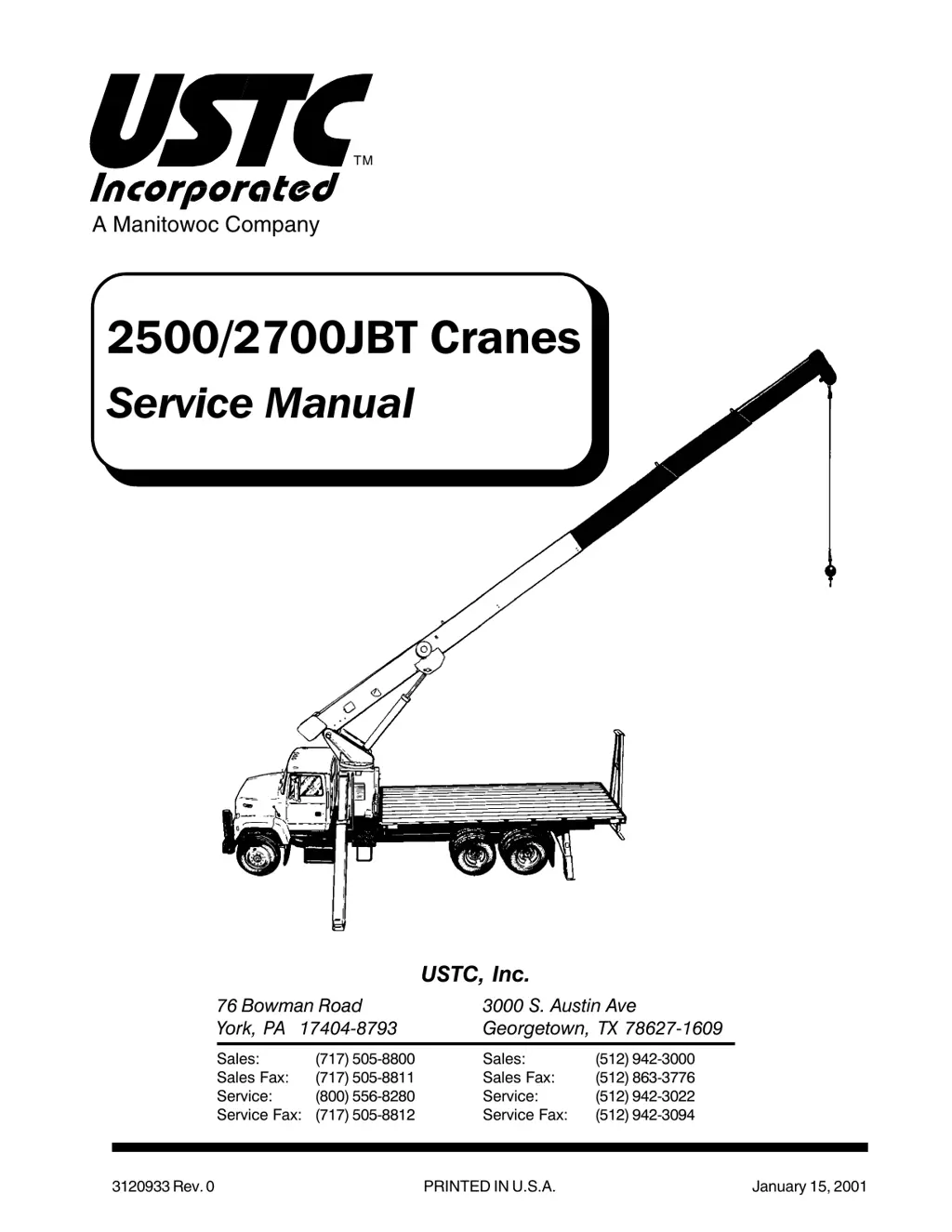
2500/2700JBT Cranes
Service Manual
Courtesy of Crane.Market

Table of Contents

Questions and Answers

  • J
    Julian BallAug 17, 2025
    What to do if the hoist will not lower load on USTC Construction Equipment?
    • J
      Jessica MooreAug 17, 2025
      If the hoist on your USTC Construction Equipment fails to lower a load or load handling device, several factors could be responsible. First, ensure that the load capacity has not been exceeded; if it has, reduce the load, referring to the Load Capacity Chart. Other potential causes include a closed anti-two-block valve (repair or replace the anti-two-block), low hydraulic oil level (add oil), or a restricted or broken hydraulic line (remove the line and clear any obstruction or replace the lines). Also, a malfunctioning hydraulic pump section (repair or replace the pump), a broken, kinked, or disconnected control cable (repair or replace the control cable), or a worn control valve spool (check pressure delivery from the control valve and repair or replace the valve) could be the reason.
  • D
    dana19Aug 21, 2025
    Why is the control valve spool sticking in USTC Construction Equipment?
    • N
      Natasha VaughnAug 21, 2025
      If the control valve spool is sticking in your USTC Construction Equipment, it could be due to several reasons. One possibility is dirt in the oil, causing excessive temperature buildup; in this case, change the oil using the recommended viscosity and flush the system. Another cause could be incorrect valve mounting, leading to warping of the unit; loosen the valve and check the mounting. Other potential issues include a scored valve spool (remove the valve and repair or replace it), a weak or broken return spring (remove the valve and repair or replace it), a malfunctioning relief valve causing excessive pressure within the valve (check pressure delivery to and from the valve and repair or replace it), or a binding control rod or lever (repair or replace the control rod or lever).
  • R
    Rachel ThompsonAug 25, 2025
    Why is the hoist cable movement erratic on USTC Construction Equipment?
    • X
      xwhiteAug 26, 2025
      Erratic hoist cable movement in USTC Construction Equipment can stem from a few causes. It might be due to insufficient lubricant on the boom nose sheaves; lubricate the sheaves as indicated in the Lubrication Chart. Another potential cause is a broken or bird-caged wire rope, which would necessitate replacing the wire rope. Additionally, the wire rope might be binding or incorrectly positioned on the sheaves; in this case, check and align the hoist and correctly position the wire rope over the sheaves.
  • J
    James WatsonAug 31, 2025
    Why is the turntable swing motion erratic on USTC Construction Equipment?
    • A
      Amber WatkinsAug 31, 2025
      Erratic turntable swing motion in USTC Construction Equipment can be caused by loose or missing swing bearing attaching hardware; replace all bearing bolts and torque them properly. Another cause is a worn swing bearing or a bearing requiring lubrication; replace the swing bearing or lubricate the bearing.
  • V
    Valerie GriffinSep 4, 2025
    What to do if fly section will not extend on USTC Construction Equipment?
    • B
      berrymichaelSep 4, 2025
      If the fly or outer-mid section(s) of your USTC Construction Equipment will not extend or retract, it could be due to a broken extend or retract cable for the fly and outer-mid section, in which case you should replace the applicable cables. Another possibility is a broken cable anchor weldment, which would require replacing the anchor weldment. Also, a broken telescope cylinder or inner/outer-mid section sheaves or sheave attach pins could be the cause, so replace the applicable sheaves or attach pins.
  • C
    Cindy JordanSep 6, 2025
    Why is the PTO noisy in USTC Construction Equipment?
    • M
      Mackenzie FryeSep 7, 2025
      A noisy PTO in USTC Construction Equipment can stem from several causes. It could be due to an improper number of gaskets; check the backlash and refer to setting the backlash. Worn and pitted gears may also be the cause, requiring replacement of the worn gears. Additionally, worn bearings due to high loads or chips can cause noise; reduce the load, replace the worn and rough bearings, and change the oil.
  • A
    aparkerSep 10, 2025
    How to fix oil leaking from PTO on USTC Construction Equipment?
    • R
      Ryan HoltSep 12, 2025
      Oil leaking from the PTO in USTC Construction Equipment can be attributed to several reasons: * Oil seal failure: Replace worn seal. * Broken gaskets: Replace the gasket(s). * Crack or hole in housing: Replace housing.
  • A
    Amber JonesNov 13, 2025
    What to do if the outrigger will not extend on USTC Construction Equipment?
    • M
      mriveraNov 14, 2025
      If the outrigger on your USTC Construction Equipment won't extend, several issues could be the cause. It might be due to a broken or disconnected control rod or lever, in which case the switch should be replaced. Other potential causes include low hydraulic oil level (add oil), a restricted or broken supply line (remove the line and clear any obstruction or replace it), a malfunctioning hydraulic pump (repair or replace the pump), or a worn control valve spool (check pressure delivery from the control valve and repair or replace the valve). Also, check if the hydraulic lines are incorrectly connected to the outrigger control valve or cylinder and connect them properly. Other possible problems include an outrigger holding valve stuck in the closed position (repair or replace the holding val...
  • B
    Brian ContrerasNov 26, 2025
    Why is the extension and retraction of fly section erratic on USTC Construction Equipment?
    • A
      Ashley DavidNov 26, 2025
      If the extension and retraction of the fly or outer-mid section on your USTC Construction Equipment is erratic, several factors could be responsible. The extend or retract cables may require adjustment. It's also possible that the cable nylon collar locking nuts or the threaded end of the cable are stripped, causing excessive cable slack, which would require replacing the nuts and applicable cables. Defective cable sheave bushings due to cable overtightening may also be the cause, so you should adjust the cable systems. A lack of lubricant on the fly or outer-mid section (85 and 94 ft. booms) or cable sheaves might be the issue, so replace and lubricate the sheaves. Additionally, check if the wear pads are out of adjustment or worn, and lubricate as required or adjust or replace the pads. ...

Summary

Section 1 - Specifications

GENERAL

General safety precautions for crane maintenance.

HYDRAULIC SYSTEM SAFETY

Safety measures for high-pressure hydraulic systems.

MAINTENANCE

Safety precautions for maintenance procedures.

COMPONENT DATA

Technical specifications for crane components.

Jibs (Optional)

Specifications for optional jib attachments.

OUTRIGGERS AND STABILIZERS

Specifications for outrigger and stabilizer systems.

CYLINDERS

Specifications for various hydraulic cylinders.

PRESSURE SETTINGS

Pressure settings for hydraulic system relief valves.

CAPACITIES

Load capacities and fluid capacities for the crane.

PERFORMANCE DATA

Operational performance metrics and speed specifications.

WEIGHTS

Weight specifications for crane components.

SOCKET HEAD SCREWS

Torque specifications for socket head screws.

Section 2 - Inspection

MACHINE INSPECTION REQUIREMENTS

OSHA and ANSI standards for crane inspection.

PREPARATION FOR USE

Procedures to ensure equipment readiness and safety.

LUBRICATION

Recommended lubrication points and types.

OPERATORS DAILY CHECKLIST

Daily inspection procedures for safe operation.

PERIODIC INSPECTION

Regular inspection schedule and key checks.

Section 3 - Troubleshooting

GENERAL

Introduction to troubleshooting procedures and system breakdown.

Boom Assembly

Troubleshooting common issues with the boom assembly.

Pedestal

Troubleshooting problems related to the crane pedestal.

Chassis Components

Troubleshooting issues with chassis and PTO components.

Hydraulic Components

Troubleshooting problems within the hydraulic system.

Electrical System

Troubleshooting common electrical system faults.

Section 4 - BOOM

GENERAL

Overview of the boom structure and maintenance.

CABLE INSPECTION PROCEDURES

Guidelines for inspecting boom cables.

HOIST CABLE

Procedures for hoist cable installation and attachment.

Break-In Procedure

Recommended break-in for new wire ropes.

CABLE REEVING

Instructions for reeving hoist cables for different configurations.

Single-Part Line Reeving

Specific reeving steps for single-part lines.

Two-Part Line Reeving

Specific reeving steps for two-part lines.

Three-Part Line Reeving

Specific reeving steps for three-part lines.

Four-Part Line Reeving

Specific reeving steps for four-part lines.

Five and Six-Part Line Reeving

Specific reeving steps for five and six-part lines.

WEAR PADS

Information on wear pad adjustment and replacement.

Side Wear Pads

Specifics on adjusting side wear pads for boom straightness.

EXTEND;RETRACT BOOM CABLES

Procedures for inspecting boom extension cables.

HOIST LAYBACK

Procedures for checking and adjusting hoist layback.

Extend;Retract Cable Adjustment Procedure

Steps for adjusting boom extend/retract cables.

Extend;Retract Cable Replacement

Procedures for replacing boom extension/retraction cables.

BOOM ASSEMBLY

General process for boom assembly.

Boom Removal

Steps for removing the boom from the truck.

Boom Installation

Steps for installing the boom assembly.

Boom Disassembly

Procedures for disassembling the boom sections.

Boom Inspection

Inspection points for boom components.

TELESCOPE CYLINDER

Information on the telescope cylinder.

Removal

Procedures for removing the telescope cylinder.

Installation

Procedures for installing the telescope cylinder.

FLY SECTION

Information on the fly section of the boom.

Removal

Procedures for removing the fly section.

Fly Section Installation

Procedures for installing the fly section.

TWO-SPEED HOIST OPERATION

Explanation of the two-speed hoist system.

Section 5 - Swing Drive

GENERAL

Overview of the crane's swing drive system.

COUNTERBALANCE VALVE

Function and troubleshooting of the counterbalance valve.

SWING MOTOR

Description of the swing motor.

SWING BRAKE

Description and adjustment of the swing brake.

Adjustment

How to adjust the swing brake flow control valve.

Disassembly

Procedures for disassembling the swing brake.

Installation

Procedures for installing the swing brake assembly.

GEAR REDUCER HUB

Description of the gear reducer hub.

Hub Disassembly

Procedures for disassembling the gear reducer hub.

Cleaning and Inspection

Cleaning and inspection of gear reducer hub components.

Carrier Disassembly

Procedures for disassembling planet carriers.

Primary Carrier Assembly

Procedures for assembling the primary carrier.

Secondary Carrier Assembly

Procedures for assembling the secondary carrier.

Hub Assembly

Procedures for assembling the gear reducer hub.

SWING BEARING

Description of the swing bearing and its importance.

Bolt Replacement, Torque Procedure

Procedures for replacing and torquing swing bearing bolts.

Swing Bearing Wear Tolerance

Information on swing bearing wear and clearance.

Section 6 - Electrical

GENERAL

Introduction to the crane's electrical system.

ANTI-TWO-BLOCK SYSTEM OPERATION

How the anti-two-block system functions.

ELECTRICAL SYSTEM

Description of the main electrical system components.

OVERLOAD SYSTEM

Explanation of the overload shut-down system.

LOAD MOMENT INDICATOR

Information on the optional LMI system.

Section 7 - Hydraulics

HYDRAULIC SYSTEM SAFETY

Critical safety warnings for hydraulic systems.

DRIFT TEST

Procedures for testing cylinder drift.

Telescope Cylinder

Testing the telescope cylinder for leaks.

Lift Cylinder

Testing the lift cylinder for leaks.

PRESSURE TESTING

How to check and set relief valve pressures.

Main Relief Valve

Specifics on testing the main relief valve.

Telescope In Relief Valve

Testing the telescope retract relief valve.

Swing Inlet Relief Valve

Testing the swing inlet relief valve.

Hoist Relief Valve

Testing the hoist relief valve.

Burst-Of-Speed and Telescope Out Relief Valve

Testing relief valves for burst-of-speed and telescope out.

CYLINDERS

General information on hydraulic cylinders.

Holding Valves

Description and function of holding valves.

Dissasembly

Procedures for disassembling a cylinder.

Cleaning and Inspection

Cleaning and inspecting cylinder components.

Assembly

Procedures for assembling a cylinder.

CONTROL VALVE

Description of the main control valve.

HOIST VALVE

Description of the hoist control valve.

MANIFOLD VALVE

Description of the manifold valve.

HYDRAULIC FILTER

Description and maintenance of the hydraulic filter.

USTC 2500 jbt Specifications

General IconGeneral
BrandUSTC
Model2500 jbt
CategoryConstruction Equipment
LanguageEnglish