Installation and maintenance instructions for uniSTOR 0020111105_00 19
Worked example
The example below is for a G1/2 temperature relief valve
with a discharge pipe (D2) having 4 No. 22 mm elbows
and length of 7 m from the tundish to the point of dis-
charge.
From Table 5.1:
Maximum resistance allowed for a straight length of
22 mm copper discharge pipe (D2) from a G1/2 tempera-
ture relief valve is: 9.0 m.
Subtract the resistance for 4 No. 22 mm elbows at 0.8 m
each = 3.2 m
Therefore the maximum permitted length equates to:
5.8 m, which is less than the actual length of 7 m there-
fore calcu late the next largest size.
Maximum resistance allowed for a straight length of
28 mm pipe (D2) from a G1/2 temperature relief valve is:
18 m.
Subtract the resistance of 4 No. 28 mm elbows at 1.0 m
each = 4.0 m.
Therefore the maximum permitted length equates to:
14 m.
As the actual length is 7 m, a 28 mm (D2) copper pipe
will be satisfactory.
A suitable place for the end of the discharge pipe is, for
example, beneath a fixed grille above the odour seal in a
gully with a siphon. Low discharge pipes, for example up
to 100mm above external surfaces such as car and
other parking spaces, grasslands, etc. can be used pro-
vided that they are secured by a wire fence or some-
thing similar to prevent children from coming into con-
tact with the waste water and provided that the system
is not visible. You must not install any valves or stop
cocks in the discharge pipe.
> Make sure that the discharge pipe from the tundish to
the drain has a constant downward incline of at least
1:200.
The discharge pipe from the pressure relief valve of the
Vaillant gas-fired wall-hung boiler can be connected to
the horizontal discharge pipe of the cylinder behind the
tundish using a T-piece.
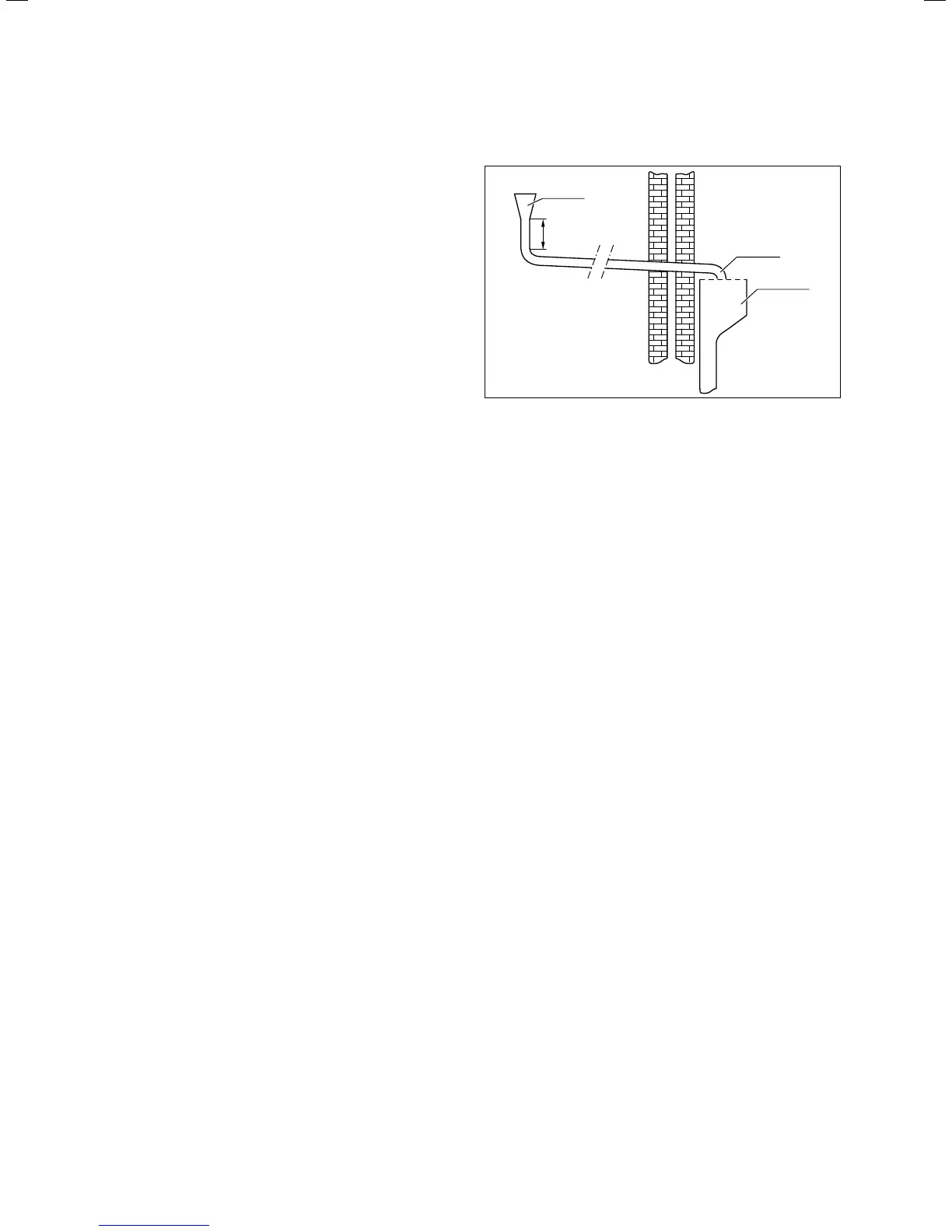
5.4.2 High drain
tundish
At least
300 mm
Discharge pipe
Metal funnel
Fig. 5.6 High drain connection
The method illustrated in fig. 5.6 is allowed provided
that no-one inside or outside the building is endangered
by the discharge point.
Examples of points to consider when deciding whether
a location is suitable for the high drain:
– The possibility (taking into account the effect of the
wind) that a person might be located in the area where
the water escapes, and, if this is the case, whether the
water is sufficiently cooled by that point to pose no dan-
ger. Thermal conductivity of the structure's surface, cli-
matic conditions and location and orientation of the
discharge pipe may or may not have an effect on redu-
cing the temperature of the discharge water.
– The position of windows and other openings.
– The probability of prams being parked under the drain.
– The resistance of the surface to hot water.
– The possibility of ice forming if the water is
discharged onto paths.
Installation 5






 To Next Page