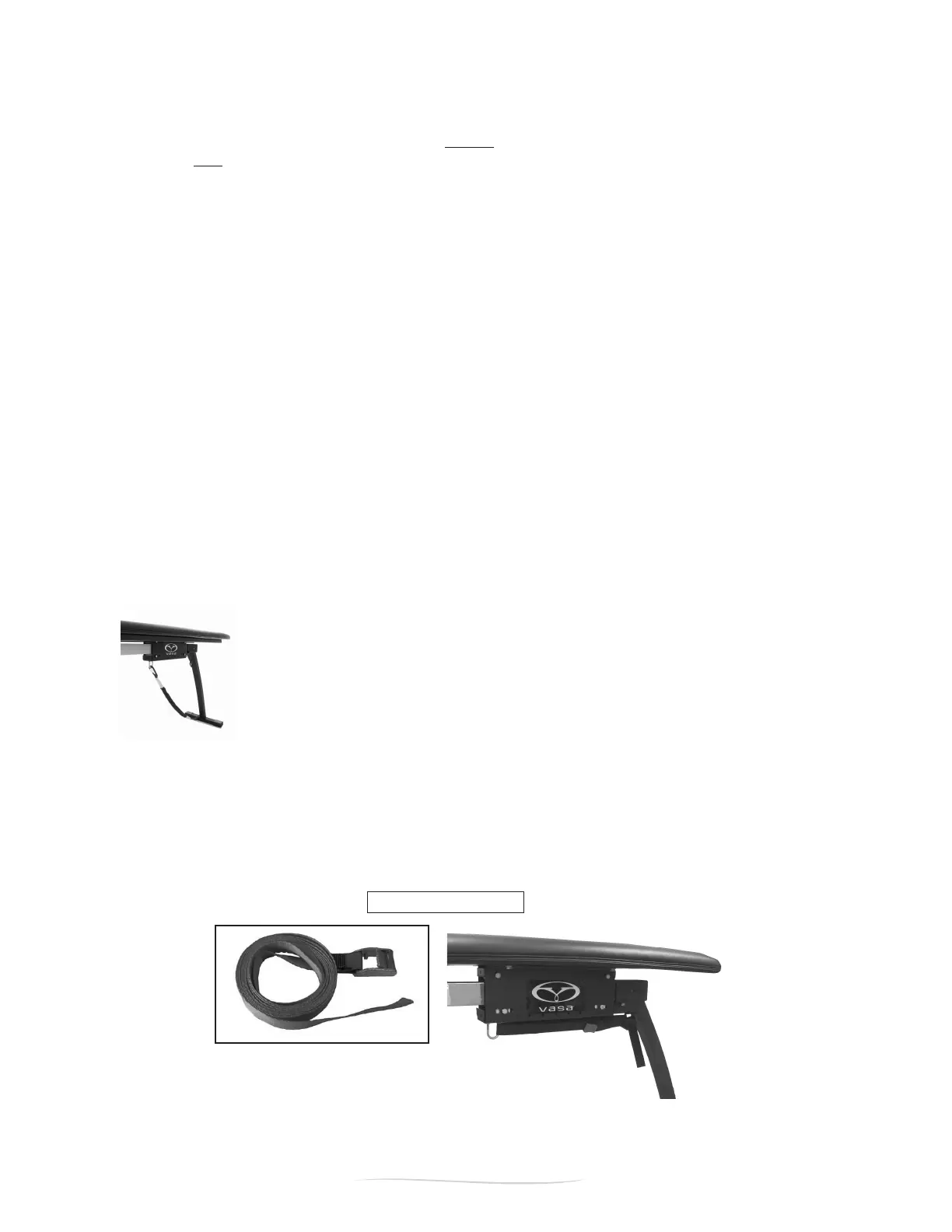
Figure A
18 August 2022
Vasa SwimErg User’s Manual
WEBBING STRAPS
Available at most hardware stores.
PART 2 - Using the SwimErg
DAMPER DOOR SETTINGS RELATING TO POWER AND FORCE OUTPUT
At high settings (5, 6, 7) it feels like swimming against a current. At low settings (1 & 2) it feels more like
swimming with a current. So if you select a setting of 1, you will have to move your arms faster than your
normal speed in still water to generate the same power (faster stroke rate). If you select a setting of 7,
you will have to move your arms slower than your normal speed in still water to generate the same power
(slower stroke rate).
Mathematically, this is expressed by the equation Power = Force x Velocity. The fan resistance determines
the force (a higher setting is a higher force) and the hand speed is the velocity. So the same power can be
achieved with either a high resistance setting combined with a low hand speed or a low resistance setting
combined with a high hand speed. As you would expect, there will be a setting where an individual can
producethemaximumpowerduetophysiologicalandbiomechanicalefciency,andthissettingwilllikely
be different depending on the individual’s body and training. The monitor calculates power by sampling the
force and hand speed many times per second throughout the stroke. Therefore it calculates power produced
& distance swam precisely regardless of the damper door setting. This allows users to choose a damper door
setting according to personal preference.
It is important to remember that the damper door setting is subjective, depending on body type, conditioning
level, and stroke technique. We think that most distance swimmers excel at the low to mid range damper
settings (either 2, 3 or 4).
Suggestion: once per week for one month do a 500 meter or a 1000 meter time trial at race pace & race
stroke rate. On week one, set the damper door at 2, for week 2, set it at 3 and so on. You’ll discover the
damper door setting that allows you to perform your best for that distance. Measure your heart rate, watts,
andtime.Monitoringthesewillhelpyouarriveatthemostefcientstrokerate,techniqueandheartrateto
sustain the power and pace you need to improve.
STRETCH CORD
The stretch cord is designed to prevent the seat from rolling too far forward. The user
should be able to complete a full range of motion without contacting the front unit.
NOTE:Allowingthebenchtorollfreelycanprovideauseful“treadmill”affect,wherebythe
user will notice a drop in average power because the bench will roll backwards.
ANCHOR BENCH TO PREVENT MOVEMENT
If you prefer to keep the bench from rolling on the monorail, you can use a webbing strap to anchor to rear
stanchion (Figure A).
Webbing straps with cam buckle are available at most hardware stores or at vasatrainer.com.


 To Next Page