Automotive Short And Open Finder
11
• For identifying wires without load connected: Connect the V210 transmitter as
described in section ‘2.9- Locating Open Circuits’ to the circuit to be identied, then
proceed to scan all suspected wiring with the V210 receiver probe sensor, until the tone
is at its maximum. In the case of tightly packed wires (bundles, conduits, etc.), it may be
necessa to spread these apa to facilitate the identication process of a paicular
wire.
On detection of an open circuit, the V210 transmitter injects a special radio signal into the
circuit, which can be picked up by the V210 receiver probe sensor.
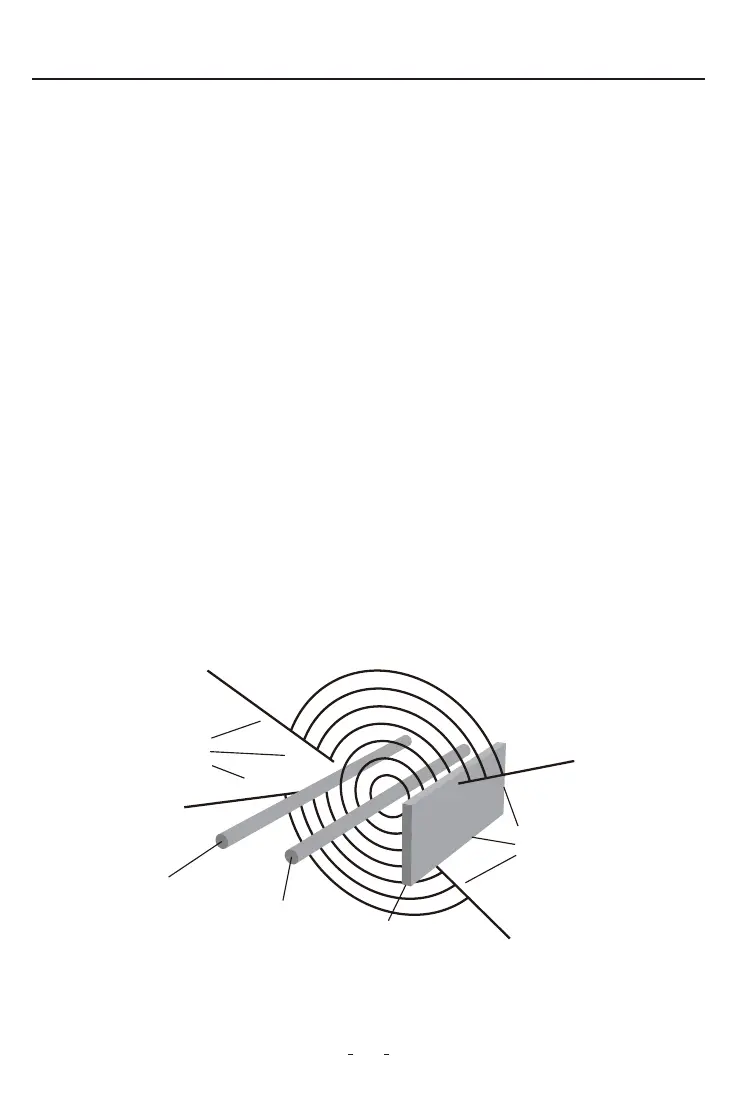
When tracing an open circuit, keep in mind that RF (radio frequency) signals injected in the
faulty wire being traced, will be easily absorbed by any other conductor nearby. (e.g.: other
wires, metal frames).The eect of this absorption may va from a reduction in the V210
receiver’s range, to a total shielding of the signal with no detection being possible at all
(See Fig. 8 as below).
2.12.1 Working with open circuits
Sho and open circuit operation – Dierences:
The V210 uses two dierent types of signals to trace either sho or open circuits.
Understanding its dierences, as explained in the following paragraphs will allow you to
make the most eective use of this versatile tool.
2.12 General Tracing Procedures
Weakened
or no
signal
area
Weakened
or no
signal
area
Other Wire
Traced wire
Steel Pa
Figure 8


 To Next Page