3
Measuring principle
Radar - Level measurement in bulk solids
29427-EN-160312
1 Measuring principle
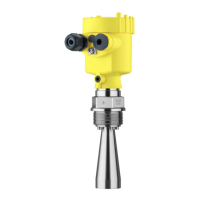
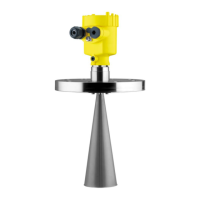
MeasuringprincipleVEGAPULS67,SR68,68
Extremely short microwave pulses are emitted by the antenna system in
the direction of the measured product, reected by the product surface
and received back again by the antenna system. They propagate at
the speed of light. The time from emission to reception of the signals is
proportional to the level in the vessel.
A special time stretching procedure allows reliable and precise measure-
ment of the extremely short times.
The VEGAPULS 67, SR 68, 68 radar sensors work with low emitted
power in the K-band frequency range.
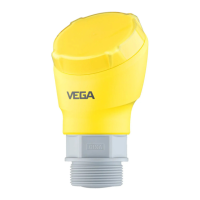
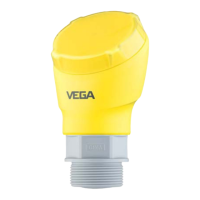
MeasuringprincipleVEGAPULS69
The instrument emits a continuous radar signal via its lens-shaped
antenna. This signal is frequency modulated with a sawtooth form. The
emitted signal is reected by the medium and received by the antenna as
echo.
The frequency of the received signal always deviates from the actual
emitted frequency. The frequency dierence is calculated by special
algorithms in the sensor electronics. It is proportional to the level in the
vessel.
The VEGAPULS 69 operates with low emitted power in the W-band
frequency range.
Optimizedforbulksolids
Due to the very good signal focussing, internal silo installations or
buildup on the vessel wall do not inuence the measurement. A high
sensitivity electronics adapted to the requirements of bulk solids meas-
urement enables reliable level measurement of dierent products up to
120 m. The measuring principle is unaected by strong dust generation,
lling noise, air ow due to pneumatic lling and temperature uctuations.
Advantages
Non-contact radar technology is characterized by extremely high accura-
cy. The measurement is inuenced neither by uctuating product features
nor by changing process conditions such as temperature, pressure or
strong dust generation. The user-friendly adjustment without vessel lling
and emptying saves time.
Inputvariable
The measured variable is the distance between the process tting of the
sensor and the product surface. The reference plane is the seal surface
of the ange.
3
4
2
1
Fig. 1: Data of the input variable
1 Reference plane
2 Measured variable, max. measuring range
3 Antenna length
4 Utilisable measuring range



 To Next Page
 Loading...