
 Need help?
Do you have a question about the VESDA VESDA-E VEP-A00 and is the answer not in the manual?
Detailed list of features for the VEP-A00 detector, including detection technology, calibration, and coverage.
Identifies field-replaceable parts like the filter, aspirator, and chamber assembly.
Explains the air sampling process, detection chamber operation, and alarm signaling.
Details the status LEDs and the reset/disable/acknowledge button functionality.
Describes internal buttons like AutoConfig and communication ports (USB, Ethernet, WiFi).
Explains VESDAnet network capabilities for reporting and central monitoring.
Provides key technical data including supply voltage, power consumption, dimensions, and operating conditions.
Illustrates front, top, bottom, and side dimensions for installation planning.
Key points to consider when designing a pipe network for optimal airflow and sampling.
Guidelines for installing sampling pipes, ensuring secure connections and proper airflow.
Details on using pipe inlet ports for VEP-A00-P and VEP-A00-1P models.
Information on connecting exhaust pipes and requirements for different environments.
Steps to prepare the detector, including removing tape and plugs from inlet ports.
Covers mounting methods using a bracket or template, including orientation and clearance.
Details on wiring power, relays, network, and GPI connections, including socket locations.
Procedure for powering up the detector and initial self-diagnostic tests.
A checklist to ensure all installation steps are completed before commissioning.
Checks to perform after installation and before system commissioning.
Steps to establish communication between Xtralis VSC software and the detector.
Methods for connecting via USB, Ethernet, WiFi, and VESDAnet.
Details on password authentication, PIN codes, and user access levels.
List of commands executable from the detector or Xtralis VSC software.
Basic identification settings for the detector, including network name and location.
Settings to control network data transmission behavior for VESDAnet connections.
Settings for joining a wired Ethernet network, including IP address configuration.
Settings for joining a WiFi network, including SSID, security, and IP configuration.
Setting smoke obscuration trigger points for alarm levels and day/night thresholds.
Setting airflow limits for faults, pipe usage, and aspirator speed.
Defining the service interval for filter replacement and fault generation.
Setting up referencing to compensate for background smoke levels.
Configuring the behavior of unmonitored and monitored GPIs.
Assigning alarm/fault conditions to relays and configuring their behavior (latching, beep).
Lists default values for all configurable parameters, affected by factory reset.
Learning ambient smoke levels to set appropriate alarm thresholds.
Learning airflow behavior to set appropriate fault thresholds.
Verifying pipe network integrity and measuring smoke transport time.
Temporarily disabling the aspirator for maintenance without affecting fault signaling.
Procedure for accessing internal components by opening the detector's front door.
Instructions for removing and replacing the air sampling filter for optimal performance.
Steps to remove the fascia for access to internal components, including ESD precautions.
Procedure for safely removing and installing a replacement aspirator unit.
Instructions for removing and installing the smoke detection chamber assembly.
Procedure for safely removing and installing a replacement sampling module.
List of available field-replaceable spare parts with their part numbers.
How fault conditions are signaled to Fire Alarm Control Panels or BMS via relays.
Using VSC software to identify fault causes, view event logs, and find troubleshooting information.
Form to record detector configuration settings printed from Xtralis VSC.
Instructions to print the ASPIRE Installation Data Pack for system modeling results.
Form to record results from smoke testing, including test method and type of smoke.
Form to document air sampling test results, including transport time and response levels.
 General
| Model | VESDA-E VEP-A00 |
|---|---|
| Detection Principle | Laser-based light scattering |
| Humidity Range | 10% to 95% RH, non-condensing |
| Number of Pipes | 4 pipes |
| IP Rating | IP40 |
| Event Log | Up to 20, 000 events |
| Sensitivity Range | 0.005% to 20% obs/m |
| Alarm Levels | Alert, Action, Fire 1, Fire 2 |
| Power Supply | 24 VDC (18 to 30 VDC) |
| Communication Protocol | Ethernet |
| Operating Temperature | 0°C to 39°C (32°F to 102°F) |
| Pipe Length | Up to 100m per pipe |
| Weight | 3.5 kg |
| Approvals | UL, FM, LPCB |
| Communication Interface | Ethernet |
| Dimensions | 350 mm x 225 mm x 135 mm |
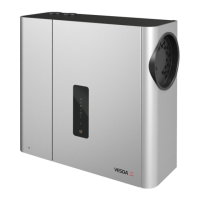
| Type | Addressable aspirating smoke detector |
| Air Sampling Method | Continuous air sampling via aspirator |


 To Next Page