Table 9 – Draw-off demand per point of use at a DHW tempera-
ture of 45 °C
Point of use Volume of hot
water drawn
off per use in
l
Draw-off demand Q
h max.
per single
room in kWh
per double
room in kWh
Bath 170 7.0 10.5
Shower cubicle 70 3.0 4.5
Washbasin 20 0.8 1.2
Calculating the required cylinder capacity
Q
h max.
= Draw-off demand per draw-off point in kWh
n = Number of rooms with identical draw-off demand
ϕ
n
= Utilisation factor (simultaneity); can be applied condi-
tionally:
Number of
rooms
1 to 15 16 to 36 35 to 75 76 to 300
ϕ
n
*12
1 0.9 to 0.7 0.7 to 0.6 0.6 to 0.5
ϕ
2
= Hotel grading factor
The following factors can be applied to reflect the cate-
gory of hotel:
Hotel category Standard Good High
ϕ
2
1.0 1.1 1.2
Z
A
= Heat-up time in h
The heat-up time is subject to the rated heating output
available for DHW heating. Subject to the rated boiler
heating output, you can select a smaller Z
A
value than 2
h.
Z
B
= Duration of the peak DHW demand in h
Assumption: 1 to 1.5 h
V = Volume of the DHW cylinder in l
T
a
= Cylinder storage temperature in °C
T
e
= Cold water inlet temperature in °C
a = 0.8
This takes into account the heat-up condition of the
DHW cylinder.
Example:
Hotel with 50 rooms (30 double rooms and 20 single rooms)
■ Amenities of the single rooms:
5 single rooms with bath, shower cubicle and washbasin
10 single rooms with shower cubicle and washbasin
5 single rooms with washbasin
■ Amenities of double rooms:
5 double rooms with bath and washbasin
20 double rooms with shower cubicle and washbasin
5 double rooms with washbasin
■ Heating water flow temperature = 80 °C
■ Required heat-up time of the DHW cylinder 1.5 hours
■ Duration of peak demand 1.5 hours
Heat demand for DHW heating
Type of room Equipment
level (draw-
off point)
n Q
h max.
in kWh
n × Q
h max.
in kWh
Single room: Bath 5 7.0 35.00
Shower cubi-
cle
10 3.0 30.00
Washbasin 5 0.8 4.00
Double rooms: Bath 5 10.5 52.50
Shower cubi-
cle
20 4.5 90.00
Washbasin 5 1.2 6.00
Σ (n · Q
h max.
) = 217.50
860 · Σ(n · Q
h max.
) · φ
n
· φ
2
· Z
A
V =
(Z
A
+ Z
B
) · (T
a
– T
e
) · a
860 · 217.5 · 0.65 · 1 · 1.5
=
(1.5 + 1.5) · (60 – 10) · 0.8
=1520 l
Selected DHW cylinders:
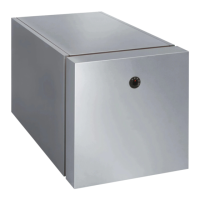
3 × Vitocell 300-H, each with 500 l capacity
or
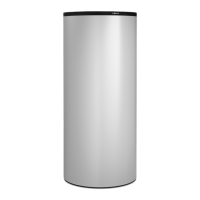
3 × Vitocell 300-V, each with 500 l capacity
Calculating the required heat-up output
1500 · (60 – 10)
Z
A
² = Φ =
860 · 1.5
= = 58 kW
V · c · (T
a
– T
e
)
² or Φ
= Heat-up output in kW
V = Selected capacity in l
c = Spec. thermal capacity
T
a
= Cylinder storage temperature in °C
T
e
= Cold water inlet temperature in °C
Z
A
= Heat-up time in h
The boiler and circulation pump for cylinder heating must be sized
accordingly for the required heat up output.
To guarantee adequate heating of the building during winter too, this
heat volume must be added to the heat load.
Calculating the heat demand for DHW heating in commercial saunas
Assumptions:
The sauna is used by 15 people/h.
5 showers with 12 l/min are available, i.e. the showers are utilised
3 times in a row. A showering time of 5 min results in a DHW
demand of 60 l per use.
The heat load of the building is ²
N
= Φ
HL buil.
= 25 kW.
Two points must be observed to safeguard adequate DHW heating:
a) Adequate cylinder capacity (sized according to peak output).
b) The boiler must be large enough to cover the DHW heating and
²
N
.
Regarding a)
Calculating the cylinder capacity:
15 persons @ 60 l = 900 l at 40 °C at the DHW outlet.
The cylinder storage temperature is 60 °C.
As a low temperature boiler is to be installed, the peak output at a
heating water flow temperature of 70 °C must be calculated; see
tables in the datasheets for the relevant DHW cylinders.
Conversion to an outlet temperature of 45 °C results in:
*12
For spa hotels, trade fair hotels or similar installations, select a utilisation factor of ϕ
n
= 1.
Sizing
(cont.)
DHW heating
VIESMANN
19
5414646
4


 To Next Page
 Loading...