Brakes
must be depressed harder to achieve the
same braking force as before.
CAUTION
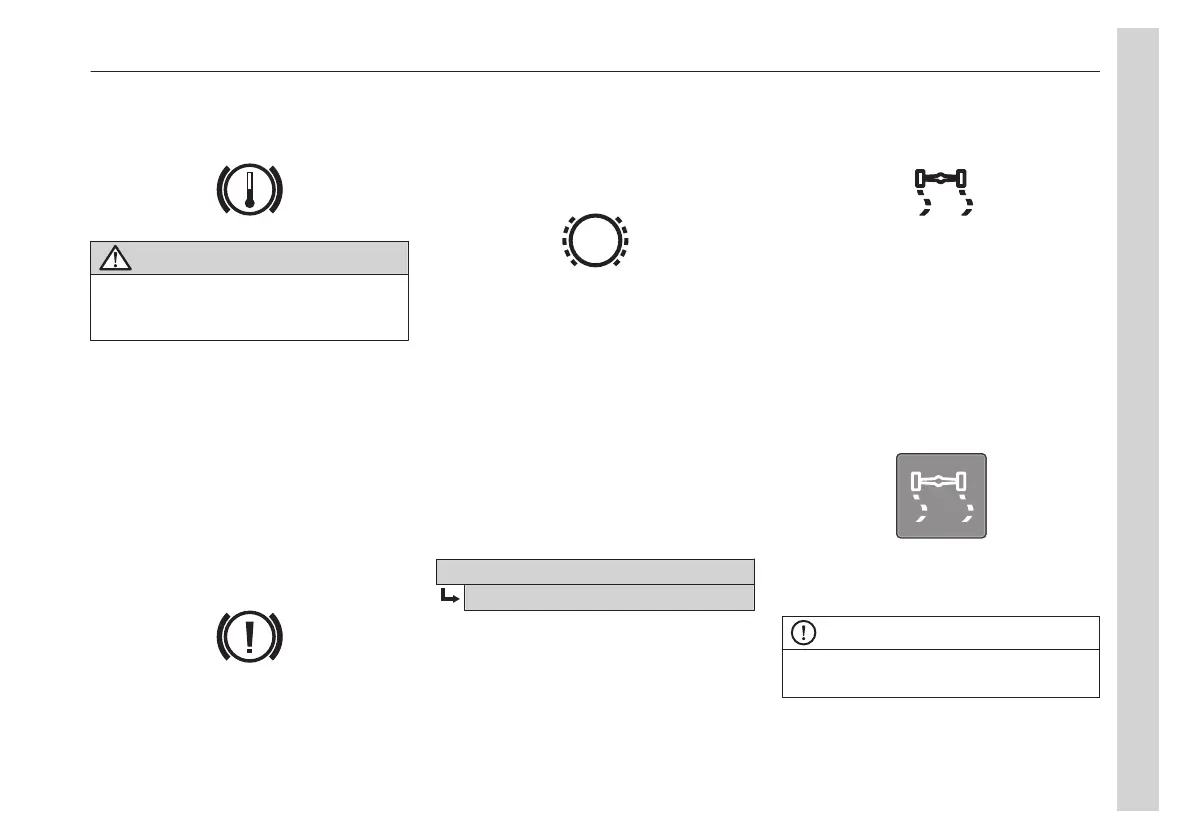
If the warning for high brake temperature
is shown, slow down using the retarder, or
stop the bus.
Monitoring wheel brakes
If any wheel is braking less efficiently
than the other wheels, the CHECK lamp
is illuminated and a symbol is shown in
the driver information display.
No difference can be detected in braking
force since the other wheels are braked
harder to compensate. However, a fault
code is stored in the system and an
authorised Volvo workshop should
examine the brake system.
When the brakes have a poor effect, a
symbol is shown in the driver information
display.
Wear on brake linings
If the brake linings wear more on one
axle than on the other, the braking force
is changed so that the wear is equalised.
When it is time to change the brake
linings, a symbol is shown in the driver
information display.
Estimated wear
The calculated remaining distance
before the brake linings need replacing,
based on the current driving style, can
be found in the driver information
display. An authorised Volvo workshop
can also help retrieve this information.
Driver information display
Vehicle data
Lining wear, prediction
Traction control system
The traction control system (TCS)
provides better stability and traction.
TCS automatically reduces the
wheelspin by reducing the engine torque.
At speeds below 40 km/h ,TCS also
works as an automatic limited slip
differential clutch and applies the brake
on the wheel that is spinning.
When the TCS is active, a symbol is
shown in the driver information display.
Off-road TCS
Off-road TCS is used under difficult
conditions to improve traction, such as
driving on sand, gravel or snow. The
function reduces the system's sensitivity
and allows a little more wheel spin
before reducing power.
The function is activated by pressing the
switch. The indicator lamp in the switch
is illuminated when activated.
NOTE
Do not use the off-road TCS during normal
driving.
09
Function descriptions
139


 To Next Page