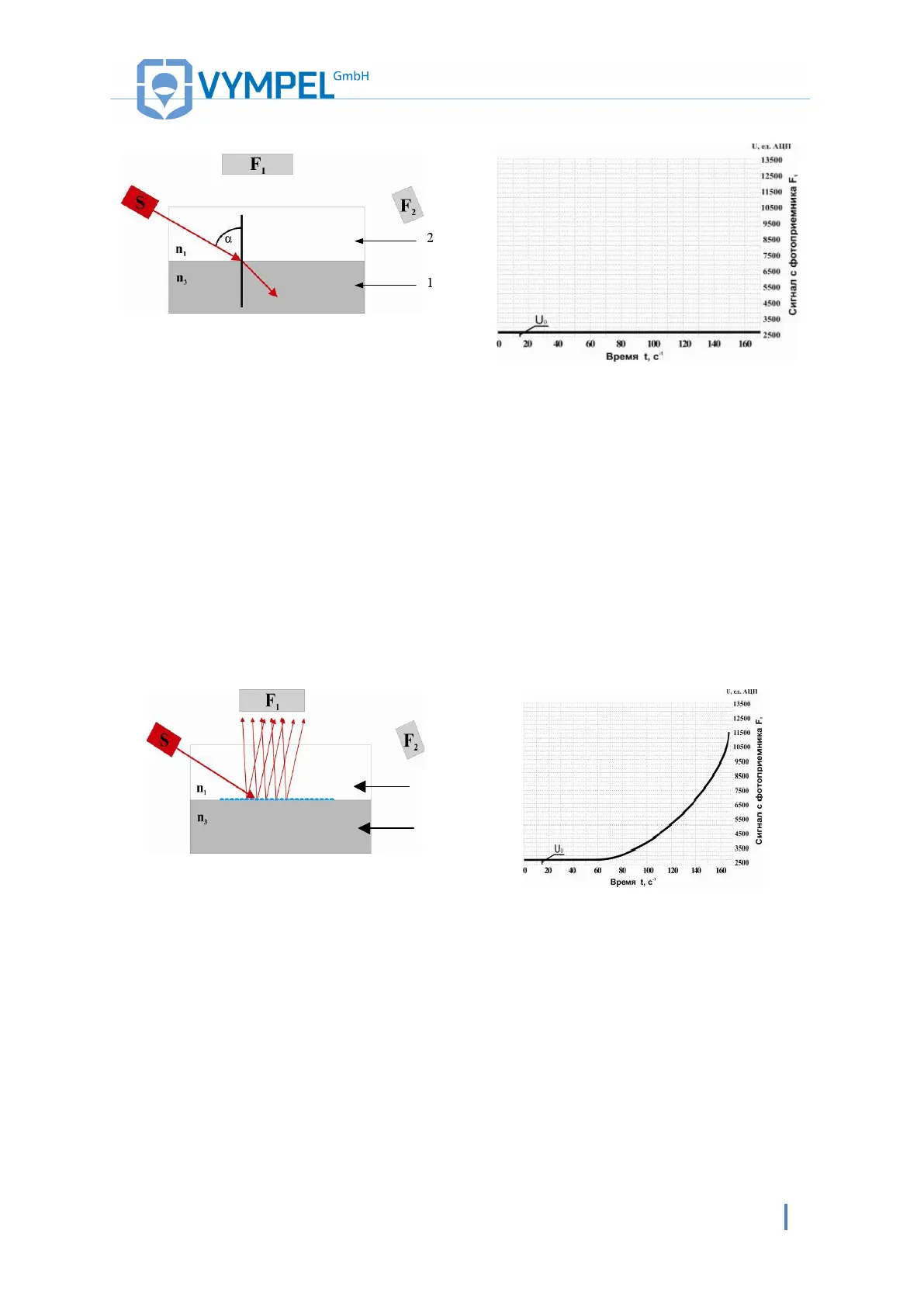
α – Brewster’s angle; 1 – dielectric chilled mirror; 2 – sample medium (gas); S – laser-
emitting diode; F1 and F2 – photo detectors of the registration system; U
0
– Zero signal from
the photo sensor.
As the mirror is chilled, droplets of water condensation begin to form on the mirror’s surface.
The rays of polarized light emitted from the laser diode are scattered when they strike these
droplets and are registered by the photo detectors (F1).
The signal created by photons hitting the detector (Illus. 2.1) is boosted and registered by the
detection system (Illus. 2.1). The signal intensity is dependent on the amount of water
condensation on the chilled mirror’s surface.
Light scattered by water condensation on the surface of the chilled;
1– chilled dielectric mirror; 2 – sample medium (gas)
In the absence of water vapor, hydrocarbons in the sample gas condense onto the surface of
the chilled mirror. Instead of droplets, this condensation forms a smooth film. The build up of
a cohesive film on the mirror’s surface alters the angle of incidence at which the polarized
light rays encounter the surface of the mirror.
As the light strikes the gas/condensation film interface it is partially reflected.
At the same time, due to the transparency of the condensate film, some of the light will only
be reflected at the next boundary, the interface of the condensation film with the mirror’s


 To Next Page