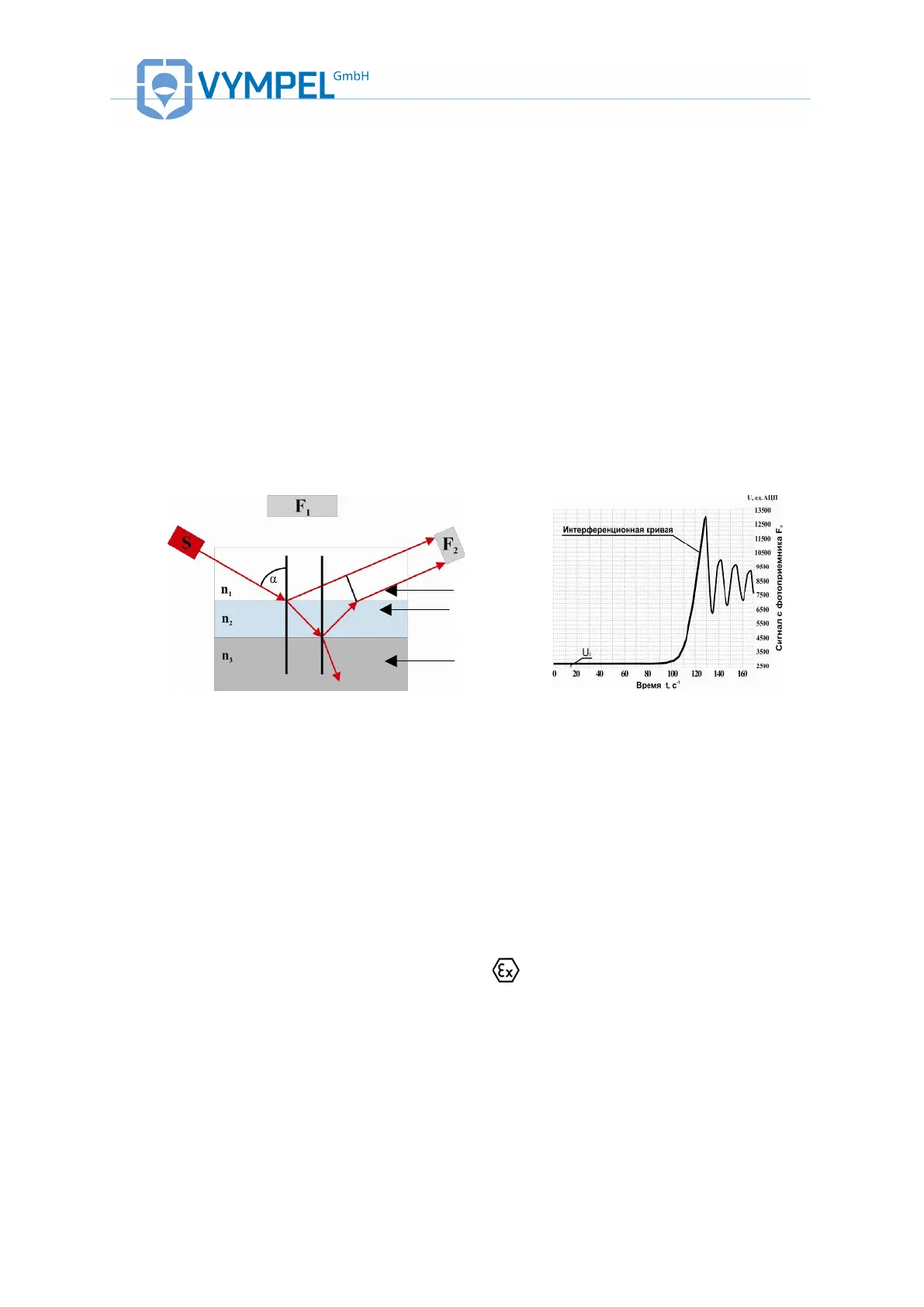
surface. As a result, the photo detector F2 receives two sets of reflected light rays, which are
slightly out of phase.
The light signal registered by the detection system produces a characteristic interference
pattern.
The intensity of the light received by the photo detector is directly dependent on the amount
of hydrocarbon condensation on the mirror’s surface. As more hydrocarbons precipitate onto
the mirror the film becomes thicker, this in turn means that the distance between the two
upper and lower boundary interfaces becomes greater. This increase in distance correlates
to a greater phase discrepancy between the two reflected rays that increases the signal
strength.
The registration of the hydrocarbon dew point temperature occurs as soon as the
condensation film reaches a thickness of 5 – 10nm (default setting).
In this way, these two separate modalities generate two separate signals: the signal from
photo detector F1 is used to establish the dpW and the signal from photo detector F2 to
establish the dpHC (Illus. 3.1 and 3.2).
Diagram of the light scatter from a hydrocarbon film (2) on a mirror with a reflection index of n2.
1 – chilled dielectric mirror;
2– hydrocarbon condensate;
3 – sample medium (ex. gas)
1.3 CP 2M provision for explosion protection
The CP2M is certified as compliant with the requirements of EN 60079-0:2009, EN 60079-
1:2007. It carries the explosion protection marking II 2G EEx d IIA + Н
2
T5.
This marking identifies the CP 2M as a “flameproof enclosure” as per the requirements
stated in EN 60079-1:2007.
Explosion protection is provided by encasing the electrical elements of the electronics unit in
an enclosure that is mechanically robust and meets the standards of EN 60079-0:2009. This
enclosure can withstand explosion pressures and prevent combustion from escaping into an
ambient explosive environment.
Integrity of the flameproof enclosure is maintained through the use of threaded and
cylindrical flameproof joints. A drawing of the explosion protection measures (Appendix С)


 To Next Page