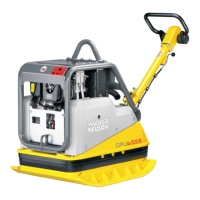
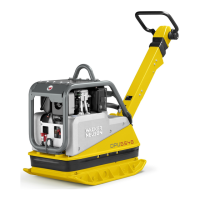
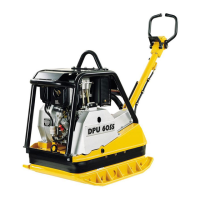
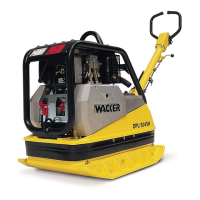
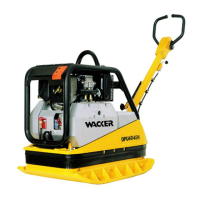
This document is an operator's manual for the Wacker Neuson DPS 1850 vibratory plate, a machine designed for soil compaction. The manual covers various aspects of the machine, including its function, technical specifications, usage, and maintenance.
Function Description
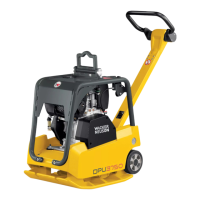
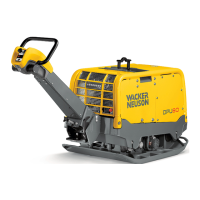
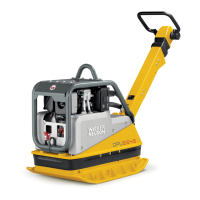
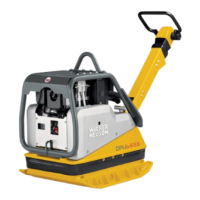
The vibratory plate is a machine used to compact soils. It is suitable for use in gardening and landscaping, civil engineering, road and highway construction, and paving work. The vibration necessary for compaction is generated by an exciter firmly connected to the base plate. This exciter is designed as a single-directional, front-mounted exciter with circular vibrations.
The drive motor, attached to the engine console, powers the exciter. The torque is transferred through a centrifugal clutch and the exciter V-belt. At low engine speeds, the centrifugal clutch disengages, allowing the drive motor to idle smoothly. The engine's revolutions per minute (RPM) can be adjusted using the throttle lever, from full throttle to idling and to stop.
The engine console and base plate are connected by four vibration-absorbing rubber-metal buffers. This damping system prevents the transfer of high frequencies to the engine console, ensuring the drive motor's functionality despite high compaction performance. The drive motor operates on the diesel principle, features a recoil starter, draws combustion air through a dry-type air cleaner, and is air-cooled.
The manual lists three versions of the DPS 1850:
- DPS1850Hb: Basic - normal standard design.
- DPS1850Hv: Vario - with two compaction levels.
- DPS1850Ha: Asphalt - with water tank.
The machine is delivered fully assembled and ready for operation.
Important Technical Specifications
The DPS 1850 series vibratory plates share several key technical specifications:
- Centrifugal force: 18 kN (DPS1850Hb, DPS1850Ha) or 11/18 kN (DPS1850Hv).
- Oscillations: 88 Hz (DPS1850Hb, DPS1850Ha) or 98 Hz (DPS1850Hv).
- Nominal speed: 5,300 rpm (DPS1850Hb, DPS1850Ha) or 5,880 rpm (DPS1850Hv).
- Compaction performance: 660 m²/h (4,079.3 ft²/h) for DPS1850Hb and DPS1850Ha, and 600 m²/h (3,368.8 ft²/h) for DPS1850Hv.
- Travel speed: 22 m/min (DPS1850Hb, DPS1850Ha) or 14/20 m/min (DPS1850Hv).
- Gradeability: 46.6%.
- Width: 500 mm (19.7 in).
- Height: 865 mm (34.1 in) for DPS1850Hb and DPS1850Hv, and 869 mm (34.2 in) for DPS1850Ha.
- Operating weight: 114.1 kg (251.3 lb) for DPS1850Hb, 139.0 kg (306.4 lb) for DPS1850Ha, and 116.0 kg (255.7 lb) for DPS1850Hv.
- Ground clearance: 625 mm (24.6 in) for DPS1850Hb and DPS1850Hv, and 653 mm (25.7 in) for DPS1850Ha.
- Rated power: 3.4 kW.
- Nominal speed (engine): 3,600 rpm.
- Exciter oil volume: 0.1 l (0.03 gal).
- Exciter oil type: SAE 10W-40.
- Bearing and operating temperature range: -6 to +40 °C.
- Sound pressure level at operator's location (LpA): 92 dB(A) (DPS1850Hb, DPS1850Ha) or 93 dB(A) (DPS1850Hv).
- Guaranteed sound power level (Lwa): 108 dB(A).
- Vibration total value (ahv): 8.6 m/s² (28.2 ft/s²) for DPS1850Hb, 15.5 m/s² (50.9 ft/s²) for DPS1850Ha, and 7.6 m/s² (24.9 ft/s²) for DPS1850Hv.
- Uncertainty of measurement of ahv: 0.5 m/s² (1.6 ft/s²).
The combustion engine is a Hatz 1B20-6-325, four-cycle, air-cooled, single-cylinder diesel engine. Its displacement is 232 cm³ (14.2 in³), with a maximum slanting position of 16.7°. Fuel consumption is 0.4 l/h (0.1 gal/h), and the tank capacity is 3.0 l (0.8 gal). Oil specification is SAE 10W-40, with an oil filling volume of 0.9 l (0.2 gal). Max performance is 3.5 kW. The starter type is recoil starter.
Usage Features
The manual emphasizes safe and proper operation. Key usage features and safety instructions include:
- Intended Use: The machine is designed for soil compaction, asphalt compaction, and vibrating sett paving. It should not be used for very cohesive, frozen, hard, non-compressible, or non-load-bearing soils.
- Operator Responsibility: Operators must be trained, understand the manual, and adhere to all safety regulations. The manual must be available at all times.
- Personal Protective Equipment: Operators must wear safety shoes, protective gloves, and ear protection to prevent injuries.
- Safety Devices: The machine is equipped with a belt guard (Item 1 in the diagram) to protect against moving parts.
- Operation:
- Before starting, check for damage, loose packaging material, fuel level, engine oil level, fuel lines for leaks, and ensure screw connections are firmly seated.
- The operator should be behind the machine and guide it using the control handle.
- For short-term stoppage, move the throttle lever to idling.
- The exciter adjusting knob allows for different compaction levels: pull out for normal compaction (large amplitude with high centrifugal force) and push in for blacktop and interlocking paving stones (small oscillation amplitude with reduced centrifugal force). This knob is only active at a standstill.
- Sloped Surfaces: Do not operate in heavy rain on sloped surfaces due to the risk of slipping. Only approach gradients from below. Do not stand in the descent direction. Do not exceed the maximum permissible slanting position to avoid engine lubrication issues.
- Environmental Hazards: Avoid operating in oil field environments (explosion hazard from methane), dry flammable vegetation (fire hazard), or explosive vicinities.
- Transport:
- Always switch off the engine before transport.
- Use a suitable lifting gear with a minimum load-bearing capacity of 150 kg, attached to the central lifting point.
- Lash down the machine securely to prevent rolling, sliding, or tipping. The front handle can be used as a tie-down, ensuring the machine does not tilt laterally.
- An optional transport device can be used: release the lock with your foot, tilt the machine forward to engage the device, and then place the machine back on the device.
- Wacker Neuson recommends emptying the fuel tank prior to transport.
Maintenance Features
The manual outlines a comprehensive maintenance schedule and procedures to ensure the machine's longevity and safe operation.
- Maintenance Schedule:
- Daily: Clean the machine, visual inspection for completeness and damage, check engine oil level, check intake area of combustion air, check screw connections.
- 25 h/250 h: Replace engine oil, replace engine oil filter, check tapped clearance.
- 125 hours: Check rubber buffer.
- 250 h/1/2 year: Replace exciter oil.
- 500 hours: Replace fuel filter, clean air cleaner cartridge.
- 1500 hours: Clean, set, repair, replace injection nozzles.
- 3000 hours: Clean, set, repair, replace injection valve.
- Weekly: Check water trap, check exciter oil level.
- Monthly: Retention/replace V-belt.
- General Safety during Maintenance:
- Always switch off the engine and allow it to cool down before maintenance.
- Wear appropriate protective equipment (gloves, safety shoes, ear protection).
- Do not smoke or refuel near open flames.
- Do not modify or remove safety devices.
- Only use original spare parts and accessories.
- Fuel and Lubricants:
- Only use clean diesel fuel. Fill the fuel tank to the bottom edge of the filler neck.
- Check the fuel level visually and top off if necessary with a clean container.
- Check the water trap for moisture daily. Loosen the drain plug to release water, then tighten once only fuel escapes. Dispose of the water-fuel mixture environmentally.
- Avoid skin or eye contact with fuel, lubricants, and coolants.
- Cleaning: Do not use high-pressure washer directly at air intake area and electrical elements.
- Replacing the exciter V-belt:
- Disassemble the belt guard.
- Loosen the screws on the engine V-belt pulley and remove the outer V-belt pulley half.
- Remove the required number of shims.
- Attach the removed shims to the outside of the V-belt pulley half.
- Affix the V-belt pulley half and tighten the screws to 10 Nm.
- Turn the V-belt pulley half to avoid pinching the V-belt.
- Replacing exciter oil:
- Perform oil change and oil level check with warm exciter oil.
- Lay an impermeable film to protect against escaping oil.
- Tip the machine to the side of the filler boring and support it.
- Place a collecting container below the filler boring.
- Remove dirt around the filler boring.
- Unscrew the screw plug to drain oil completely.
- Dispose of waste oil environmentally.
- Tip the machine to the other side and support it.
- Fill with the prescribed volume of oil (0.1 l SAE 10W-40).
- Place the machine level on the ground.
- Screw the screw plug with seal ring into the filler boring. The torque setting is 100 Nm.
- Troubleshooting: The manual provides a table of common faults, possible causes, and remedial measures. For example, if the engine does not start, possible causes include the throttle lever being in the stop or idling position, not enough fuel, wrong tapped clearance, worn valves, or issues with the cylinder/piston ring or injection nozzle. Remedial measures range from adjusting the throttle lever and checking fuel to having the machine repaired by a service department.
The manual also includes an EC Declaration of Conformity, stating that the product complies with relevant directives and requirements, and information on emission control systems warranty.

 Need help?
 General

 To Next Page