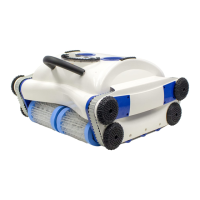
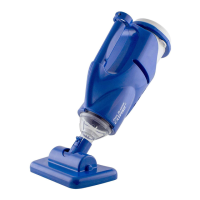
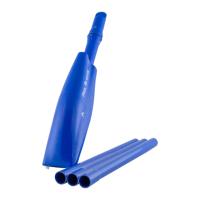
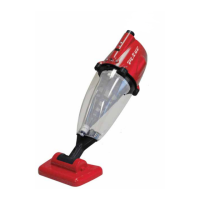
The Pool Blaster Pulse is a cordless, rechargeable pool and spa vacuum designed for efficient underwater cleaning. It is a handheld device that can also be attached to a telescopic pole (not included) for extended reach, making it suitable for cleaning various areas of a pool or spa, including walls and bottoms. The vacuum operates by generating suction to collect debris, which is then captured in a filter sock and sleeve system.
Function Description
The primary function of the Pool Blaster Pulse is to provide a convenient and effective way to clean pools and spas without the need for hoses or external power cords during operation. It is designed for underwater use only and should not be operated outside of water for more than 15 seconds to prevent damage to the shaft seals and motor, which would void the warranty. The vacuum is powered by a rechargeable Nickel Metal Hydride battery, offering cordless freedom during cleaning.
The device features a suction nozzle flap that acts as a door to prevent collected debris from escaping the filter. Debris is drawn into the vacuum and trapped by a filter sock and filter sleeve, ensuring that the cleaned water is returned to the pool. The vacuum head is equipped with brushes and wheels, which are recommended to be kept intact for the most efficient cleaning and to prevent damage to the pool surface. The motor is started and stopped using an On/Off button.
Usage Features
The Pool Blaster Pulse offers flexible setup options for charging. It can be charged either free-standing on a dry, clean, and flat surface or wall-mounted using screws (not included) to secure the charging base. The cleaner is aligned with the charging base's hooks and tabs to ensure a secure connection for charging. Charging must be done indoors in a well-ventilated area, away from sunlight, children, heat, and ignition sources. Only the original external adaptor provided should be used, and power extension cords are not recommended. The initial charge time is 4 hours, and subsequent re-charges also take 4 hours. An indicator light on the external adaptor changes from red to green when charging is complete. It is advised to wait 10 to 15 minutes after charging before using the cleaner.
For operation, the handle can be attached to the cleaner in two different directions, allowing users to select the most comfortable position for cleaning. The handle is secured by a side pin that locks into a handle locking hole on the cleaner. To release the handle, the side pin is pressed down. For extended reach, a telescopic pole (not included) can be attached to the pole connector, with its side pins aligning with the handle locking hole. The vacuum head adapter is inserted directly into the suction hole of the cleaner.
Before operation, it is crucial to ensure the cleaner is fully immersed in the water immediately after powering it on. The maximum operating depth is 3 meters (10 ft), and the maximum water temperature should be between 5°C (41°F) and 35°C (95°F). The cleaner should not be operated when people or pets are in the water. It is also important to ensure the filter sock and sleeve are intact and in place, as operating without them will void the warranty. Users should be aware of the suction entrapment hazard and avoid contact between hair, body parts, clothing, or other objects and the suction hole or moving parts of the cleaner. The device should not be used to pick up toxic, flammable, or combustible liquids, nor should it be operated in the presence of explosive or flammable fumes.
Maintenance Features
Regular maintenance of the Pool Blaster Pulse is essential for maximizing cleaning efficiency and prolonging its lifespan. The filter should be cleaned before and after every use. To empty the filter, the cleaner is placed on a stable surface, the filter sleeve locking tab is pressed down, and the sleeve is rotated until its tabs are released from the filter cone base. The filter sleeve is then detached, and debris is cleaned out. The filter sock, which has an elastic band and a small loop, is lifted from the filter cone base and rinsed with clean water only; it should not be washed in a washing machine or with detergent. After cleaning, the filter sock and sleeve are reassembled, ensuring the elastic band is not twisted and the sleeve's indentation is secured by the locking tab. Damaged filter socks should be replaced immediately.
For storage, the external adaptor should be unplugged from both the power source and the charging base. The cleaner and all accessories should be rinsed with fresh water (without detergent), cleaned and dried with a dry damp cloth, and stored indoors in a well-ventilated area. This storage location should be away from sunlight, children, heat, ignition sources, and pool chemicals. The recommended ambient temperature for storage is 10°C – 40°C (50°F – 104°F). If the cleaner is not used for an extended period, it should be detached from the charging base.
Battery maintenance is crucial for battery life. The battery should be recharged within 24 to 48 hours after use and at least every three months when not in use. Incorrect battery maintenance can reduce battery life and influence its function. The Nickel Metal Hydride battery must be properly disposed of according to State and local laws. Users are warned against disassembling the cleaner or attempting to replace the impeller, motor, or battery themselves, as this can result in severe injury and void the warranty. If the battery appears damaged, does not charge fully, or its operation time is noticeably reduced, the dealer should be consulted for a new replacement battery or service.
In case of a battery leak, contact with the leaking acid should be avoided, and the damaged battery should be placed in a plastic bag. If acid contacts skin or clothing, it should be washed immediately with plenty of soap and water. If acid contacts eyes, they should be flooded with running cool water for at least 15 minutes, and medical attention sought immediately. The manual provides detailed instructions for safely removing the battery using specific tools, emphasizing precautions to avoid short circuits during the process.


 To Next Page
 General