9
Getting Started
BRUSH
AND MOP
Look for a basting brush with heat-
resistant silicone bristles and a long
handle, and a mop with long, cotton
threads that sop up the thinner,
vinegar-based sauces.
M
U
S
T
-
H
A
V
E
G
R
I
L
L
I
N
G
T
O
O
L
S
•
M
U
S
T
-
H
A
V
E
G
R
I
L
L
I
N
G
T
O
O
L
S
•
M
U
S
T
-
H
A
V
E
G
R
I
L
L
I
N
G
T
O
O
L
S
•
M
U
S
T
-
H
A
V
E
G
R
I
L
L
I
N
G
T
O
O
L
S
•
M
U
S
T
-
H
A
V
E
G
R
I
L
L
I
N
G
T
O
O
L
S
•
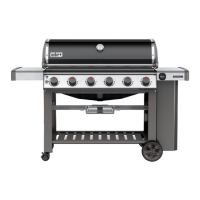
GENESIS II Burner Valve Orifice Sizes & Consumption Data
BURNER VALVE ORIFICE SIZES
Country Gas Category 2 Burner Models 3 Burner Models 4 Burner Models 6 Burner Models
China, Cyprus,
CzechRepublic, Denmark,
Estonia, Finland, HongKong,
Hungary, Iceland, India,
Israel, Japan, Korea,
Latvia, Lithuania, Malta,
Netherlands, Norway,
Romania, Russia, Singapore,
SlovakRepublic, Slovenia,
South Africa, Sweden,
Turkey
I
3B/P
(30 mbar or 2.8 kPa) Main Burners 1,02 mm Main Burners 1,00 mm Main Burners 1,00 mm Main Burners 0,90 mm
Belgium, France,
Greece, Ireland, Italy,
Luxembourg, Portugal,
Spain, Switzerland,
UnitedKingdom
I
3+
(28-30/37 mbar) Main Burners 0,94 mm Main Burners 0,94 mm Main Burners 0,92 mm Main Burners 0,84 mm
Poland I
3P
(37 mbar) Main Burners 0,94 mm Main Burners 0,94 mm Main Burners 0,92 mm Main Burners 0,84 mm
Austria, Germany I
3B/P
(50 mbar) Main Burners 0,86 mm Main Burners 0,86 mm Main Burners 0,84 mm Main Burners 0,78 mm
CONSUMPTION DATA
2 Burner Models 3 Burner Models 4 Burner Models 6 Burner Models
7,6 kW Propane
8,7 kW Butane
543 g/h Propane
633 g/h Butane
11,0 kW Propane
12,6 kW Butane
786 g/h Propane
917 g/h Butane
14,1 kW Propane
16,2 kW Butane
1008 g/h Propane
1179 g/h Butane
17,6 kW Propane
20,2 kW Butane
1258 g/h Propane
1470 g/h Butane
Important Information about
LPGas & GasConnections
What is LPG?
Liquefied petroleum gas, also called LPG or LP gas, is
the flammable, petroleum-based product used to fuel
your barbecue. It is a gas at moderate temperatures
and pressure when it is not contained. But at moderate
pressure inside a container, such as a cylinder, LPG is
a liquid. As pressure is released from the cylinder, the
liquid readily vaporises and becomes gas.
Safe Handling Tips for LPG Cylinders
• A dented or rusty LPG cylinder may be hazardous and
should be checked by your LP gas supplier. Donot use
a cylinder with a damaged valve.
• Although your LPG cylinder may appear to be empty,
gas may still be present, and the cylinder should be
transported and stored accordingly.
• The LPG cylinder must be installed, transported, and
stored in an upright, secure position. Cylinders should
not be dropped or handled roughly.
• Never store or transport the LPG cylinder where
temperatures can reach 50°C (125°F) (the cylinder will
become too hot to hold by hand).
LPG Cylinder Requirements
• Use cylinders with a minimum capacity of 3 kg and
amaximum capacity of 13 kg.
What is a Regulator?
Your gas barbecue is equipped with a pressure
regulator, which is a device to control and maintain
uniform gas pressure as gas is released from the
LPGcylinder.
Regulator and Hose Requirements
• In the United Kingdom, this barbecue must be fitted
with a regulator complying with BS 3016, having a
nominal output of 37 millibars.
• The length of the hose must not exceed 1.5 metres.
• Avoid kinking the hose.
• Replacement regulator and hose assemblies must be
as specified by Weber-Stephen Products LLC.
m IMPORTANT: We recommend that you replace
the gas hose assembly on your gas barbecue
every five years. Some countries may have
requirements that the gas hose be replaced
within less than five years, in which case that
country’s requirement would take precedence.
For replacement hose, regulator, and valve
assemblies, contact the Customer Service
Representative in your area using the contact
information on our web site.
Log on to weber.com.


 To Next Page
 Loading...