11
Getting StartedGetting Started
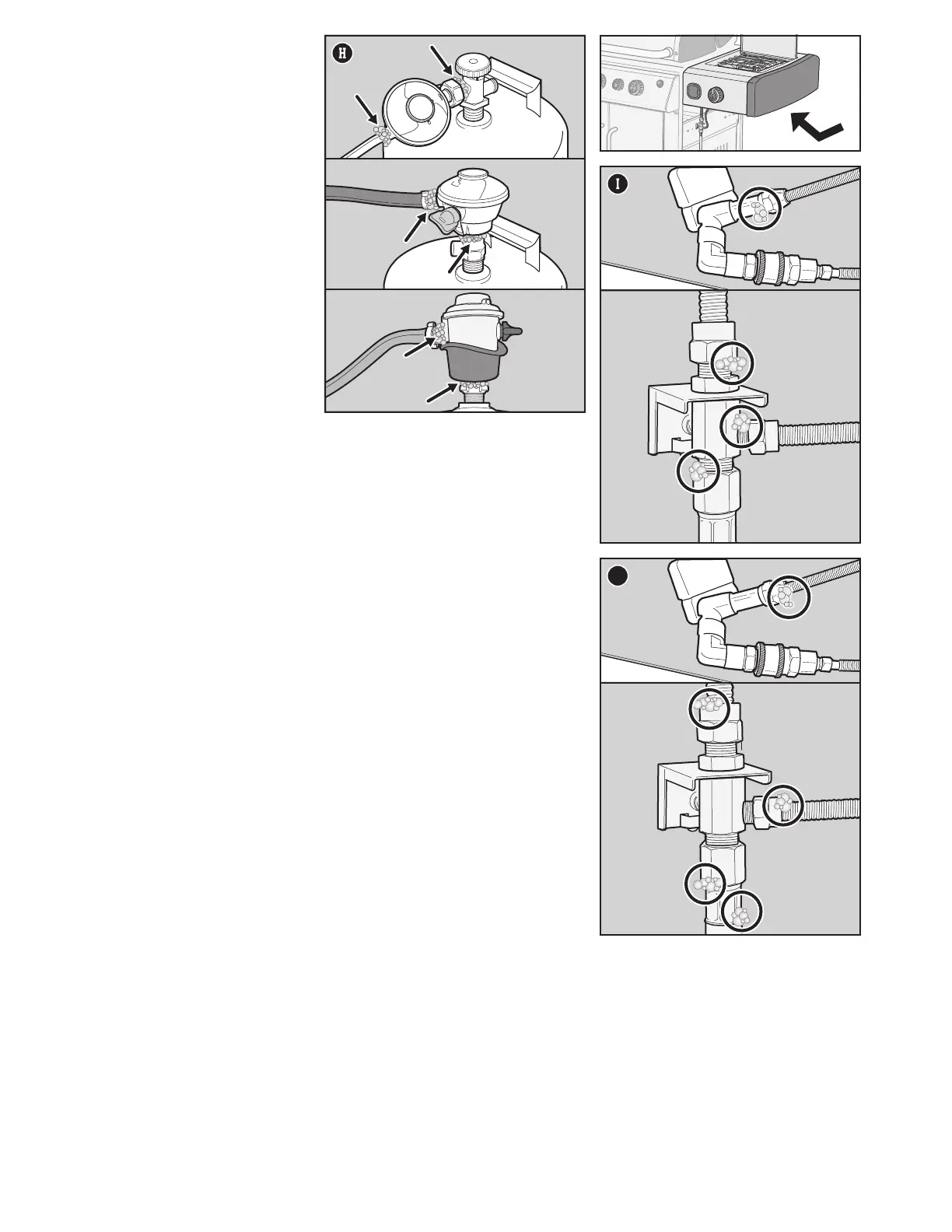
3) If bubbles appear there is a leak:
a) If the leak is at the regulator-to-cylinder
connection or the regulator hose-to-regulator
connection (H), turn gas supply o. DO NOT
OPERATE THE BARBECUE. Contact the Customer
Service Representative in your area using the
contact information on our website.
b) If the leak is at any fittings indicated in
illustration (I), re-tighten fitting with a wrench
and recheck for leaks with soap and water
solution. If leak persists, turn o the gas. DO NOT
OPERATE THE BARBECUE.
c) If the leak is at any fittings indicated in
illustration (J), turn o the gas. DO NOT OPERATE
THE BARBECUE.
If a leak is present, contact the Customer Service
Representative in your area using the contact
information on our website.
4) If bubbles do not appear, leak checking is complete:
a) Turn gas supply o and rinse connections
withwater.
NOTE: Since some leak test solutions, including soap and
water, may be slightly corrosive, all connections should
be rinsed with water after checking for leaks.
Additional Leak Check Precautions
The following fittings should be tested for gas leaks
each time a tank is refilled and reinstalled:
• At the regulator and where the regulator connects to
the cylinder (H).
Follow the instructions for "Checking for Gas Leaks".
Disconnect the Regulator from
theCylinder
1) Confirm that the LPG cylinder valve or regulator
lever are fully closed.
2) Disconnect the regulator.
J



 To Next Page