EasyManua.ls Logo

Weber Spirit E-325 GBS - User Manual

Weber Spirit E-325 GBS
28 pages
Print Icon
To Next Page IconTo Next Page
Loading...
Keep this Owners Manual for future reference, thoroughly read through it, and if you
have any questions please contact us today.
LPG Owners Manual
PHONE MOBILE EMAIL ONLINE
REGISTER today
76437
120220
en - English
E225 GBS • E325 GBS
Unlock barbecuing happiness: Register your gas barbecue and receive special content
to make you the ultimate backyard hero.
Registration is easy and we only ask a few quick questions. In less than two minutes,
activate your unique WEBER-ID, and unlock a lifetime of WEBER knowledge and
guidance. Stay inspired along the way.
Question and Answer IconNeed help?

Do you have a question about the Weber Spirit E-325 GBS and is the answer not in the manual?

Summary

Important Safety Information

Understanding Safety Statement Definitions

DANGER, WARNING, and CAUTION statements emphasize critical information for safety and preventing property damage.

Gas Leak and Operation Safety Precautions

Covers gas leak procedures, general operation safety, and storage precautions for safe use.

Getting Started: LP Gas and Installation

Connecting Regulator and Performing Leak Checks

Step-by-step instructions for connecting the regulator and performing essential gas leak checks.

Operation and Maintenance Procedures

Troubleshooting Common Barbecue Issues

Diagnosing Burner Ignition Failures

Resolving issues where main or side burners fail to ignite using matches or electronic ignition.

Addressing Gas Flow and Flame Pattern Problems

Troubleshooting low heat, uneven heating, erratic flames, or yellow/lazy flames due to gas flow or obstructions.

Summary

Important Safety Information

Understanding Safety Statement Definitions

DANGER, WARNING, and CAUTION statements emphasize critical information for safety and preventing property damage.

Gas Leak and Operation Safety Precautions

Covers gas leak procedures, general operation safety, and storage precautions for safe use.

Getting Started: LP Gas and Installation

Connecting Regulator and Performing Leak Checks

Step-by-step instructions for connecting the regulator and performing essential gas leak checks.

Operation and Maintenance Procedures

Troubleshooting Common Barbecue Issues

Diagnosing Burner Ignition Failures

Resolving issues where main or side burners fail to ignite using matches or electronic ignition.

Addressing Gas Flow and Flame Pattern Problems

Troubleshooting low heat, uneven heating, erratic flames, or yellow/lazy flames due to gas flow or obstructions.

Overview

This document is an owner's manual for the Weber Spirit E-225 GBS and E-325 GBS LPG gas barbecues. It provides comprehensive information on safety, installation, operation, maintenance, and troubleshooting, aiming to help users achieve a satisfying barbecuing experience.

Function Description

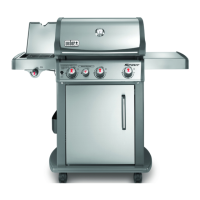
The Weber Spirit E-225 GBS and E-325 GBS are outdoor gas barbecues designed for cooking food using liquefied petroleum gas (LPG). They feature multiple burners for versatile cooking, including direct and indirect heat methods. The barbecues are equipped with a built-in thermometer to monitor internal temperature, side tables for food preparation and tool storage, and a barbecue cabinet for enclosed storage of accessories. A unique GOURMET BBQ SYSTEM (GBS) allows for the use of various inserts like griddles, poultry roasters, or pizza stones, expanding the cooking possibilities beyond traditional grilling. Some models also include a side burner for simmering sauces or boiling side dishes. The CROSSOVER Ignition System ensures reliable ignition of the main burners, while the side burner also has an electronic ignition.

Usage Features

The manual emphasizes safe and efficient operation. Users are instructed to always use the barbecue outdoors in a well-ventilated area, away from combustible materials and enclosed spaces. Before each use, an "Initial Burn-Off" is recommended, where the barbecue is heated on the highest setting for at least 20 minutes with the lid closed. This helps to burn off any manufacturing residues and prepare the cooking grates.

Preheating is highlighted as critical for successful barbecuing, preventing food from sticking and ensuring proper searing. The barbecue should be preheated with all burners on high for 10-15 minutes until the lid thermometer reaches 260°C (500°F).

The manual details two primary cooking methods:

  • Direct Heat: Used for small, tender pieces of food that cook in less than 20 minutes (e.g., hamburgers, steaks, chops, kabobs, boneless chicken pieces, fish fillets, shellfish, sliced vegetables). With direct heat, the fire is directly below the food, searing surfaces and developing flavors.
  • Indirect Heat: Used for larger cuts of meat that require 20 minutes or more of cooking time, or for delicate foods that would dry out or scorch over direct heat (e.g., roasts, bone-in poultry pieces, whole fish, whole chickens, turkeys, ribs). With indirect heat, the heat is on either side of the food or off to one side, with the food placed over the unlit part of the cooking grate.

Igniting the barbecue involves opening the lid, ensuring all burner control knobs are in the off position, turning on the gas supply, pushing in and turning the leftmost burner (burner 1) control knob to the start/high position, and then pushing and holding the electronic ignition button. The side burner ignition follows a similar process, with the side burner lid open.

The manual also provides "Tips and Hints" for optimal barbecuing, such as:

  • Preheat each and every time: Essential for preventing sticking and achieving proper searing.
  • Don't barbecue on dirty grates: Clean grates prevent food from sticking and avoid transferring old flavors.
  • Be present in the process: Have all necessary tools and ingredients within reach.
  • Create a little elbow room: Avoid overcrowding the cooking grates to allow for easy food manipulation.
  • Try not to peek: Keeping the lid closed maintains heat and smoke, leading to faster cooking and stronger smoky flavors.
  • Only flip once: Allows for deep searing and caramelization.
  • Know when to tame the flame: Use an instant-read thermometer to determine food doneness.
  • Don't be afraid to experiment: Encourages users to try cooking various appetizers, side dishes, and desserts.

Maintenance Features

Regular cleaning and maintenance are crucial for the barbecue's performance and longevity. The manual outlines a "Meal-to-Meal Maintenance" plan, which includes steps to be performed before each barbecuing session:

  • Check for Grease: The grease management system, consisting of a slide-out grease tray and a catch pan with a disposable drip tray, should be cleaned every time to prevent grease fires. Excess grease should be scraped from the tray, and the disposable drip pan replaced when necessary.
  • Inspect the Hose: The gas hose should be routinely checked for cracks, abrasions, or cuts. A damaged hose must be replaced immediately with a Weber-authorized part.

A thorough cleaning of the barbecue is recommended at least twice a year, with quarterly cleanings for consistent use.

  • Cleaning the Lid: Carbonized grease flakes that resemble peeling paint should be brushed off the inside of the lid with a stainless steel bristle barbecue brush. Wiping the lid with a paper towel while warm can minimize build-up.
  • Cleaning the Cooking Grates: After preheating, debris should be brushed off the grates with a stainless steel bristle barbecue brush.
  • Cleaning the FLAVORIZER BARS: These bars, which vaporize drippings for flavor and protect burners, should be scraped with a plastic scraper and brushed with a stainless steel bristle barbecue brush if needed.
  • Cleaning the Burners: The burner ports (small openings along the length of the burners) and the spider/insect screens on the ends of the burners are critical for safe operation. The burner ports should be cleaned with a stainless steel bristle brush, taking care not to damage the ignition electrode. The spider/insect screens should be cleaned with a soft bristle brush to prevent obstructions.
  • Cleaning the Outside: Stainless steel surfaces should be cleaned with a non-toxic, non-abrasive stainless steel cleaner and a microfibre cloth, cleaning in the direction of the grain. Painted, porcelain-enameled, and plastic components should be cleaned with warm soapy water and dried thoroughly. For barbecues in harsh environments (e.g., coastal areas, near pools), more frequent cleaning with warm soapy water and a stainless steel cleaner is recommended to prevent rust.

The manual also includes instructions for removing and reinstalling the side burner valve for cleaning the burner tube, emphasizing careful handling of the corrugated gas line.

Safety and Troubleshooting

The manual prominently features "DANGER," "WARNING," and "CAUTION" statements throughout to highlight critical safety information. Key safety warnings include:

  • Never use the barbecue indoors or in enclosed spaces.
  • Keep combustible materials at least 61 cm (24 inches) from the barbecue.
  • Do not store flammable liquids or vapours near the barbecue.
  • Never leave the barbecue unattended during use.
  • Accessible parts can be very hot; keep young children away.
  • Always turn off the gas supply at the cylinder after use.
  • LPG cylinders must be stored outdoors, out of reach of children, and not in enclosed spaces.

A crucial "Leak Check" procedure is detailed for verifying gas connections after cylinder installation or refill. This involves applying a soap and water solution to fittings and checking for bubbles, which indicate a leak. Users are warned never to use a flame to check for leaks and to contact emergency services if a gas leak is detected.

The troubleshooting section addresses common issues:

  • Main burner(s) or side burner will not ignite: This section guides users through determining if the problem is with gas flow or the electronic ignition system, including instructions for match lighting to test gas flow.
  • Gas flow issues (e.g., low temperature, uneven heat, burners failing to ignite, low flame on high, erratic flame pattern): Solutions include resetting the "flow limiting device" on the regulator, refilling the LPG cylinder, straightening the fuel hose, and cleaning burner ports.
  • Smell of gas and/or light hissing sound: This could indicate a damaged internal rubber seal in the LPG cylinder valve, requiring the cylinder to be returned to the retailer.
  • Greasy barbecue (peeling paint & flare-ups): Explains that "peeling paint" on the lid is carbonized cooking vapours and advises cleaning the lid. For flare-ups, it suggests cleaning leftover food and thoroughly cleaning the barbecue's interior.
  • Electronic ignition system issues (no ticking sound): Guides users to check the battery (for plastic wrap, correct installation, and age) and the ignition wires (for secure connections and proper attachment to the module).

The manual also provides a "Barbecuing Guide" with approximate cooking times and methods for various types of meat, poultry, seafood, and vegetables, emphasizing that these are guidelines and factors like altitude, wind, and temperature can affect cooking times. It encourages users to register their barbecue for special content and ongoing support.

Weber Spirit E-325 GBS Specifications

General IconGeneral
Main Burners3
Side Tables2
Grate MaterialPorcelain-enameled cast iron
Side BurnerNo
GBS Cooking GratesYes
Total Cooking Area529 sq. in.
Fuel TypeLiquid Propane
Cooking Area529 square inches
BTU Output32, 000 BTUs
IgnitionElectronic ignition
Warranty10 years

Related product manuals