EasyManua.ls Logo

White Rodgers 1C20 - User Manual

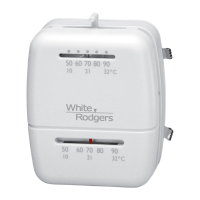
White Rodgers 1C20
4 pages
Print Icon
To Next Page IconTo Next Page
Loading...
SUBBASE
(MODEL 300
ONLY)
BASE
COVER
ANTICIPATOR
CAPTIVE SCREWS
MOUNTING SCREWS
Figure 1.
Installation Instructions for
Heating only
1C20
and
Heating & Cooling
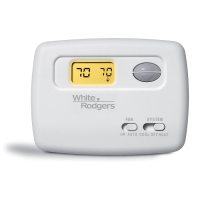
1C26
WHITE-RODGERS
CONTENTS
Preparations........................................... 1
Thermostat Features.............................. 2
Removing Old Thermostat ..................... 3
Mounting and Wiring .............................. 4
Set Heat Anticipator ............................... 5
New Thermostat Operation .................... 6
Specifications ......................................... 7
Troubleshooting ..................................... 8
PREPARATIONS
THERMOSTAT FEATURES
REMOVING OLD THERMOSTAT
Before removing wires from old thermostat’s switching subbase,
label each wire with the terminal designation it was removed from.
Some models also include an adaptor plate to cover unpainted
surfaces. Thermostat wires pass through the adaptor plate center
opening.
1. Remove Old Thermostat: A standard heat/cool thermostat
consists of three basic parts:
a. The cover, which may be either a snap-on or hinge type.
b. The base, which is removed by loosening all captive screws.
c. The switching subbase, which is removed by unscrewing
the mounting screws that hold it on the wall or adaptor plate.
Make a note here of the anticipator setting on
the old thermostat for future reference and use in step 5.
The heat anticipator pointer, if adjustable, will be set at one of a
series of numbers representing the current rating of the primary
control in your furnace. The number will be one of the following:
.2, .4, .8, etc. or 0.2, 0.4, 0.8, etc.
If no heat anticipator/indication is showing, do not be concerned;
move on to the next step.
Printed in U.S.A.
PART NO. 37-6335A
0142
WHITE-RODGERS
EMERSON ELECTRIC CO.
9797 REAVIS ROAD
ST. LOUIS, MISSOURI 63123-5398
www.white-rodgers.com
Failure to follow and read all instructions carefully be-
fore installing or operating this control could cause
personal injury and/or property damage
Assemble tools required as shown below.
YOUR THERMOSTAT REPLACES
Adaptor Plate
(optional)
Description
1C20 1C26
Standard Heating & Cooling Systems - 4 or 5 wires No Yes
Standard Heat Only Systems Yes Yes
Millivolt Heat Only Systems - Floor or Wall Furnaces Yes Yes
Standard Central Air Conditioning No Yes
Gas or Oil Heat Yes Yes
Electric Furnace Yes Yes
Hydronic (Hot Water) Zone Heat - 2 Wires Yes Yes
Hydronic (Hot Water) Zone Heat - 3 Wires No No
Heat Pump (No Aux or Emergency Heat) No Yes
Heat Pump (with Aux or Emergency Heat) No No
Baseboard Electric Heating or Line Voltage (120 or 240 Volt) No No
1
2
3
WIRE CUTTER/STRIPPER
SPIRIT LEVEL OR PLUMB BOB AND LINE OPTIONAL—
THERMOSTAT MUST BE LEVEL TO WORK PROPERLY
FLAT BLADE SCREWDRIVER
HAND OR POWER
DRILL WITH 3/16 INCH
DRILL BIT, IF NEEDED
To prevent electrical shock and/or equipment damage,
disconnect electrical power to the system at the main
fuse or circuit breaker until installation is complete.
CAUTION
!
Question and Answer IconNeed help?

Do you have a question about the White Rodgers 1C20 and is the answer not in the manual?

Summary

Preparations

Removing Old Thermostat

Remove Old Thermostat

Instructions for removing the old thermostat's cover, base, and subbase.

Mounting and Wiring

1 C20 Heat Only Wiring

Instructions for mounting and wiring the 1C20 heat-only thermostat.

1 C26 Heating and Cooling Wiring

Instructions for mounting and wiring the 1C26 heating and cooling thermostat.

Mount Thermostat Base

Instructions for mounting the thermostat base to the sub-base.

Set Heat Anticipator

Adjusting the Anticipator

How to adjust the heat anticipator pointer for optimal heating cycles.

Troubleshooting

No Heat;No Cool;No Fan

Common issues and corrective actions for no heating, cooling, or fan operation.

Summary

Preparations

Removing Old Thermostat

Remove Old Thermostat

Instructions for removing the old thermostat's cover, base, and subbase.

Mounting and Wiring

1 C20 Heat Only Wiring

Instructions for mounting and wiring the 1C20 heat-only thermostat.

1 C26 Heating and Cooling Wiring

Instructions for mounting and wiring the 1C26 heating and cooling thermostat.

Mount Thermostat Base

Instructions for mounting the thermostat base to the sub-base.

Set Heat Anticipator

Adjusting the Anticipator

How to adjust the heat anticipator pointer for optimal heating cycles.

Troubleshooting

No Heat;No Cool;No Fan

Common issues and corrective actions for no heating, cooling, or fan operation.

Overview

This document describes the installation and operation of White-Rodgers 1C20 (Heating only) and 1C26 (Heating & Cooling) thermostats. These thermostats are designed to replace various standard heating and cooling systems, including those with 4 or 5 wires, heat-only systems, millivolt floor or wall furnaces, standard central air conditioning, gas or oil heat, electric furnaces, and hydronic (hot water) zone heat systems. They are not suitable for heat pump systems with auxiliary or emergency heat, or for baseboard electric heating or line voltage (120 or 240 Volt) systems.

Function Description

The White-Rodgers 1C20 and 1C26 thermostats serve as control units for residential heating and/or cooling systems. The 1C20 model is designed exclusively for heating applications, while the 1C26 model handles both heating and cooling. They regulate room temperature by switching the heating or cooling equipment on and off based on user-defined settings. The 1C26 model also includes a fan control feature, allowing users to set the fan to run automatically with the system or continuously.

Usage Features

Installation:

Before installation, it is crucial to disconnect electrical power to the system at the main fuse or circuit breaker to prevent electrical shock and equipment damage. The installation process involves several steps:

  1. Preparation: Gather necessary tools such as a hand or power drill with a 3/16 inch drill bit, a flat blade screwdriver, wire cutters/strippers, and optionally a spirit level or plumb bob and line to ensure the thermostat is level for proper operation.
  2. Removing Old Thermostat: The old thermostat typically consists of a cover, a base, and a switching subbase. Users should carefully remove these parts. Before disconnecting wires, each wire should be labeled with its terminal designation from the old thermostat's switching subbase. It is also important to note the heat anticipator setting from the old thermostat for future reference. If the old thermostat contains mercury, specific disposal instructions are provided to ensure environmental safety.
  3. Mounting and Wiring:
    • 1C20 (Heat Only Two Wire): The base and an optional adaptor plate are mounted to the wall. One wire is attached to the 'R' terminal and the other to the 'W' terminal on the base.
    • 1C26 (Heating and Cooling): The base is removed from the subbase. The switching subbase and optional adaptor plate are mounted to the wall. Wires are then attached to the appropriate terminals based on the system type. A terminal cross-reference chart is provided to guide connections for various manufacturers' terminal designations.
      • For two-wire systems (Heat Only or Cool Only), specific connections are detailed.
      • For systems with more than two wires, the cross-reference chart is used, and factory-installed jumpers may need to be removed or retained.
      • For electric heat or single-stage heat pump systems, a specific wiring modification is required to allow the thermostat to energize the fan on a call for heat. This involves moving a yellow factory-installed jumper wire from the 'Y' terminal to the 'A' terminal. For single-stage heat pump applications without auxiliary heat, a short jumper wire (not included) is installed across 'W' and 'Y' terminals. Reversing valve connections are also specified for cooling or heating energized systems.
    • After wiring, excess wire should be pushed back into the wall opening, and the hole should be plugged with fire-resistant material to prevent drafts. The thermostat base is then mounted to the subbase using captive screws.
  4. Setting Heat Anticipator: The heat anticipator, adjustable from 0.15 to 1.2 amps, must be set to match the current rating of the main heating control or the setting noted from the old thermostat. This adjustment is made by rotating a contact arm. Moving the pointer counterclockwise lengthens heating system cycles, while moving it clockwise shortens them. Adjustments should not exceed 1/2 marking at a time. This feature helps optimize the heating cycle rate.
  5. Snap on Cover: The cover is carefully aligned and snapped onto the base.

Operation:

  • 1C20 (Heat Only): Once power is on, users slide the temperature lever to the desired setting. To turn off heat, the lever is slid all the way to the left until it clicks.
  • 1C26 (Heating & Cooling): This model offers more control with system and fan switches.
    • System Switch: Users select between 'COOL', 'OFF', or 'HEAT'.
    • Fan Switch: Users select between 'AUTO' or 'ON'. In 'AUTO' mode, the fan cycles with the heating or cooling system. In 'ON' mode, the fan runs continuously, regardless of the system switch position. A detailed table illustrates the various combinations of switch positions and their corresponding operations (e.g., no heating/cooling/fan, fan runs continuously, cooling cycles with continuous fan, heating cycles with fan control from furnace).

Maintenance Features

The manual includes a comprehensive troubleshooting section to help users diagnose and resolve common issues. This section lists various symptoms, possible causes, and corrective actions:

  • No Heat/No Cool/No Fan: Possible causes include blown fuses, tripped circuit breakers, furnace power switch off, loose blower compartment door, pilot light not lit, broken anticipator wire, loose connections, or a system switch not set correctly. Corrective actions range from replacing fuses and turning switches on to relighting pilot lights and verifying connections.
  • Intermittent Heat: Often caused by a furnace lock-out condition, requiring assistance from a service person.
  • Heat, Cool or Fan Runs Constantly: Possible causes include short circuits in wiring, the thermostat, or the heat/cool/fan system. Corrective action involves checking wire connections for neatness and proper looping.
  • Furnace Cycles Too Fast or Too Slow: This relates to the heating cycle rate and is primarily influenced by the heat anticipator setting. Adjustments to the anticipator are the main corrective action.
  • Cooling Cycles Too Fast or Too Slow: Unlike heating, the cooling cycle rate cannot be adjusted by the user. Factors like thermostat location, system size, and current draw influence this.
  • Thermostat Setting and Thermostat Thermometer Disagree: This indicates a need for adjustment or calibration. The thermometer pointer screw inside the front cover can be adjusted with a slotted screwdriver to match other room thermometers. For calibrating the setting lever, a service person should be contacted.

The manual emphasizes safety warnings throughout, particularly regarding electrical shock and property damage if instructions are not followed. It also highlights the importance of proper disposal for old thermostats containing mercury.

White Rodgers 1C20 Specifications

General IconGeneral
TypeMechanical
Temperature Range50°F to 90°F (10°C to 32°C)
DisplayAnalog
Voltage24 VAC
Stages1
MountingWall
CompatibilitySingle-stage heating and cooling systems
Accuracy±2°F

Related product manuals