The XHDATA D-808 is a versatile digital signal processing (DSP) receiver designed for a wide range of radio enthusiasts, offering reception across FM Stereo, Longwave (LW), Mediumwave (MW), Shortwave (SW) with Single Sideband (SSB), and Air Band (AIR) frequencies, along with Radio Data System (RDS) functionality. This portable radio is engineered to provide a comprehensive listening experience, from local FM broadcasts to distant shortwave transmissions and aviation communications.
Function Description
The core function of the XHDATA D-808 is to receive and process radio signals across multiple bands. It utilizes DSP technology to enhance signal clarity and reduce interference, providing a more stable and enjoyable listening experience.
- FM Stereo Reception: The radio can receive FM broadcasts, with the added benefit of FM Stereo when listening through headphones. It supports various FM tuning ranges (64.0 MHz, 76.0 MHz, 87.5 MHz) to accommodate different regional standards. The RDS feature allows the display of station information such as program service name (PS), date and time (DATE), program type (PTY), and radio text (RT), enriching the FM listening experience.
- Longwave (LW) and Mediumwave (MW) Reception: The D-808 is capable of receiving LW and MW broadcasts. The LW band, though not enabled by default, can be activated through a simple setup process. For MW, the tuning step can be adjusted between 9 kHz and 10 kHz, catering to different broadcasting standards around the world.
- Shortwave (SW) Reception with Single Sideband (SSB): A significant feature for DXers and shortwave listeners, the radio covers 14 international shortwave broadcast bands. The inclusion of SSB reception allows for tuning into amateur radio and commercial radio services that use this transmission method. The fine-tuning knob is crucial for precise SSB reception, which often requires careful adjustment for optimal audio.
- Air Band (AIR) Reception: The D-808 can receive aviation transmissions, making it suitable for monitoring airport communications. This band includes a "squelch" feature, which mutes the radio until a signal stronger than a set threshold is received, eliminating background noise during periods of inactivity.
- Memory System: The radio boasts a robust memory system with 500 memory locations, divided into 100 for each band and organized into 10 pages with 10 locations per page. Each memory location stores the station frequency, along with band-specific settings like FM stereo and bandwidth.
- Auto Tune Storage (ATS): This function allows the radio to automatically scan and store strong stations into memory for each band, simplifying the process of finding and saving active frequencies.
- Clock and Alarm Functions: The radio includes a 24-hour clock, which can be set manually or automatically from FM RDS broadcasts. It also features an alarm function with options to wake to radio or a tone.
- Display and Illumination: The display provides essential information such as frequency, signal strength, noise level, battery charge, sleep timer status, alarm status, and temperature. The display light can be set to illuminate temporarily or indefinitely.
Usage Features
The XHDATA D-808 is designed for intuitive operation, with a combination of physical buttons and a multi-function tuning knob.
- Power On/Off and Sleep Timer: The orange power button turns the radio on. A brief press while on activates the sleep timer, allowing users to select a duration (120 to 15 minutes) after which the radio will automatically power off.
- Band Selection: Dedicated buttons for FM, LW/MW, SW, and AIR allow for quick switching between frequency bands.
- Tuning: Stations can be tuned directly by entering the frequency using the number pad after pressing the FREQ button. Alternatively, the main tuning knob allows for continuous tuning. The tuning knob has three modes: fast, slow, and stop, which can be toggled by pressing the knob. Up and down arrow keys also facilitate frequency navigation and scanning for strong stations.
- Volume Control: A dedicated volume knob on the side of the radio allows for easy adjustment of audio output.
- Display Mode: The DISPLAY button cycles through various information displays, including signal strength/signal-to-noise ratio, time, temperature, and alarm time.
- Bandwidth Selection: For LW, MW, and SW bands, the AM BW button allows users to select different bandwidths (e.g., 6, 4, 3, 2.5, 2, 1.8, 1 kHz) to optimize reception and reduce interference. In SSB mode, specific bandwidths (4, 2, 2.2, 1.2, 1, 0.5 kHz) are available.
- SSB Operation: To receive SSB, tune to the desired station, then press the SSB button. The INFO button can be used to switch between Upper Sideband (USB) and Lower Sideband (LSB). The fine-tuning knob on the side is essential for clear SSB reception.
- Squelch (AIR Band): In AIR band, long-pressing the tuning knob activates the squelch feature. Immediately rotating the knob allows setting the squelch level from 1 to 9 or turning it off, useful for eliminating static during quiet periods.
- Key Lock: The INFO button can be long-pressed to lock or unlock the radio's keys, preventing accidental operation, especially when the radio is being handled or transported.
- Antenna Options: The radio features an internal ferrite bar antenna for LW/MW, a 25.5" telescopic whip antenna for SW/FM/AIR, and a 3.5mm jack for connecting an external antenna for SW, FM, and AIR, offering flexibility for optimizing reception. For best reception, the radio's orientation can be adjusted, especially for the directional ferrite bar antenna.
Maintenance Features
The XHDATA D-808 incorporates several features related to its power source and general upkeep.
- Battery and Charging: The radio is powered by an 18650 battery (included) and can be charged via a USB-C cable (included) plugged into the USB charging port. The battery icon on the display indicates charging status.
- Battery Replacement: The battery is accessible via a battery door on the rear of the radio. When replacing the battery, care should be taken to align the polarity correctly. Changing the battery within one minute helps retain time and other settings.
- Reset Function: In case the radio becomes inoperable, a small reset button access hole is provided. Inserting a small object like a toothpick or paperclip into this hole and pressing until a click is felt can reset the radio.
- Cleaning: The radio should be cleaned with a dry cloth, avoiding detergents or chemical solvents to prevent damage.
- Environmental Considerations: Users are advised not to expose the radio to water, moisture, or excessive humidity, and to keep it out of freezing temperatures. The operating temperature range is specified as 0°C to 40°C (32°F to 104°F).
- Unit Integrity: Users are cautioned against attempting to open the unit, as this may cause damage.

 Need help?
 General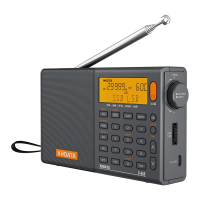

 To Next Page
