1-7
E
RULES WHEN ENCOUNTERING
VESSELS
There are three main situations which
you may encounter with other vessels
which could lead to a collision unless
the Steering Rules are followed:
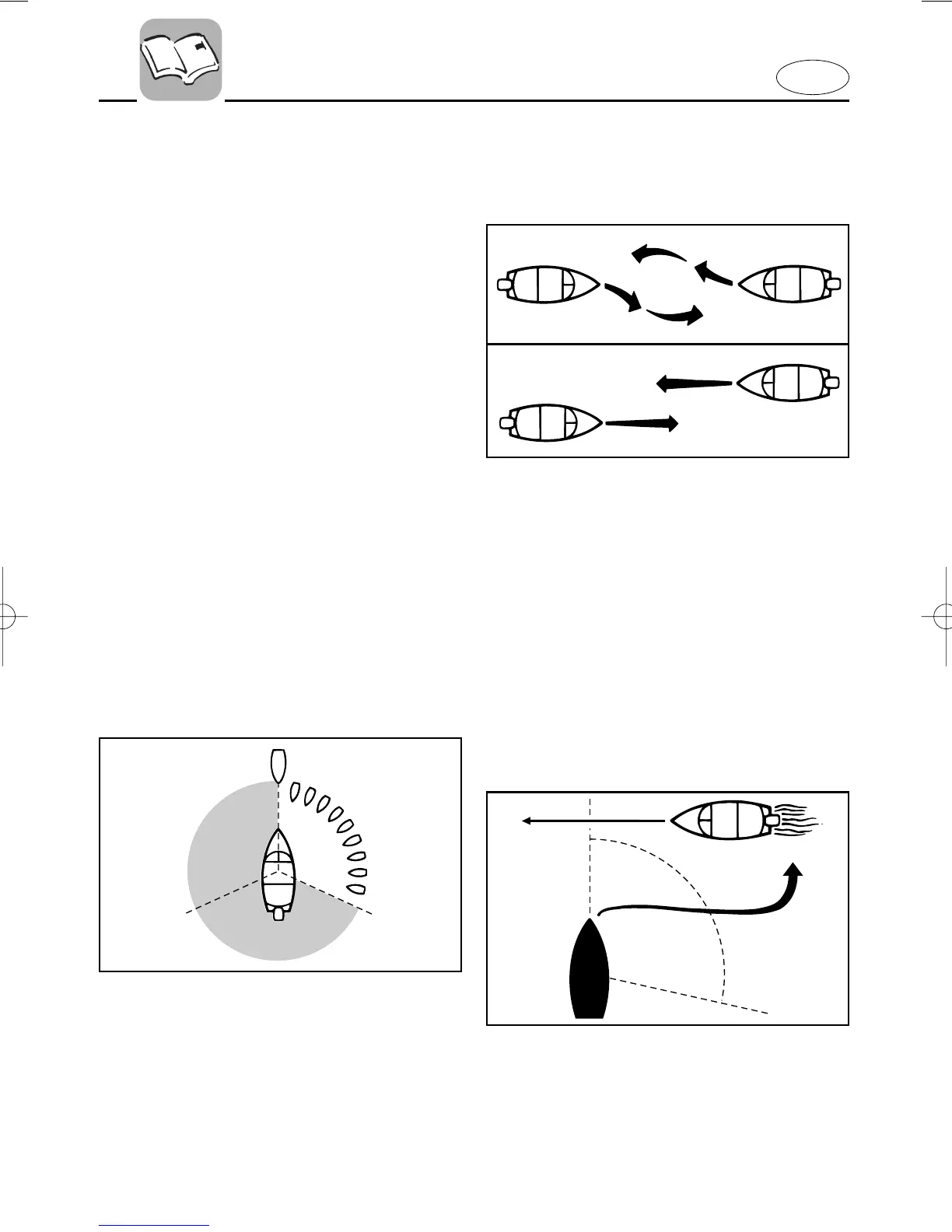
Meeting
(you are approaching another vessel
head-on)
Crossing
(you are travelling across the other
vessel’s path)
Overtaking
(you are passing or being passed by
another vessel)
In the following illustration, your boat is
in the center. You should give the right-
of-way to any vessels shown in white
area (you are the Give-Way vessel). Any
vessels in the shaded area must yield to
you (they are the Give-Way vessels).
Both you and the meeting vessel must
alter course to avoid each other.
Meeting
If you are meeting another power vessel
head on, and are close enough to run
the risk of collision, neither of you has
the right-of-way! Both of you should
alter course to avoid an accident. You
should keep the other vessel on your
port (left) side. This rule doesn’t apply if
both of you will clear one another if you
continue on your set course and speed.
Crossing
When two power driven vessels are
crossing each other’s path close enough
to run the risk of collision, the vessel
which has the other on the starboard
(right) side must keep out of the way of
the other. If the other vessel is on your
right, you must keep out of its way; you
are the Give-Way vessel. If the other
vessel is on your port (left) side, remem-
ber that you should maintain course and
direction, provided the other vessel
gives you the right-of-way as it should.
Overtaking
If you are passing another vessel, you
are the “Give-Way” vessel. This means
that the other vessel is expected to
102044
6A1-9-1L 1 4/20/01 12:01 PM Page 12



 To Next Page