EasyManua.ls Logo

Yamaha CS-80 - Page 29

Yamaha CS-80
56 pages
Print Icon
To Next Page IconTo Next Page
To Previous Page IconTo Previous Page
Loading...
h
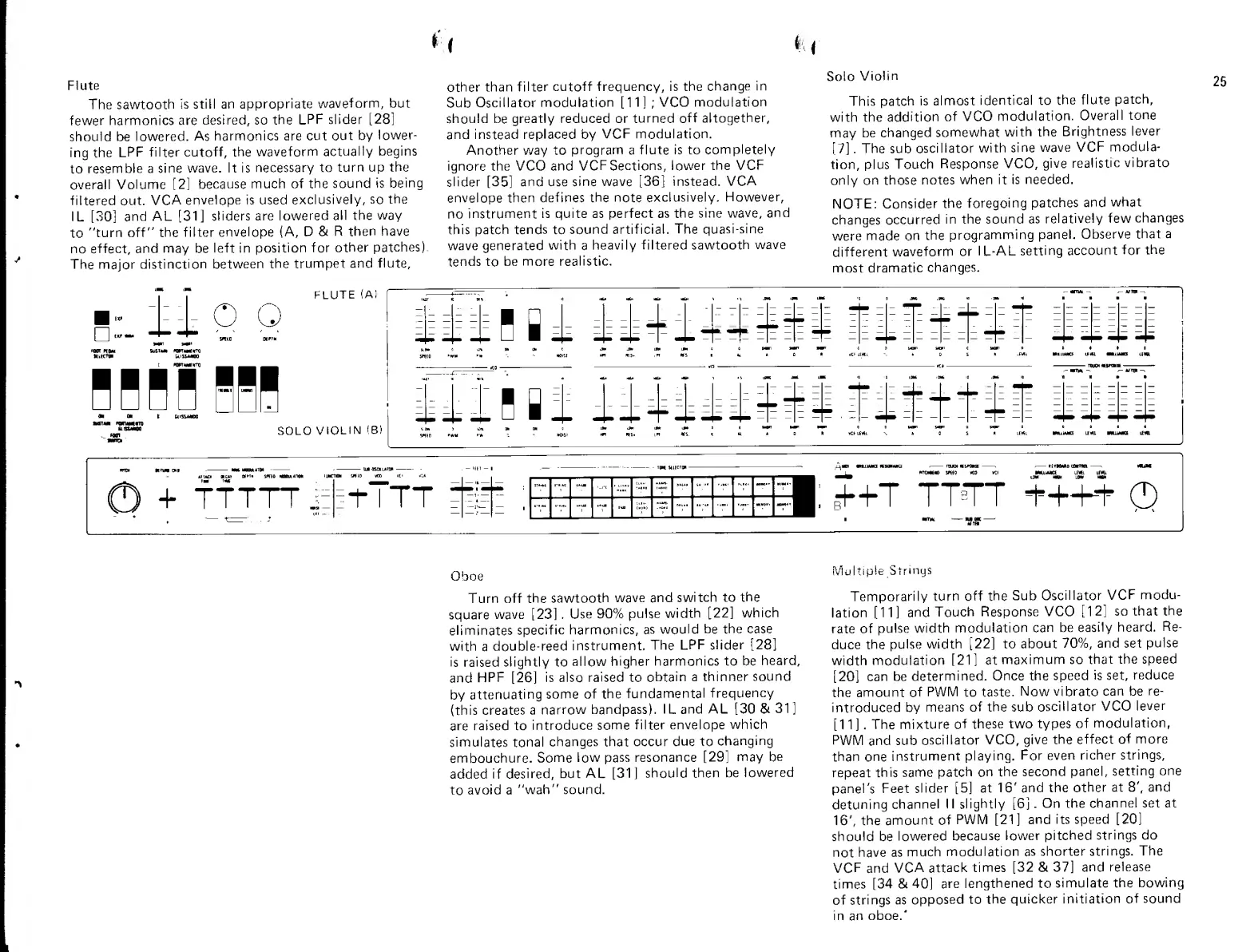
Flute
The
sawtooth
is still an
appropriate
waveform,
but
fewer
harmonics are
desired, so
the
LPF
slider
[28]
should be
lowered.
As
harmonics are
cut
out by
lower-
ing the
LPF filter cutoff,
the
waveform
actually
begins
to
resemble
a sine
wave. It is
necessary
to
turn
up the
overall
Volume
[2]
because
much of
the
sound is
being
filtered out.
VGA
envelope is used
exclusively,
so
the
IL
[30]
andAL[31]
sliders are
lowered
all
the
way
to
"turn off"
the
filter
envelope
(A, D
&
R then have
no
effect,
and may be
left
in
position
for
other patches).
The major
distinction
between the
trumpet
and
flute.
other
than
filter
cutoff frequency, is the
change
in
Sub
Oscillator
modulation
[11]
;
VCO
modulation
should be
greatly reduced or
turned
off
altogether,
and
instead replaced by
VCF
modulation.
Another way to
program
a
flute is to
completely
ignore the VCO and
VCF
Sections,
lower
the VCF
slider
[35]
and use
sine wave
[36]
instead.
VCA
envelope then
defines
the note
exclusively.
However,
no
instrument
is quite as
perfect
as
the
sine
wave,
and
this
patch tends
to
sound artificial.
The
quasi-sine
wave generated
with
a
heavily filtered
sawtooth
wave
tends to
be
more
realistic.
Solo
Violin
This
patch
is almost
identical to
the flute
patch,
with the
addition
of
VCO
modulation.
Overall
tone
may
be
changed
somewhat
with the
Brightness
lever
[7]
. The sub
oscillator
with
sine
wave
VCF
modula-
tion, plus
Touch
Response
VCO,
give
realistic
vibrato
only
on those
notes
when
it
is needed.
NOTE:
Consider
the
foregoing
patches
and
what
changes
occurred
in the
sound as
relatively
few
changes
were
made
on
the
programming
panel.
Observe
that
a
different
waveform
or
IL-AL
setting
account
for
the
most
dramatic
changes.
25
n-«
FLUTE
(A;
IT f(^
suiT«* rarwfVTC
Q Q
HHBBHBI
laHiiii-^illllffi
nLLiMO
It Id
SOLO
VIOLIN
(B)
liiiilii^iMIII
LiVtL MUIAKE LiWi MliJMia t£W.
mw
HnH VI
MrtiauAtiw
KMSLiiw
fn i M
momm
JHJO »co
vc( NUiMa
ina mu
ifj\
1
-p-^-T-^p-p
—-.^
TT
----
=
'"
"^
-
-
-
""'
'"
"*"
'""'
J.-LX "TT-T" r -h-L-L-^
fT\
U
-h
TTTT
T
-i-^
T TT
3z;--_
.
.,.
„,
...
..
;,,
.^i.. ...
.,^....^.,J.
^t
\ \
\
-\
Ttx
T
\y
I
-*
TJff
Oboe
Turn off
the
sawtooth
wave
and
switch
to
the
square
wave
[23]
.
Use
90%
pulse
width
[22]
which
eliminates
specific
harmonics,
as
would
be
the case
with
a
double-reed
instrument.
The
LPF
slider
[28]
is raised
slightly
to
allow
higher harmonics to be
heard,
and
HPF
[26]
is also raised to
obtain
a
thinner
sound
by
attenuating
some of
the
fundamental
frequency
(this
creates
a
narrow
bandpass).
I
L
and AL
[30
&
31
]
are
raised to
introduce
some
filter
envelope
which
simulates tonal
changes that
occur
due
to
changing
embouchure.
Some
low pass
resonance
[29]
may
be
added if
desired,
but
AL
[31
]
should
then
be
lowered
to
avoid a
"wah" sound.
Multiple
Strings
Temporarily
turn off
the
Sub
Oscillator
VCF
modu-
lation
[11]
and
Touch
Response VCO
[12]
so that
the
rate of
pulse
width
modulation can
be
easily
heard.
Re-
duce
the
pulse
width
[22]
to
about
70%,
and set
pulse
width
modulation [21
]
at
maximum so
that
the speed
[20]
can
be
determined.
Once
the
speed is set,
reduce
the
amount of
PWM
to
taste.
Now vibrato
can be
re-
introduced by
means of the sub
oscillator
VCO
lever
[11],
The mixture
of these
two types
of
modulation,
PWM
and sub
oscillator
VCO,
give
the
effect
of
more
than
one
instrument
playing.
For even
richer strings,
repeat
this
same
patch
on the
second
panel,
setting
one
panel's
Feet
slider
[5]
at
16'
and the
other
at
8',
and
detuning
channel
II slightly
[6j
.
On the
channel set at
16',
the
amount of
PWM
[21]
and
its speed
[20]
should be
lowered
because
lower
pitched
strings do
not
have as
much
modulation
as
shorter
strings. The
VCF
and
VCA
attack
times
[32
&
37]
and
release
times
[34
&
40]
are
lengthened
to
simulate
the
bowing
of
strings as
opposed
to
the
quicker
initiation
of
sound
in
an
oboe.'