EasyManua.ls Logo

Yamaha CS-80 - Page 31

Yamaha CS-80
56 pages
Print Icon
To Next Page IconTo Next Page
To Previous Page IconTo Previous Page
Loading...
(
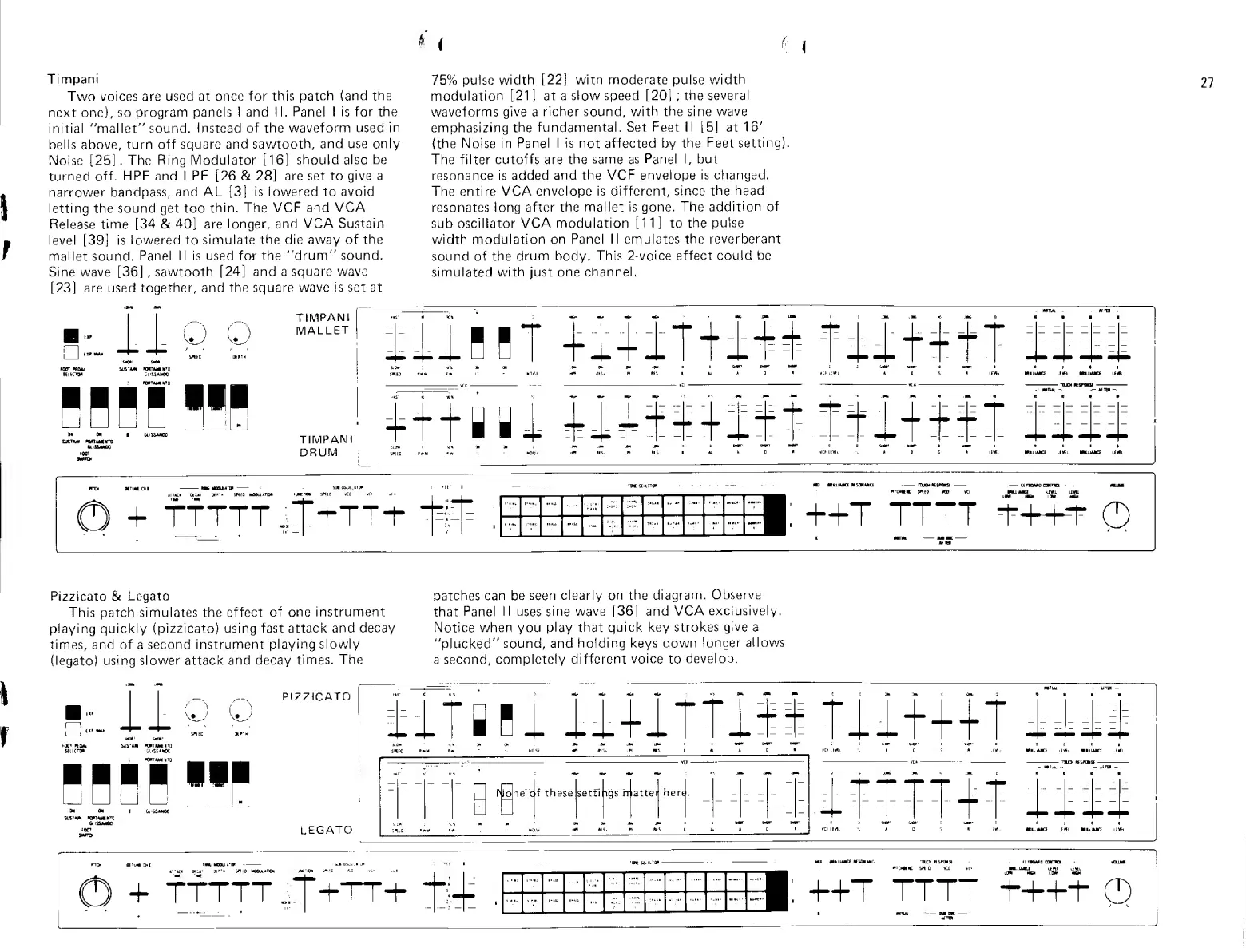
Timpani
Two voices
are used
at
once for
this patch
(and the
next
one),
so
program
panels
]
and
II. Panel i is
for the
initial
"mallet"
sound.
Instead of the
waveform used
in
bells above,
turn
off square and
sawtooth,
and
use
only
Noise
[26]
. The
Ring
Modulator
[16]
should also
be
turned
off.
HPF
and
LPF
[26
&
28]
are set to
give
a
narrower
bandpass,
and AL
[3]
is
lowered
to
avoid
letting
the sound get too
thin.
The
VCF
and
VGA
Release
time
[34
&
40]
are
longer, and VGA
Sustain
level
[39]
is
lowered
to
simulate
the
die
away
of
the
mallet sound.
Panel
II is used for the
"drum" sound.
Sine wave
[36] ,
sawtooth
[24]
and a square
wave
[23]
are used
together,
and
the square
wave
is set at
75% pulse
width
[22]
with moderate pulse
width
modulation [21
]
at
a slow speed
[20] ;
the several
waveforms
give
a
richer sound, with
the
sine
wave
emphasizing
the
fundamental. Set
Feet il
[5]
at
16'
(the
Noise in
Panel I is
not affected
by the
Feet setting).
The filter cutoffs are
the
same as
Panel I, but
resonance
is
added and
the VCF envelope
is changed.
The entire
VGA
envelope is different, since
the
head
resonates
long after
the
mallet
is
gone.
The
addition of
sub oscillator
VGA modulation
[11]
to
the
pulse
width modulation
on
Panel II emulates the
reverberant
sound of the
drum
body.
This 2-voice effect
could be
simulated
with just one
channel.
27
-
11
o o
far
KOU
UATMi PCCTAMCIaTCl
'0«Ti**^TD
^^ ^^ ^^
GBBHPB
TIMPANI
MALLET
iUBBT+l+±
U 0*
BjtTM)
mnAMim
TIMPANI
DRUM
+HBaj.
W-^fSHf
HT1>
HTM CXI
IW6U00U*IW
-
9«asoi,*iw
<n- 1
'WfMlt:T(P
--
-
W MUllMCI
MUHiJiU
.
rU» «SMHi
HmHOEDHUD
.
HUH
+
ttTTT„:;p^TT^
"f-
,
'*.-
....
'::'.l
>;;:
\:z
....
""
'"'m' -\-4^T TTTT
^^x-h
H^
....
-r
- -
-
'":.
-;'
.... ......
"
»r'-(.
\\
1
1
1 1 1
IT
XT
\iJ
ss-
Pizzicato &
Legato
This patch
simulates the
effect
of one
instrument
playing
quickly
(pizzicato)
using
fast attack
and decay
times, and
of
a
second
instrument
playing slowly
(legato)
using
slower
attack
and decay
times.
The
CH?B"B
PIZZICATO
patches
can
be
seen
clearly
on
the
diagram.
Observe
that
Panel
II
uses
sine
wave
[36]
and
VGA
exclusively.
Notice
when you
play that
quick key strokes
give
a
"plucked"
sound,
and
holding
keys down
longer
allows
a
second,
completely different
voice
to
develop.
ua?4W
PVTMcir
+
IITBBIIIIITTI-IITIIH+Tllll
LEGATO
u
hlonec
f
these setti
igs
njattef
hen
+ ?
1111
«ou..,
^
»=....:.
^::
.
,....
«
.««-o
^.^. .
..^.™™
.
^
r-j—r
i
-1
r^\
--«
-
'"
'"'"M^
XXT
TTTT T 4-TT C^
1
1 1
„.
T
!
1
T
:-"
.
-
-:
-
-
-^
.;:.
.....
^..^.
TT 1
1 1 1 1
rTT 1
\_J
-- -^

Other manuals for Yamaha CS-80

Related product manuals