EasyManua.ls Logo

Yamaha MG82CX - User Manual

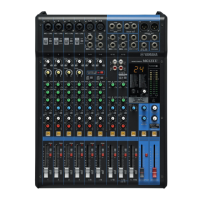
Yamaha MG82CX
21 pages
Print Icon
To Next Page IconTo Next Page
Loading...
ES
FR
DE
EN
Owner’s Manual
Bedienungsanleitung
Mode d’emploi
Manual de instrucciones
Owner’s Manual
Bedienungsanleitung
Mode d’emploi
Manual de instrucciones
MIXING CONSOLE
MIXING CONSOLE
Features
Input Channels..............................................................page 10
With up to four mic/line inputs or up to three (four for MG102C)
stereo inputs, the MG mixer can simultaneously connect to a
wide range of devices: microphones, line-level devices, stereo
synthesizers, and more.
Compression...................................................................page 9
Compression increases the overall level without introducing
distortion by compressing excessive peaks in the signals from
microphones and guitars.
AUX Sends and Stereo AUX Return............................page 12
You can use the AUX SEND jack to feed the signal sent to an
external signal processor, and then return the processed stereo
signal through the RETURN jack.
High-quality digital effects (MG82CX)...................page 13, 57
With digital effects built in, the MG82CX can deliver a wide range
of sound variations all by itself.
Caractéristiques
Canaux d’entrée..............................................................page 36
Avec quatre entrées micro/ligne ou trois entrées stéréo maximum
(quatre pour la console MG102C), la console de mixage MG peut
connecter simultanément une grande variété d’appareils :
micros, appareils de ligne, synthétiseurs stéréo, etc.
Compression...................................................................page 35
La compression augmente le niveau général sans engendrer de
distorsion en comprimant les pics excessifs des signaux des
micros et des guitares.
Envois AUX et retour AUX stéréo..................................page 38
Vous pouvez utiliser la prise jack AUX SEND pour envoyer le
signal vers une unité de traitement de signaux externes, puis
pour renvoyer le signal stéréo traité via la prise jack RETURN.
Effets numériques de qualité supérieure (MG82CX)
...
page 39, 57
Grâce aux effets numériques intégrés, la console MG82CX peut
proposer de nombreuses variations de sons.
Funktionen
Eingangskanäle.............................................................Seite 23
Mit bis zu vier Mikrofon-/Line-Eingängen oder bis zu drei (vier
beim MG102C) Stereoeingängen können viele Geräte
gleichzeitig am MG-Mischpult angeschlossen werden:
Mikrofone, Geräte mit Leitungspegel, Stereo-Synthesizer uvm.
Kompression..................................................................Seite 22
Kompression erhöht den Durchschnittspegel, ohne Verzerrung
hinzuzufügen, indem übermäßige Pegelspitzen der Signale von
Mikrofonen oder Gitarren komprimiert werden.
AUX Sends und Stereo AUX Return............................Seite 25
Von der AUX SEND-Buchse können Sie das Signal einzeln an
einen externen Signalprozessor führen, und das verarbeitete
Stereosignal über die RETURN-Buchse zurück in das Pult
führen.
Hochwertige Digitaleffekte (MG82CX)...................Seite 26, 57
Mit den eingebauten digitalen Effekten kann das MG82CX aus
sich heraus eine Reihe von Klangvariationen liefern.
Características
Canales de entrada......................................................página 49
Con un máximo de cuatro entradas de micrófono/línea o tres
entradas estereofónicas (cuatro en el modelo MG102C), la
mezcladora MG puede conectarse simultáneamente con una
gran variedad de dispositivos: micrófonos, dispositivos de nivel
de línea, sintetizadores estereofónicos, etc.
Compresión..................................................................página 48
La compresión aumenta el nivel general sin causar distorsión,
mediante la compresión del exceso de picos en las señales de
los micrófonos y guitarras.
Envíos AUX y retorno AUX estereofónico.................página 51
Puede utilizar la toma AUX SEND para introducir la señal
enviada en un procesador de señales externo y luego devolver la
señal estereofónica procesada a través de la toma RETURN
(retorno).
Efectos digitales de alta calidad (MG82CX)........página 52, 57
Gracias a sus efectos digitales incorporados, la mezcladora
MG82CX puede producir por sí misma una amplia gama de
variaciones de sonido.

Questions and Answers

Summary

Introduction

Before Turning on the Mixer

Essential pre-operation checks and safety advice before powering the mixer.

Turning the Power On

Step-by-step guide on how to safely power the mixing console on and off.

Mixer Basics

Quick Guide

A concise guide to connecting speakers and achieving initial stereo output.

Making the Most of Your Mixer

Tips and techniques for optimizing mixer performance and achieving better sound quality.

Balanced, Unbalanced-Whats the Difference?

Explains the concept of balanced vs. unbalanced audio connections and their impact on noise.

Signal Levels and the Decibel

Details the use of decibels (dB) in audio measurements and understanding signal levels.

To EQ or Not to EQ

Guidance on using equalization (EQ) to shape the sound and improve mix clarity.

Ambience

Discusses using reverb and delay effects to add depth and character to mixes.

The Modulation Effects: Phasing, Chorus, and Flanging

Explains the principles and applications of modulation effects like phasing, chorus, and flanging.

Compression

Details how to use compression to control dynamic range and achieve a unified sound.

Reference

Front & Rear Panels

Overview of the mixer's physical controls and connection jacks.

Channel Control Section

Detailed explanation of controls for individual input channels.

Master Control Section

Explanation of the main output controls and master section functions.

DIGITAL EFFECT

Details on the built-in digital effects processor, including program selection and parameter adjustment.

Rear Input;Output Section

Description of the various input and output connectors located on the rear panel.

Setup

Guidance on connecting the mixer and setting up audio sources.

Jack List

A comprehensive list and explanation of all input and output jacks on the mixer.

Troubleshooting

Common issues and solutions for operating the mixing console.

Mounting to a Microphone Stand

Instructions for attaching the mixer to a microphone stand using an adaptor.

Specifications

Technical details and performance data for the mixing console.

Electrical Specifications

Detailed electrical performance metrics, including frequency response and distortion.

General Specifications

General technical parameters, power requirements, and physical dimensions.

Input Specifications

Detailed specifications for all input connectors and their performance.

Output Specifications

Detailed specifications for all output connectors and their performance.

Digital Effect Program List

A list of all 16 internal digital effects, their parameters, and descriptions.

Dimensional Diagrams

Diagrams showing the physical dimensions and layout of the mixer.

Block Diagram and Level Diagram

Visual representation of the mixer's internal signal flow and level characteristics.

Summary

Introduction

Before Turning on the Mixer

Essential pre-operation checks and safety advice before powering the mixer.

Turning the Power On

Step-by-step guide on how to safely power the mixing console on and off.

Mixer Basics

Quick Guide

A concise guide to connecting speakers and achieving initial stereo output.

Making the Most of Your Mixer

Tips and techniques for optimizing mixer performance and achieving better sound quality.

Balanced, Unbalanced-Whats the Difference?

Explains the concept of balanced vs. unbalanced audio connections and their impact on noise.

Signal Levels and the Decibel

Details the use of decibels (dB) in audio measurements and understanding signal levels.

To EQ or Not to EQ

Guidance on using equalization (EQ) to shape the sound and improve mix clarity.

Ambience

Discusses using reverb and delay effects to add depth and character to mixes.

The Modulation Effects: Phasing, Chorus, and Flanging

Explains the principles and applications of modulation effects like phasing, chorus, and flanging.

Compression

Details how to use compression to control dynamic range and achieve a unified sound.

Reference

Front & Rear Panels

Overview of the mixer's physical controls and connection jacks.

Channel Control Section

Detailed explanation of controls for individual input channels.

Master Control Section

Explanation of the main output controls and master section functions.

DIGITAL EFFECT

Details on the built-in digital effects processor, including program selection and parameter adjustment.

Rear Input;Output Section

Description of the various input and output connectors located on the rear panel.

Setup

Guidance on connecting the mixer and setting up audio sources.

Jack List

A comprehensive list and explanation of all input and output jacks on the mixer.

Troubleshooting

Common issues and solutions for operating the mixing console.

Mounting to a Microphone Stand

Instructions for attaching the mixer to a microphone stand using an adaptor.

Specifications

Technical details and performance data for the mixing console.

Electrical Specifications

Detailed electrical performance metrics, including frequency response and distortion.

General Specifications

General technical parameters, power requirements, and physical dimensions.

Input Specifications

Detailed specifications for all input connectors and their performance.

Output Specifications

Detailed specifications for all output connectors and their performance.

Digital Effect Program List

A list of all 16 internal digital effects, their parameters, and descriptions.

Dimensional Diagrams

Diagrams showing the physical dimensions and layout of the mixer.

Block Diagram and Level Diagram

Visual representation of the mixer's internal signal flow and level characteristics.

Overview

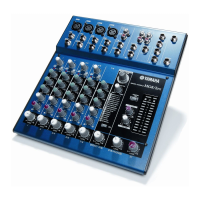
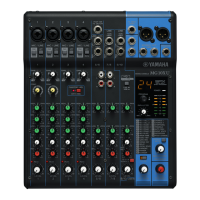
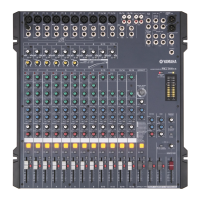
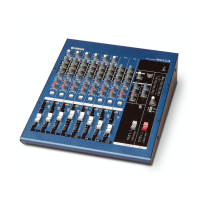
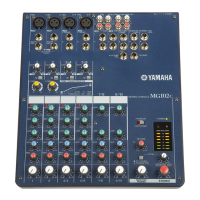
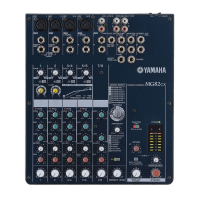
The Yamaha MG82CX/MG102C is a mixing console designed for a wide range of audio environments, offering ease of operation and support for various usage scenarios. The MG82CX model specifically includes high-quality built-in digital effects, enhancing its sound variation capabilities.

Function Description

The mixer features multiple input channels, including up to four mic/line inputs and up to three (four for MG102C) stereo inputs. This allows for simultaneous connection of a diverse array of devices such as microphones, line-level devices, and stereo synthesizers.

A key feature is the compression control, which increases the overall signal level without introducing distortion. This is achieved by compressing excessive peaks in signals from microphones and guitars, resulting in a smoother, more even dynamic range. The MG compressor simplifies this process by automatically adjusting pertinent parameters with a single "compression" control.

The console also includes AUX Sends and a Stereo AUX Return. The AUX SEND jack allows you to route a signal to an external signal processor, with the processed stereo signal then returned via the RETURN jack. This is useful for incorporating external effects or for creating a monitor mix.

For the MG82CX, high-quality digital effects are built-in, offering a wide range of sound variations. These effects include various reverbs (Hall, Room, Stage, Plate, Drum Ambience), echoes (Karaoke Echo, Vocal Echo), and modulation effects (Chorus, Flanger, Phaser, Auto Wah), as well as Distortion. These internal effects can be applied to individual channels, similar to external effects processors.

The channel control section provides comprehensive adjustments. Each input channel (mono and stereo) has a GAIN control to adjust the input signal level, ensuring optimal balance between signal-to-noise ratio and dynamic range. PEAK indicators light up when the signal level approaches clipping, helping users prevent distortion. Three-band equalizers (HIGH, MID, LOW) are available for most channels, allowing for precise frequency adjustments to shape the sound and prevent interference between instruments. Stereo channels (7/8, and 9/10 for MG102C) feature two-band equalizers (HIGH, LOW). An EFFECT (AUX) control adjusts the signal level sent from the channel to the internal digital effect unit or external AUX bus. PAN/BAL controls determine the stereo positioning of the channel signal. Level controls adjust the signal level of each channel, facilitating balance between various inputs.

The master control section includes 2TR IN jacks for connecting stereo sound sources like CD players, and REC OUT (L, R) jacks for connecting to external recorders. STEREO OUT (L, R) jacks provide impedance-balanced outputs for connecting to power amplifiers. MONITOR (L, R) jacks offer impedance-balanced outputs for connecting to a monitor system, and a PHONES jack allows for headphone monitoring. A PHANTOM +48V switch enables phantom power for condenser microphones on channels 1-5/6. The RETURN control adjusts the level of the signal received at the RETURN jacks. A POWER indicator shows when the mixer is ON, and a Level Meter displays the signal level for the MONITOR and PHONES outputs. The 2TR IN switch allows routing of the 2TR IN signal to either the STEREO L/R buses or the MONITOR OUT/PHONES jacks, enabling a MONITOR MIX feature for overdubbing. A MONITOR/PHONES control adjusts the output level for headphones and monitors, while the STEREO Master control adjusts the overall signal level sent to the STEREO OUT jacks.

Usage Features

The mixer is designed for intuitive setup. Users are guided to first ensure all level controls are turned down before connecting microphones, instruments, and speakers. The power-up sequence is crucial: peripheral devices first, then the MG mixer, and finally power amps or powered speakers, with the reverse order for powering down to prevent speaker damage.

The GAIN controls should be adjusted so that PEAK indicators flash only briefly on the highest peak levels, optimizing signal quality. The STEREO Master control is initially set to a nominal position, and individual Level controls are used to establish the desired balance, with overall volume adjusted via the STEREO Master control. The LEVEL meter helps monitor signal levels to avoid distortion.

The manual provides guidance on balanced versus unbalanced lines, emphasizing balanced lines for long cable runs and microphones to minimize noise. It also explains signal levels and the decibel (dB) unit, helping users understand and match input/output levels.

EQ usage is advised with caution, recommending cutting frequencies to eliminate interference and improve clarity, while boosting should be done sparingly. The manual details frequency ranges for various instruments to aid in effective equalization.

Ambience effects, such as reverb and delay, can be added to refine mixes. The MG82CX's internal effects offer various reverb times and tones, and delay times can be adjusted for different musical "grooves." Modulation effects like phasing, chorus, and flanging are explained as time-shifting a portion of the audio signal to create rich, swirling sounds.

The MG82CX's digital effects unit includes a PROGRAM dial to select from 16 internal effects and a PARAMETER control to adjust effect parameters like depth or speed. An ON switch activates or deactivates the internal effect, and an optional foot switch can be connected for hands-free control. The EFFECT RTN control adjusts the level of the internal digital effect sent to the STEREO buses.

Maintenance Features

The manual emphasizes several precautions for safe and reliable operation. Users are instructed to use only the specified AC power adaptor (PA-10) and voltage. The device should not be opened or modified, and any malfunction requires immediate inspection by qualified Yamaha service personnel. Protection from water, excessive dust, vibrations, extreme cold or heat, and unstable placement is crucial.

Proper power cord handling is stressed, including unplugging the device during extended non-use or electrical storms, and always holding the plug, not the cord, when disconnecting. To avoid unwanted noise, the AC power adaptor should be kept at least 50 cm away from the device.

When connecting to other devices, all power should be turned off, and all volume levels set to minimum. When powering on an audio system, the power amplifier should always be turned on last, and off first, to prevent speaker damage.

The manual also provides troubleshooting tips for common issues like power failure, no sound, faint/distorted/noisy sound, and issues with effects application or phantom power. It also includes instructions for mounting the mixer to a microphone stand using the BMS-10A adaptor, ensuring stability and proper angle adjustment.

Yamaha MG82CX Specifications

General IconGeneral
Channels8
Stereo Line Inputs2
Aux Sends1
Aux Returns1 stereo
Phantom PowerYes
Headphone Output1
USB InterfaceNo
EQ Bands3-band
Built-in EffectsYes (SPX digital effects)
High-Pass Filter80 Hz
Main Outputs2
Monitor Outputs1
Mic Inputs4 (XLR/TRS combo)
Line Inputs8 (4 mono + 2 stereo)

Related product manuals