EasyManua.ls Logo

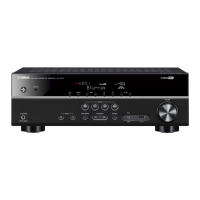
Yamaha RX-V340 - Service Manual

Yamaha RX-V340
79 pages
Print Icon
To Next Page IconTo Next Page
Loading...
SERVICE MANUAL
100848
IMPORTANT NOTICE
This manual has been provided for the use of authorized YAMAHA Retailers and their service personnel.
It has been assumed that basic service procedures inherent to the industry, and more specifically YAMAHA Products, are already
known and understood by the users, and have therefore not been restated.
WARNING: Failure to follow appropriate service and safety procedures when servicing this product may result in personal
injury, destruction of expensive components, and failure of the product to perform as specified. For these reasons,
we advise all YAMAHA product owners that any service required should be performed by an authorized
YAMAHA Retailer or the appointed service representative.
IMPORTANT: The presentation or sale of this manual to any individual or firm does not constitute authorization, certification or
recognition of any applicable technical capabilities, or establish a principle-agent relationship of any form.
The data provided is believed to be accurate and applicable to the unit(s) indicated on the cover. The research, engineering, and
service departments of YAMAHA are continually striving to improve YAMAHA products. Modifications are, therefore, inevitable
and specifications are subject to change without notice or obligation to retrofit. Should any discrepancy appear to exist, please
contact the distributor's Service Division.
WARNING: Static discharges can destroy expensive components. Discharge any static electricity your body may have
accumulated by grounding yourself to the ground buss in the unit (heavy gauge black wires connect to this buss).
IMPORTANT: Turn the unit OFF during disassembly and part replacement. Recheck all work before you apply power to the unit.
P.O.Box 1, Hamamatsu, Japan
CONTENTS
TO SERVICE PERSONNEL .......................................... 2
FRONT PANELS ........................................................ 3~4
REAR PANELS .......................................................... 4~7
REMOTE CONTROL PANELS...................................... 7
SPECIFICATIONS / 参考仕様 .................................. 8~11
INTERNAL VIEW ......................................................... 11
DISASSEMBLY PROCEDURES/分解手順 ......... 12~14
SELF DIAGNOSIS FUNCTION (DIAG)/
自己診断機能(ダイアグ)..................................... 15~35
CONFIRMATION OF IDLING CURRENT/
アイドリング電流の確認 .............................................. 36
DISPLAY DATA ..................................................... 37~38
IC DATA ................................................................. 39~44
PRINTED CIRCUIT BOARD .................................. 45~53
PIN CONNECTION DIAGRAM .................................... 54
BLOCK DIAGRAM ....................................................... 55
SCHEMATIC DIAGRAM ........................................ 56~60
PARTS LIST ........................................................... 61~79
REMOTE CONTROL.............................................. 80~81
AV RECEIVER/AV AMPLIFIER
RX-V340/RX-V340RDS/
HTR-5630/HTR-5630RDS/DSP-AX340
RX-V340/RX-V340RDS/
HTR-5630/HTR-5630RDS/DSP-AX340
w
w
w
.
x
i
a
o
y
u
1
6
3
.
c
o
m
Q
Q
3
7
6
3
1
5
1
5
0
9
9
2
8
9
4
2
9
8
T
E
L
1
3
9
4
2
2
9
6
5
1
3
9
9
2
8
9
4
2
9
8
0
5
1
5
1
3
6
7
3
Q
Q
TEL 13942296513 QQ 376315150 892498299
http://www.xiaoyu163.com

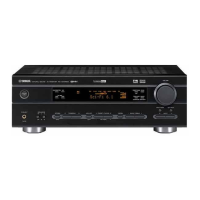
Table of Contents

Other manuals for Yamaha RX-V340

Questions and Answers

  • A
    Ashley FullerSep 12, 2025
    Why can't I increase the volume or why is the sound distorted on my Yamaha Receiver?
    • E
      ewingstephanieSep 12, 2025
      If you cannot increase the volume level or the sound is distorted on your Yamaha Receiver, check if the component connected to the OUT (REC) jacks is turned off. If so, turn it on.
  • G
    Gene SwansonSep 12, 2025
    How to eliminate buzzing and whining noises from Yamaha RX-V340?
    • A
      andrea14Sep 12, 2025
      If you're hearing buzzing and whining noises from your Yamaha Receiver, especially in the evening, move the unit away from any nearby TV set.
  • E
    elizabeth40Sep 12, 2025
    How to reduce noise interference on Yamaha RX-V340?
    • W
      williamwashingtonSep 12, 2025
      If you're experiencing noise interference with your Yamaha Receiver, move the unit further away from digital or high-frequency equipment.
  • J
    Jennifer JohnsonSep 9, 2025
    How to stop a humming sound from Yamaha RX-V340 Receiver?
    • A
      Albert WongSep 9, 2025
      If you're hearing a humming sound from your Yamaha Receiver, ensure the audio plugs are firmly connected. If the problem continues, the cables may be defective and need replacement.
  • C
    Christopher ConradSep 8, 2025
    How to improve poor bass reproduction on Yamaha Receiver?
    • B
      Brenda MatthewsSep 8, 2025
      If you're experiencing poor bass reproduction with your Yamaha Receiver, try these fixes: * If “SOUND 1D BASS” on the set menu is set to SWFR or BOTH and you don't have a subwoofer, select MAIN. * Ensure the speaker mode settings (main, center, or rear) on the set menu match your speaker configuration. Select the appropriate position for each speaker based on their size.
  • J
    Juan HebertSep 7, 2025
    Why is there no sound from effect speakers on my Yamaha Receiver?
    • A
      Amanda FordSep 7, 2025
      If there is no sound from the effect speakers on your Yamaha Receiver, it may be because the sound effect is switched off. Press STEREO to turn it on. Alternatively, a Dolby Surround, Dolby Digital or DTS decoding DSP program is being used with material not encoded with Dolby Surround, Dolby Digital or DTS. Select another DSP program.
  • M
    Maria GuzmanAug 23, 2025
    Why does the sound on my Yamaha Receiver suddenly go off?
    • K
      Kristine WeberAug 23, 2025
      If the sound on your Yamaha Receiver suddenly cuts out, here are a few things to investigate: * Check the speaker wires to ensure they aren't touching each other. Then, turn the unit back on. * If the sleep timer is activated, turn the power back on and restart the source. * If the unit is muted, press the MUTE button or any other operation button to cancel the mute function, then adjust the volume.
  • J
    jonesmichelleSep 5, 2025
    Why is there no sound from my Yamaha RX-V340 Receiver's subwoofer?
    • J
      Justin WestSep 6, 2025
      If there is no sound from the subwoofer connected to your Yamaha Receiver, check the following settings in the set menu: * If “SOUND 1D BASS” is set to MAIN when a Dolby Digital or DTS signal is being played, select SWFR or BOTH. * If “SOUND 1D BASS” is set to SWFR or MAIN when a 2-channel source is being played, select BOTH.
  • C
    Colleen SandovalSep 4, 2025
    What does 'CHECK SP WIRES' mean on my Yamaha RX-V340?
    • V
      Victor WilliamsSep 5, 2025
      If “CHECK SP WIRES” appears on the front panel display of your Yamaha Receiver, it means the speaker cables are short circuited. Make sure all speaker cables are connected correctly.
  • B
    Bobby PerrySep 3, 2025
    How to fix a Yamaha Receiver that won't turn on?
    • C
      charles62Sep 4, 2025
      If your Yamaha Receiver fails to turn on or enters standby mode shortly after being turned on, it could be due to a few reasons: * Ensure the power cord is firmly connected. * Check that the protection circuitry hasn't been activated. Make sure all speaker wire connections on this unit and on all speakers are secure and that the wire for each connection is not touching anything other than its respective connection. * If the unit has been exposed to a strong external electric shock, set this unit in standby mode, disconnect the power cord, plug it back in after 30 seconds, then use it normally.

Summary

Important Notices

To Service Personnel

Critical Components Information

Information on components with special characteristics that require specific replacement parts.

Leakage Current Measurement (For 120 V Models Only)

Procedure to verify insulation of conductive surfaces and measure leakage current.

Chemical Content Notice

Notice about lead in solder and other chemicals, with safety precautions.

Dimensions and Diagram

Front Panel Overview

Rear Panel Overview

Remote Control Panels

Specifications

Audio Section Specifications

Detailed technical specifications for the audio processing section of the unit.

Video Section Specifications

Technical specifications related to video signal handling and display.

FM Section Specifications

Technical specifications for the FM tuner functionality.

AM Section Specifications

General Specifications

Included Accessories

Set Menu Table

Basic Setup Menu

Basic setup menu items related to speaker configuration and levels.

Sound Settings Menu

Sound settings menu items including speaker setup, distance, LFE, and tone controls.

Input Menu Settings

Input assignment and display settings within the menu system.

Option Menu Settings

Option menu items for audio mute and dual mono settings.

Internal View and Component Locations

Main P.C.B. Locations

Locations of Main P.C.B.s (1, 2, 3, 4, 5) on the internal layout.

Function P.C.B. Locations

Locations of Function P.C.B.s (1, 2, 3, 4, 5, 6, 7, 8) on the internal layout.

Tuner and DSP P.C.B. Locations

Locations of Tuner and DSP P.C.B. on the internal layout.

Power Transformer Location

Location of the Power Transformer on the internal layout.

Disassembly Procedures

Removal of Top Cover

Steps for removing the top cover of the unit, including screw and slide instructions.

Removal of Front Panel Unit

Steps for removing the front panel unit, involving harness, screws, and sliding.

Removal of DSP P.C.B.

Procedures for removing the DSP P.C.B. with its support, including screw and connector removal.

Disassembly of Main and Function P.C.B.s

Removal of Main and Function P.C.B.s

Steps to remove specific P.C.B.s and the Tuner, involving connector and screw removal.

Disassembly of Specific P.C.B.s and P.C.B. Checking

Removal of Main and Function P.C.B.s

Procedures for removing MAIN (1), FUNCTION (1), and FUNCTION (8) P.C.B.s, including connector and screw removal.

P.C.B. Checking Guidelines

Guidelines for reconnecting cables, checking polarity, and ensuring proper grounding of P.C.B.s.

Self Diagnosis Function (DIAG)

DSP Through Function

DSP through function, including analog bypass and YSS settings.

RAM Through Function

RAM through function for YSS938, outputting only CT signal via Sub DSP DRAM.

Pro Logic and Neo:6 Settings

Pro Logic and Neo:6 settings, including mode selection and tone control.

Speaker Settings

Speaker settings for automatic input switching and output signal routing.

Margin Check and Other Inputs

Margin check for audio signals and settings for other input sources.

Display and Manual Test Functions

Checks for FL display segments and manual tests for noise generation across channels.

Factory Preset and Data Checks

Presets for memory initialization and checks for AD data and fan test.

DIAG Menu Details and Operation

IF Status

Displays status information of the microprocessor, signal processing, and internal status.

DSP RAM Check

Checks bus connections for YSS938 and external RAM, indicating errors.

SD DL Code

Displays data version of FLASH ROM, TOC information, and sum calculated values.

Soft Switch Settings

Switches function settings on P.C.B. via software, affecting protection and operation modes.

Microprocessor Information

Displays microprocessor version, checksum, and port settings.

DIAG Mode Operation

Starting DIAG Mode

Procedure to start the DIAG mode by pressing specific keys and the power button.

DIAG Mode with Protection Cancelled

How to enter DIAG mode with protection functions disabled for troubleshooting.

Canceling DIAG Mode

Steps to cancel DIAG mode, including memory setting and power-off.

DIAG Display Interpretation

DIAG Protection History and Display

Protection Function History

How protection history is stored, accessed, and cleared.

Display During Menu Operation

How functions are indicated on the FL display during DIAG operation.

DIAG Menu Navigation and Functions

DIAG Menu and Sub-Menu Operation

How to navigate and select DIAG menu items and sub-menu items using the unit's keys.

Functions Available in DIAG Mode

Available functions during DIAG mode, excluding tuner and set menu operations.

Initial Settings for Starting DIAG

Default settings applied when starting the DIAG mode, which are restored upon cancellation.

Detailed DIAG Menu Functions

DSP Through Function Details

Details of DSP through function, including Main DSP selection and analog bypass.

YSS 0 dB and YSS Front 0 dB Modes

Output signal characteristics for YSS 0dB and YSS Front 0dB modes, including head margin.

DIAG Menu: YSS Full Bit Modes

YSS Full Bit Mode

Output signal characteristics for YSS FULL BIT mode, without head margin.

YSS Full Bit F Mode

Output signal characteristics for YSS FULL BIT F mode, with front CH digital full bit output.

DIAG Menu: RAM Through Function

RAM Through Function Details

Details of RAM THROUGH function for YSS938, outputting CT signal via Sub DSP DRAM.

RAM 0 dB Signal Output

Signal output characteristics for RAM 0dB mode.

DIAG Menu: Pro Logic Functions

Pro Logic Processing Details

Pro Logic processing details, including signal routing and mode selection.

Pro Logic I and Pro Logic II Modes

Specifics of PRO LOGIC I and PRO LOGIC II modes, including signal routing and Dolby Digital compatibility.

DIAG Menu: Neo:6 and Speaker Settings

Neo:6 Function Details

Details of Neo:6 function, noting it's not applied to all models.

Speaker Settings Details

Speaker settings for automatic input switching and output signal routing.

DIAG Menu: Margin Check

Margin Check Function

Margin check for signals, including specific dB margin levels for main channels.

Main 12 dB and 18 dB Margin

Signal output characteristics for MAIN 12dB and 18dB MARGIN modes.

DIAG Menu: Other Input and Display Check

Other Input and External Decoder

Input via 6CH terminal and external decoder output.

Display Check Functions

FL display check programs for various segment lighting and synchronization modes.

DIAG Menu: Manual Test and Factory Preset

Manual Test Procedures

Manual tests for noise generation across channels, with specific frequency ranges.

Factory Preset Settings

Menu for reserving and inhibiting RAM initialization, and setting factory presets.

DIAG Menu: Data Check and Fan Test

AD Data Check and Fan Test

Checks A/D conversion, fan drive level, and protection statuses.

Protection Detection Values

Protection detection values for DC and power supply voltage.

Temperature and Fan Monitoring

Temperature detection and fan drive level monitoring.

DIAG Menu: Impedance, Key, and Fan Tests

Impedance and Power Limiter Checks

Checks impedance switch setting and power limiter detection values.

Panel Key Checks (K0;K1)

Checks panel key function and A/D deviation, and confirms key status.

Fan Drive Test (High;Mid;Low)

Tests for fan drive levels (HIGH, MID, LOW) on applicable models.

DIAG Menu: IF Status and Checks

IF Status (Input Function Status)

Displays input function status, microprocessor status, and signal processing information.

Internal Status Information

Displays microprocessor status information.

DIAG Menu: RAM and DL Code Checks

DSP RAM Check

Checks bus connections between YSS938 and external RAM, indicating errors.

SD DL Code Information

Displays data version of FLASH ROM, TOC information, and sum calculated values.

DIAG Menu: Soft Switch Settings

Soft Switch Functionality

Switches function settings on P.C.B. via software, affecting protection and operation modes.

Microprocessor Information Details

Microprocessor Information Display

Displays microprocessor version, checksum, and port settings.

Idling Current Confirmation

Main P.C.B. Idling Current Check

Procedure to confirm idling current voltage across specific terminals on the main P.C.B.

Display Data and Pin Connections

Display Data Overview

Information displayed regarding signal status and patterns.

Pin Connection Diagrams

Pin connection diagrams for various ICs, diodes, and transistors.

Grid Assignment Details

Assignment of grid numbers to various signals and connections.

Anode Connection Details

IC Data and Pin Assignments

IC472 Microprocessor Pin Assignments

Pin assignment details for the M3062VMGP microprocessor on the main P.C.B.

IC472 Microprocessor Pin Assignments (Continued)

Block Diagram of System Architecture

Main System Blocks

Main functional blocks of the system, including input selectors and monitor outputs.

DSP and Function Blocks

Digital Signal Processing and functional blocks for sound processing and control.

Printed Circuit Board Layouts (Foil Side)

DSP P.C.B. Layouts

Foil side layouts of the DSP P.C.B. showing lead type and surface mount components.

Printed Circuit Board Layouts (Foil Side)

Function P.C.B. Layouts (Lead Type)

Foil side layouts of FUNCTION P.C.B.s with lead type devices.

Main P.C.B. Layouts

Foil side layouts of MAIN P.C.B.s.

Power Transformer Layout

Foil side layout of the Power Transformer.

Printed Circuit Board Layouts (Foil Side)

Function P.C.B. Layouts (Surface Mount)

Foil side layouts of FUNCTION P.C.B.s with surface mount components.

Printed Circuit Board Layouts (Foil Side)

Function P.C.B. Layouts (Lead Type)

Foil side layouts of FUNCTION P.C.B.s with lead type devices.

DSP P.C.B. Layout

Foil side layout of the DSP P.C.B.

Function and Main P.C.B. Layouts

Foil side layouts of FUNCTION and MAIN P.C.B.s.

Printed Circuit Board Layouts (Foil Side)

Function P.C.B. Layouts (Surface Mount)

Foil side layouts of FUNCTION P.C.B.s with surface mount devices.

Main P.C.B. Layout (Surface Mount)

Main P.C.B. Layout (Surface Mount) (Continued)

Main P.C.B. Layouts (Lead Type and Surface Mount)

Main P.C.B. Layouts (Lead Type)

Foil side layouts of MAIN P.C.B.s with lead type devices.

Main P.C.B. Layouts (Surface Mount)

Foil side layouts of MAIN P.C.B.s with surface mount components.

Main P.C.B. Layouts (Surface Mount)

Pin Connection Diagrams

IC Pin Connections

Pin connection diagrams for various Integrated Circuits (ICs) used in the unit.

Diode Pin Connections

Pin connection diagrams for various diodes.

Transistor Pin Connections

Pin connection diagrams for various transistors.

Schematic Diagrams (Main 1;2)

Power Amplifier Schematics

Schematics for Left, Right, and Center Channel Power Amplifier circuits.

Speaker Relay and Power Supply Schematics

Schematics for the speaker relay and power supply sections.

Schematic Diagrams (Main 2;2)

Microcomputer and Input Selector Schematics

Schematics of the microcomputer and input selector circuitry.

Level Shift Circuit Schematics

Schematic of the level shift circuits.

Parts List

Electrical Parts List

List of electrical components with part numbers, descriptions, and abbreviations.

Parts List: DSP P.C.B.

Parts List: DSP P.C.B. (Continued)

Parts List: DSP P.C.B. (Continued)

Parts List: DSP & Function P.C.B.s

P.C.B. DSP and Function P.C.B. Parts

Parts list for DSP P.C.B. and FUNCTION P.C.B.s, including ICs, connectors, and transistors.

P.C.B. FUNCTION Parts

Parts list for FUNCTION P.C.B.s, including connectors and transistors.

Parts List: Function P.C.B.

Parts List: Function P.C.B. (Continued)

Parts List: Function P.C.B. (Continued)

Parts List: Function and Main P.C.B.s

Function and Main P.C.B. Parts

Parts list for FUNCTION and MAIN P.C.B.s, including switches, transformers, and connectors.

Main P.C.B. Parts List

Parts list for MAIN P.C.B.s, including connectors, transformers, and transistors.

Parts List: Main P.C.B. (Continued)

Parts List: Main P.C.B. (Continued)

Parts List: Main P.C.B. (Continued)

Parts List: Main P.C.B. (Continued)

Parts List: Main P.C.B. (Continued)

Parts List: Main P.C.B. (Continued)

Parts List: Chip Resistors

Parts List: Chip Resistors (Continued)

Exploded View of Unit Assembly

Exploded View for R Models

Exploded view of the unit for R models, showing component assembly.

Exploded View for J, U, C, R, T, K, A, L Models

Exploded view of the unit for J, U, C, R, T, K, A, L models, showing component assembly.

Exploded View for B, G Models

Exploded view of the unit for B, G models, showing component assembly.

Remote Control RAV300 Schematic

Remote Control RAV300 Schematic Diagram

Schematic diagram of the remote control's internal circuitry.

Remote Control RAV16 Information

Yamaha RX-V340 Specifications

General IconGeneral
Channels5.1
Weight9 kg
Signal to Noise Ratio100 dB
Dimensions (WxHxD)435 x 151 x 363 mm (17.1 x 5.9 x 14.3 inches)
TypeReceiver
Frequency Response10 - 100000 Hz
Total Harmonic Distortion0.06 %
Outputs1 subwoofer
Input Sensitivity200 mV
Input Impedance47 kΩ
Digital Audio Inputs1 optical, 1 coaxial
Surround SoundDolby Digital, DTS
Inputs4 analog audio, 2 digital audio (1 optical, 1 coaxial)

Related product manuals