140
Individual pumping elements are used on sin-
gle-cylinder engines as shown in
Figure 4. Multi-
ple-cylinder engines are equipped with pumping elements
combined in a single unit
as shown in Figure 5.
Fuel injection pumps are precision-built units that re-
quire clean fuel to operate properly. The extremely close
tolerances and high injection pressure dictate that special-
ized equipment and experienced technicians are needed to
service fuel injection pumps.
If
properly operated and
maintained, a fuel injection pump will provide
long-lasting, trouble-free service.
Fuel Injector
A fuel injector (A, Figure 6) is required for each cylin-
der to inject fuel into the combustion chamber. A
high-pressure fuel line (B,
Figure 6) directs fuel from the
fuel injection pump to the fuel injector, while a fuel return
line (C,
Figure 6) carries bypass fuel back to the fuel tank.
Refer to
Figure 7 for an exploded view
of
the fuel injec-
tor.
The engines covered in this manual are equipped with
an inward opening, throttling-pintle type fuel injector
(Figure 8). High fuel pressure from the injection pump
enters the injection nozzle, surrounds the nozzle valve and
forces the valve away from the seat. The pressure exerted
by the spring above the nozzle holds the nozzle valve
closed until the pressure
of
the fuel rises higher than
spring pressure. The fuel delivered by the pump sprays
from the nozzle tip into the combustion chamber when the
valve opens. After the fuel is injected, fuel pressure de-
creases and the spring once again closes the valve.
The injection nozzle atomizes the fuel to help mix fuel
with the compressed air in the engine's cylinder. The fuel
must be broken into very small particles so that the fuel
will quickly absorb heat from the compressed (hot) air,
change to a vapor, then ignite. The design
ofthe
nozzle tip
affects the size and shape
of
the fuel spray. The throttling
pintle reduces the amount
of
fuel injected for a given ori-
fice and causes a delay in the injection
of
the principal
amount
of
fuel.
Excess fuel is routed from the injectors back to the fuel
tank through a fuel return line.
Fuel and Fuel Filters
Clean, moisture-free fuel is very important to a diesel
fuel system. As well as acting as the fuel for combustion,
diesel fuel is also a lubricant for many ofthe internal mov-
ing parts in the fuel system. The close tolerances
ofthe
in-
CHAPTER SEVEN
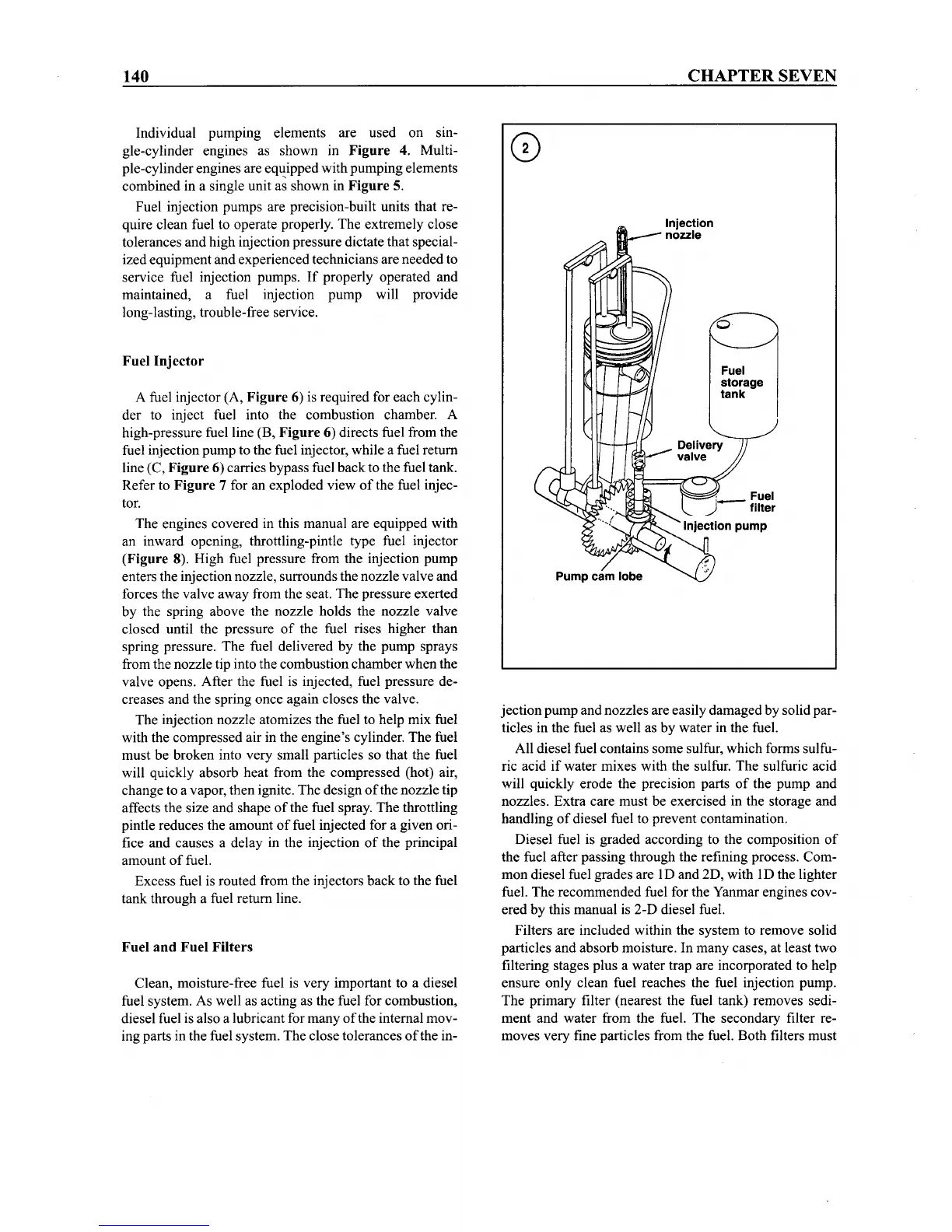
Injection
nozzle
Fuel
storage
tank
jection pump and nozzles are easily damaged by solid par-
ticles in the fuel as well as by water in the fuel.
All diesel fuel contains some sulfur, which forms sulfu-
ric acid if water mixes with the sulfur. The sulfuric acid
will quickly erode the precision parts
of
the pump and
nozzles. Extra care must be exercised in the storage and
handling
of
diesel fuel to prevent contamination.
Diesel fuel is graded according to the composition of
the fuel after passing through the refining process. Com-
mon diesel fuel grades are ID and 2D, with ID the lighter
fuel. The recommended fuel for the Yanmar engines cov-
ered by this manual is 2-D diesel fuel.
Filters are included within the system to remove solid
particles and absorb moisture. In many cases, at least two
filtering stages plus a water trap are incorporated to help
ensure only clean fuel reaches the fuel injection pump.
The primary filter (nearest the fuel tank) removes sedi-
ment and water from the fuel. The secondary filter re-
moves very fine particles from the fuel. Both filters must



 To Next Page