170
Sea
water
pum
p drive b
el
t replacement
(except I
GJI
and IG.UI Oengines)
Replace the seawater drive belt as follows:
I.
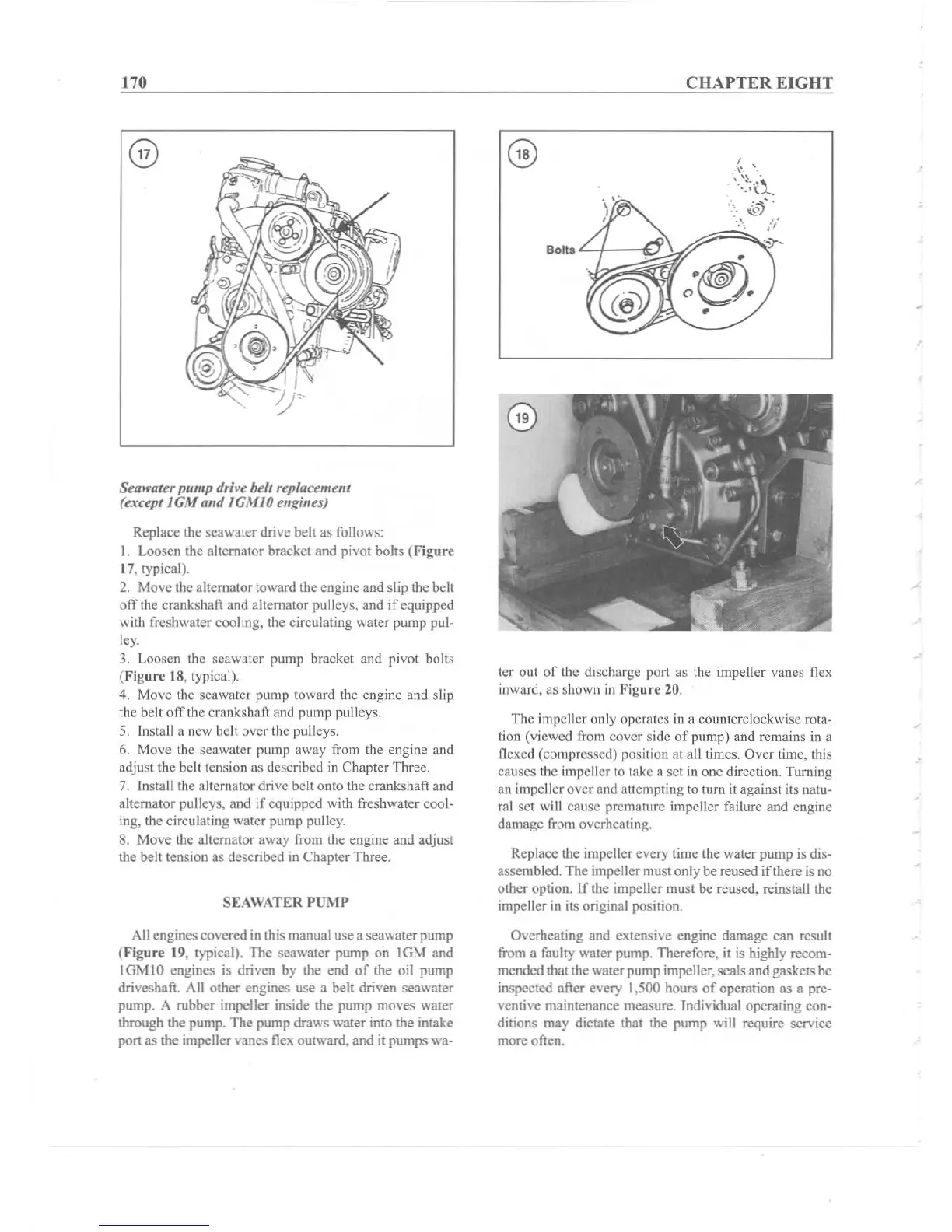
Loosen the alternator bracket and pivot bolts (Figure
17, typica l).
2. Move the alternator toward the engine and slip the
belt
off
the crankshaft and alternator pulleys, and if equipped
with freshwater cooling, the circulating water pump pul-
Icy.
3. Loosen the seawater pump bracket and pivot bolts
(Fi
J::
ure
18, typical),
4. Move the seawater pump toward the engine and slip
the belt off the crank shaft and pump pulleys.
5. Install a new belt over the pulleys.
6. Move the seawater pump away from the engine and
adjust the belt tension as described in Chapter Three.
7. Install the alternator drive bell onto the crankshaft and
alternator pulleys. and if equipped with freshwater cool-
ing. the circulating water pump pulley.
8. Move the alternator away from the engine and ad
ju
st
the belt tension as described in Chapter Three.
SEA
WATE R P
UMP
All engines covered in this manual use a seawater pump
(Ftgure 19. typical). The seawater pump on
IGM
and
IGMIO engines is driven by the end
of
the oil pump
drives haft. All other eng ines use a belt-driven seawater
pump. A rubber impeller inside the pump moves water
through the pump. The pump draws water into the intake
port as the impeller vanes flex outward. and it pumps wa-
CIIAPTER EIG
IIT
-{.
'.
-.
'
~
.
,
ito
··'l
.J..
Bolts
L-
+--
-~
D
tcr out of the discharge port as the impeller vanes flex
inward . as shown in
Fi
gur
e 20.
The impeller only operates in a counterclockwise rota-
tion (viewed from cover side
of
pump) and remains in a
flexed (compressed) position at all times.
Over
time, this
causes the impeller to take a set in one direction . Turning
an impeller over and attempting to tum it aga inst its natu-
ral set will cause premature impeller failure and engine
damage from overheat ing.
Replace the impeller every time the water pump is dis-
assemb led. The impeller must only be reused if there is no
other option. If the impeller must be reused . reinstall the
impeller in its origina l position.
Overheating and extensive engine dama ge can result
from a faulty water pump. Therefore, it is highly recom-
mended that the waterpump impeller, seals and gaskets be
inspected after every 1,500 hours
of
operation as a pre-
ventive maintenance meas ure. Individual operating con-
ditions may dictate that the pump will require service
more often.



 To Next Page