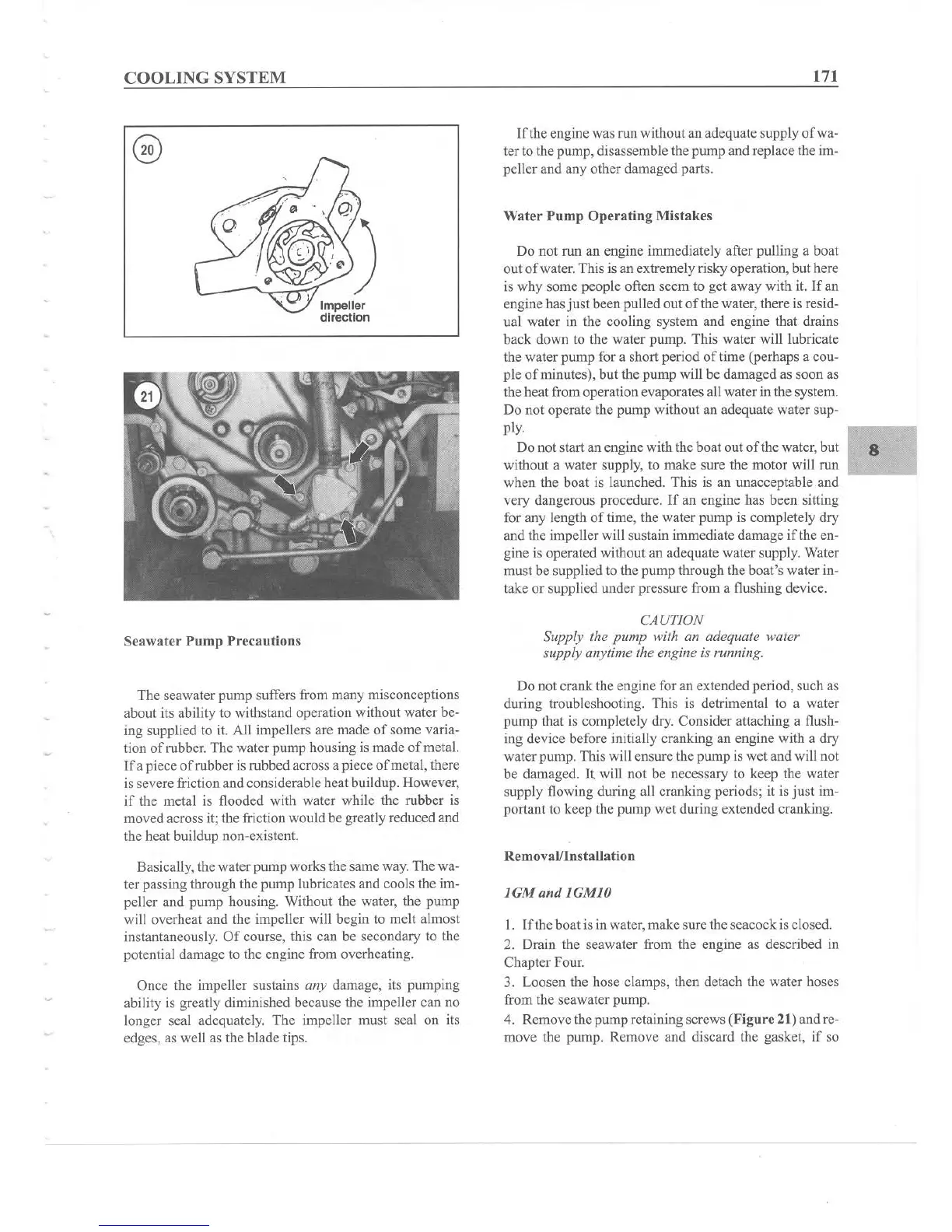
Impeller
direction
8
COOL ING SYSTEM
Seawater
Pump
Precaut
ions
The seawater pump suffers from many misconceptions
about its ability to withstand operation without water be-
ing supplied to
it. All impellers are made
of
some varia-
tion
of
rubbe r. The water pump housing is made
of
metal.
If
a piece
of
rubber is rubbed across a piece
of
metal, there
is severe friction and considerable heat buildup. However,
if the metal is flooded with water while the rubber is
moved across it; the friction would be greatly reduced and
the heat buildup non-existent.
Basically,the water pump works thesame way. The wa-
ter passing through the pump lubricates and cools the im-
peller and pump housing. Without the water, the pump
will overheat and the impeller
will begin to melt almost
instantaneously.
Of
course, this can be secondary to the
potential damage to the engine from overheating.
Once the impeller sustains any damage, its pumping
ability is greatly diminished because the impeller can no
longer seal adequately. The impeller must seal on its
edges, as well as the blade tips.
171
If
the engine was run withoutan adequate supply
ofwa-
ter to the pump, disassemble the pump and replace the im-
peller and any other damaged parts.
Wat
er
Pump
Ope
rating
Mtsrakes
Do not run an engine immediately after pulling a boat
out
of
water. This is an extremely risky operation, but here
is why some people often seem to get away with it.
If
an
engine has just been pulled out of the water, there is resid-
ual water in the cooling system and
eng
ine that drains
back down to the water pump. This water will lubricate
the water pump for a short period
of
time (perhaps a cou-
ple of minutes), but the pump will be damaged as soon as
the heat from operation evaporates all waterin the system.
Do not operate the pump without an adequate water sup-
ply.
....-.....,
Do not
stan
an engine with the boat out
of
the water, but
without a water supply, to make sure the motor will run
1.
..1
when the boat is launched. This is an unacceptable and
very dangerous procedure. If an engine has been sitting
for any length
of
time, the water pump is completely dry
and the impeller will sustain immediate damage
if
the en-
gine is operated without an adequate water supp ly. Water
must be supplied to the pump through the boat's water in-
take or supplied under pressure from a flushing device.
CAUTION
Supply the
pump
with an adequate water
supply anytime the engine is running.
Do not crank the engine for an extended period, such as
during troub leshooting. This is detrimental to a water
pump that is completely dry. Consi
der
attaching a flush-
ing device before initially cranking an engine with a dry
water pump. This will ensure the pump is wet and will not
be damaged.
It
will not be necessary to keep the water
supply flowing during all cranking periods;
it is just im-
portant to keep the pump wet during extended cranking.
Removal/Installation
I
GM
and
I GMIO
I. I
fth
e boatis in water, make sure the seacock is closed.
2. Drain the seawater from the engine as described in
Chapter Four.
3. Loosen the hose clamps, then detach the water hoses
from the seawater pump.
4. Remove the pump retaining screws (Figure 21) and re-
move the pump. Remove and discard the gasket,
if
so



 To Next Page