54
Freshwater
(Closed) Cooling Systems
Inspection
WARNING
When performing any service work on the
engine or cooling system, never remove the
pressure
jill
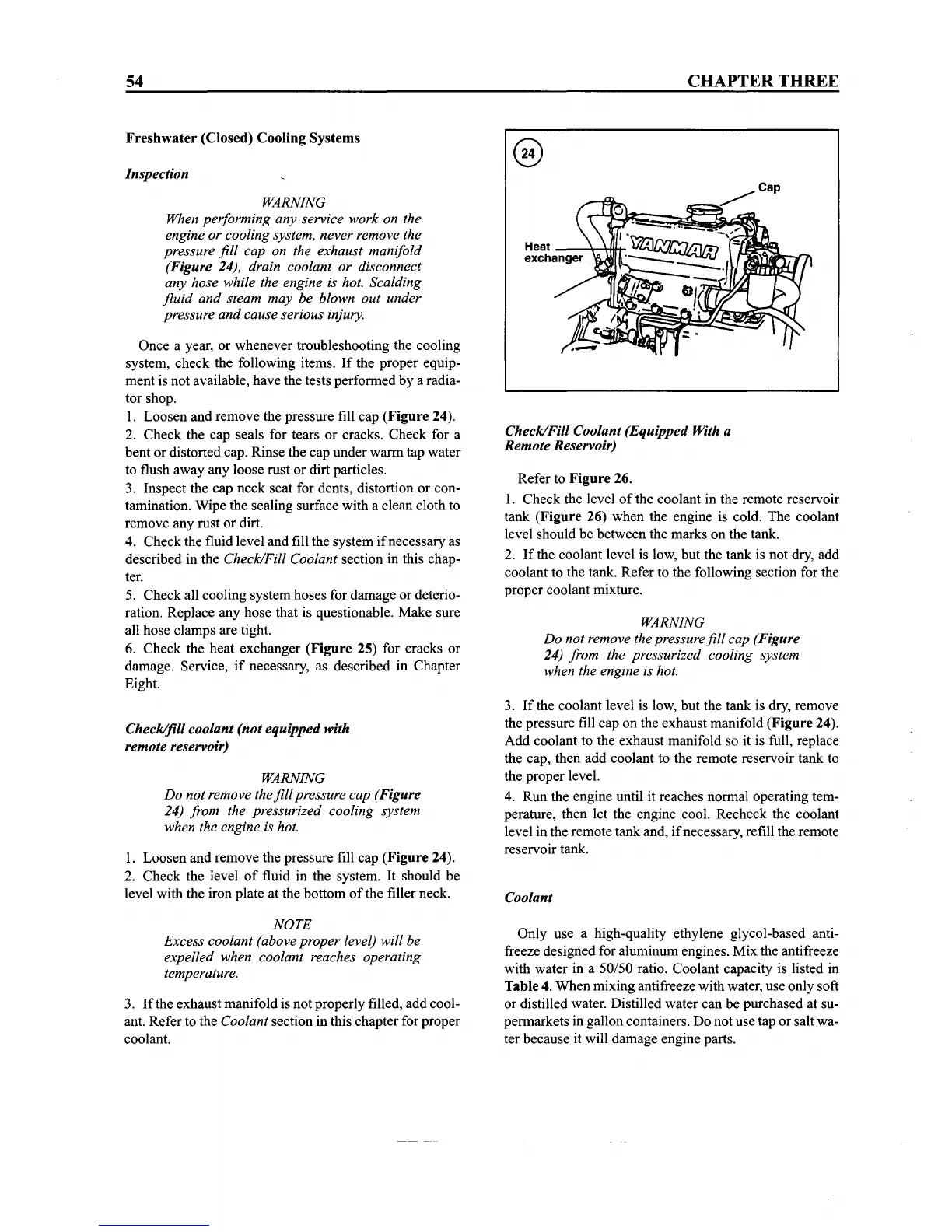
cap on the exhaust manifold
(Figure
24), drain coolant or disconnect
any hose while the engine
is hot. Scalding
fluid and steam may be blown out under
pressure and cause serious injury.
Once a year, or whenever troubleshooting the cooling
system, check the following items.
If
the proper equip-
ment is not available, have the tests performed by a radia-
tor shop.
1. Loosen and remove the pressure fill cap
(Figure
24).
2. Check the cap seals for tears or cracks. Check for a
bent or distorted cap. Rinse the cap underwarm tap water
to flush away any loose rust or dirt particles.
3. Inspect the cap neck seat for dents, distortion or con-
tamination. Wipe the sealing surface with a clean cloth to
remove any rust or dirt.
4. Check the fluid level and fill the system
if
necessary as
described in the
Check/Fill Coolant section in this chap-
ter.
5. Check all cooling system hoses for damage or deterio-
ration. Replace any hose that is questionable. Make sure
all hose clamps are tight.
6. Check the heat exchanger
(Figure
25) for cracks or
damage. Service,
if
necessary, as described in Chapter
Eight.
Check/fill coolant (not equipped with
remote reservoir)
WARNING
Do not remove the
jill
pressure cap (Figure
24) from the pressurized cooling system
when the engine
is hot.
1. Loosen and remove the pressure fill cap
(Figure
24).
2. Check the level
of
fluid in the system.
It
should be
level with the iron plate at the bottom
of
the filler neck.
NOTE
Excess coolant (above proper level) will be
expelled when coolant reaches operating
temperature.
3.
Ifthe
exhaust manifold is not properly filled, add cool-
ant. Refer to the
Coolant section in this chapter for proper
coolant.
CHAPTER THREE
Check/Fill Coolant (Equipped With a
Remote Reservoir)
Refer to
Figure
26.
1. Check the level
of
the coolant in the remote reservoir
tank
(Figure
26) when the engine is cold. The coolant
level should be between the marks on the tank.
2.
If
the coolant level is low, but the tank is not dry, add
coolant to the tank. Refer to the following section for the
proper coolant mixture.
WARNING
Do not remove the pressure jill cap (Figure
24) from the pressurized cooling system
when the engine
is hot.
3.
If
the coolant level is low, but the tank is dry, remove
the pressure fill cap on the exhaust manifold
(Figure
24).
Add coolant to the exhaust manifold so it is full, replace
the cap, then add coolant to the remote reservoir tank to
the proper level.
4. Run the engine until it reaches normal operating tem-
perature, then let the engine cool. Recheck the coolant
level in the remote tank and,
if
necessary, refill the remote
reservoir tank.
Coolant
Only use a high-quality ethylene glycol-based anti-
freeze designed for aluminum engines. Mix the antifreeze
with water in a
50/50 ratio. Coolant capacity is listed in
Table 4. Whenmixing antifreeze with water, use only soft
or distilled water. Distilled water can be purchased at su-
permarkets in gallon containers. Do not use tap or salt wa-
ter because it will damage engine parts.



 To Next Page