Need help?
Do you have a question about the Yuwell YX102 and is the answer not in the manual?
Critical safety guidelines covering device handling, usage environment, and potential hazards.
Factors affecting measurement accuracy and device performance, including environmental and usage conditions.
Introduces the oximeter's purpose, key features, and benefits for users.
Explains the scientific basis of how the pulse oximeter measures SpO2 and pulse rate.
Defines and explains the meaning of various symbols used on the device and in its documentation.
Specifies applications, target users, and situations where the device should not be used.
Explains how to read and understand the information presented on the oximeter's screen.
Lists key technical parameters including display type, power, current, dimensions, and environment.
Details the methodology and results for determining the device's SpO2 accuracy.
Highlights the main attributes of the oximeter, such as simplicity, portability, and battery life.
Covers operation scope, steps, battery, and lanyard installation for device use.
Provides instructions on how to maintain the device and store it properly to ensure longevity.
Outlines the recommended methods for cleaning and disinfecting the reusable oximeter.
Offers solutions for common problems encountered during the use of the oximeter.
The YUWELL® Finger Pulse Oximeter is a non-invasive, non-sterile, reusable, spot-checking device designed to measure and display SpO2 (oxygen saturation) and pulse rate through a finger. It is intended for use by adults and children weighing over 30 kg, for both home and hospital inspection. This device is not suitable for continuous monitoring, use during motion, or in situations with low perfusion.
The oximeter operates based on the Lambert-Beer law, utilizing the spectrum absorption characteristics of deoxyhemoglobin (HHb) and oxyhemoglobin (O₂Hb) in glow and near-infrared zones. It employs Photoelectric Oxyhemoglobin Inspection Technology in conjunction with Capacity Pulse Scanning and Recording Technology. Two beams of light (red and infrared) are focused onto the human nail tip through a clamp finger-type sensor. A photosensitive element then obtains the measured signal, which is processed by electronic circuits and a microprocessor to display the information.
Oxyhemoglobin saturation represents the percentage of oxyhemoglobin (O₂Hb) capacity, compounded with oxygen, relative to the total hemoglobin (Hb) capacity in the blood. It is a crucial physiological parameter for the Respiratory Circulation System. Many respiratory diseases can lead to lowered oxyhemoglobin saturation. Other factors, such as Automatic Organic Regulation Malfunction caused by Anesthesia, intensive Postoperative Trauma, or injuries from medical examinations, can also reduce oxyhemoglobin saturation. Timely monitoring of oxyhemoglobin saturation is vital for patients experiencing symptoms like dizziness, asthenia, or emesis, allowing doctors to identify problems promptly.
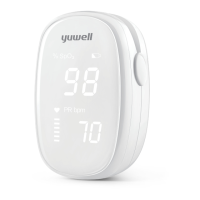
The YUWELL® Finger Pulse Oximeter is characterized by its small volume, low power consumption, convenient operation, and portability. To use the device, the patient simply places one finger into the fingertip photoelectric sensor, and the screen displays the measured values of pulse oxygen saturation and pulse rate. Clinical experiments have demonstrated its high precision and repeatability.
To operate the device, first install two AAA batteries into the battery cassette, ensuring correct polarity. Then, open the clamp to its largest extent and insert one finger into the rubber hole of the oximeter, preferably inserting it thoroughly before releasing the clamp. It is important to remain still while the oximeter is working to ensure accurate readings. After long interruptions, users should refer to the product operation steps. The corresponding data will be displayed on the screen.
The device is designed for fingers (not thumbs) between 0.3 and 0.9 inches (0.8-2.3 cm) thick, with the finger inserted into the sensor position in the middle of the device. It is not designed for newborns and infants.
The product will automatically shut down after approximately eight seconds if no signal is detected. A low voltage prompt will appear on the display when the battery voltage falls below the normal working range, indicating that the batteries need to be replaced.
Under normal conditions, the oximeter does not require special protection or routine maintenance and calibration, except for battery replacement. The device can be used for five years, with daily measurements taken ten times for ten minutes each time. It is recommended to use two AAA 1.5V alkaline batteries and replace both batteries simultaneously to avoid mixing batteries with different power levels.
The product should be stored in a dry environment to prevent moisture from affecting its lifetime and causing damage. It should be kept away from direct sunlight, extreme infrared or ultraviolet radiation, and organic solvent vapors, dust, and corrosive gases. The recommended transportation and storage conditions include a temperature range of -20℃ to +55℃, relative humidity of ≤93% (non-condensing), and atmospheric pressure of 500hPa to 1060hPa.
This product is a reusable non-sterile device that requires cleaning and disinfection. The oximeter should never be immersed or soaked in liquid. It is recommended to clean and disinfect the oximeter before and after each use, or according to hospital policies, to prevent cross-infection and long-term damage. Only recommended cleaning agents, such as water, ethanol 70%, or isopropanol 70%, should be used. Avoid using ethanol-based, amino-based, or acetone-based cleaning agents. Metal brushes or abrasive materials should not be used on the oximeter panel.
To clean, shut down the oximeter, remove the battery, and wipe the oximeter with a cotton or soft cloth moistened with water. After cleaning, wipe off any remaining water with a soft cloth and allow the oximeter to air dry. For disinfection, follow the same cleaning steps, then disinfect with a cotton or soft cloth moistened with one of the recommended disinfectants. After disinfection, wipe off any disinfectant residue with a soft cloth moistened with water and allow the oximeter to air dry. The oximeter shell should be kept free from dust by wiping it with a soft cloth or lint-free cleaning agent. Ensure no liquid enters the equipment.
The oximeter cover should only be opened by professional maintenance staff, as no internal parts require opening by end users. If there is uncertainty about measurement precision, other methods should be used to check the patient's pulse and determine if the oximeter is functioning correctly. Avoid splashing or dumping any liquid into the oximeter or its attachments, switches, and connections, as this may damage the device.
If the product is not used for an extended period, the batteries should be removed to prevent damage from leakage. Do not mix new batteries with old ones, and alkaline batteries are recommended over rechargeable batteries.
 General
| Model | YX102 |
|---|---|
| Category | Medical Equipment |
| Type | Fingertip Pulse Oximeter |
| Power Supply | 2 x AAA Batteries |
| Dimensions | 58 mm x 32 mm x 34 mm |
| PR Measuring Range | 30 bpm - 250 bpm |
| Display | OLED |
| Weight | 50g (including batteries) |
| SpO2 Measuring Range | 70% - 100% |
| Pulse Rate Range | 30 bpm - 250 bpm |

 To Next Page