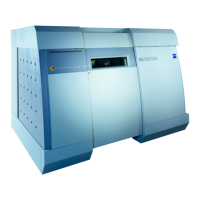
The Argon Ion Beam System is an optional additional Focused Ion Beam (FIB) column designed for the Carl Zeiss CrossBeam® model NVision 40, transforming it into a triple beam system. This system is primarily used for fine polishing of Transmission Electron Microscopy (TEM) lamellas, specifically to remove implanted gallium and amorphous layers using low kV argon ions.
Function Description:
The Argon Ion Beam System generates argon ions from argon gas. These ions pass through a column, where a condenser aperture and a lens form a microscopic ion beam. In the Triple Beam System, the FIB, Scanning Electron Microscope (SEM), and Argon Ion Beam System are arranged to intersect at a single point in the specimen chamber, known as the coincidence point. This arrangement allows all Argon Ion Beam System operations to be monitored in high-resolution SEM live imaging.
The main application of the system is fine-polishing TEM lamellas. During typical FIB milling, a flow of gallium ions from the FIB column hits the TEM lamella surface. This process can lead to gallium implantation and, in crystalline samples, the formation of amorphous surface layers, which degrade the quality of the TEM lamella. The Argon Ion Beam System addresses this by using low-energy argon ions to fine-polish these damage layers and implanted gallium ions, thereby improving the quality of the TEM lamella and enhancing the visibility of fine details.
The system offers specific imaging modes when installed:
- FIB mode Argon: Displays a live image of the argon beam in scan or spot mode, with the electron beam and focused ion beam blanked. This mode is mainly used for aligning the argon beam correctly, as its resolution is not comparable to SEM imaging.
- FIB mode Argon + SEM: Allows monitoring of the argon beam's progress in a live SEM image while the argon beam operates in scan or spot mode. The focused ion beam is blanked in this mode.
Important Technical Specifications:
- Environmental Requirements: Pollution degree 2, Installation category II.
- Electrical Supplies: Nominal AC voltage of 100 V 5 A (0.5 kVA) ±10%, 50-60 Hz single phase, ground resistance of 100 Ohm or less.
- Ion Source: Gaseous Argon.
- Lenses: Two-stage electrostatic lens.
- Beam Deflector: Quadrupole electrostatic type.
- Acceleration Voltage: 0.5 - 1.0 kV.
- Maximum Beam Current: >10 nA.
- Beam Energy: 0.5 - 1.0 keV.
- Beam Diameter/Spot Size: 50 - 150 µm, typically 100 µm at 1 kV, 10 nA.
- Max. Beam Shift: ± 1.5 mm (at WD 29 mm).
- Max. Scan Range: > 3.0 mm (at WD 29 mm).
- Ion Irradiation Angle: 0 - 30°.
- In situ lift-out: Compatible with the in-situ lift-out technique.
- Control: Fully integrated into SmartSEM® software (V05.04 or higher), operated via its graphical user interface.
Usage Features:
- Getting Started: The argon beam is switched on via the "Argon Gun" panel in the SmartSEM® software. The system performs an automatic test to ensure the gun can achieve a discharge current greater than 50 mA, which may take up to one minute.
- Coincidence Point Adjustment: Daily checks are recommended to ensure the Argon Ion Beam System remains aligned with the SEM and FIB coincidence point. This involves loading a Faraday cup, focusing on a detail in SEM, and then centering the same detail in the argon image using the "Argon Beam Shift" in the "Argon Gun" panel.
- Operational Parameter Adjustment:
- Acceleration Voltage: Adjustable from 0.5 kV to 1.0 kV using a slider. Lower voltages result in gentler polishing but decreased milling rates. The argon condenser voltage must be set according to the acceleration voltage (e.g., 1200 V at 1000 V, 1040 V at 750 V, 900 V at 500 V). After changing parameters, the coincidence point must be re-adjusted.
- Argon Gas Flow: Optimal flow is typically 2.0 - 2.3% (range 1.5 - 3.0%). The beam current decreases at higher or lower gas flow. A beam current of 10 nA is targeted at 1000 V acceleration voltage, measured with a Faraday cup. Incorrect gas flow can prevent the argon ion beam from switching on.
- Argon Discharge: Should be set to -1000 V, with a displayed current of 130 µA. If the current is lower, the argon gas flow should be reduced in 0.1% steps.
- Fine Polishing of TEM Lamellas:
- Requires adjustment of stage rotation and tilt to achieve the desired argon incidence angle, calculated using specific formulas provided in the manual.
- It is crucial not to change the Argon Beam Shift or other parameters (except focus and magnification) during polishing to maintain correct alignment.
- Polishing is recommended with a small scanning argon beam field for more homogeneous results.
- The magnification should be set to 250-300x for optimum homogeneity and effectiveness.
- Polishing time is set in the "Argon Mill" panel. The process can be monitored in the SEM image by clicking "Grab Sem Frame" or selecting "FIB Mode Argon + SEM".
- For polishing the back of a TEM lamella, a compucentric rotation of 180° is performed, and the polishing process is repeated. Alternatively, a negative incidence angle can be set.
- Switching Off: The argon beam is switched off by clicking "Standby" and then "Off" in the "Argon Gun" panel.
Maintenance Features:
- Change of Consumables: The argon supply will eventually be used up. Replacement of the argon gas bottle must be performed by a local Carl Zeiss service engineer.
- Repair: The Argon Ion Beam System is not user-serviceable. All repairs and maintenance tasks not described in the instruction manual must be performed by authorized Carl Zeiss service staff.
- Troubleshooting: The manual provides a table of common problems (e.g., image visibility issues, beam not switching on) with possible reasons (e.g., incorrect gas flow, empty argon bottle, contamination) and recommended actions (e.g., adjust gas flow, contact Carl Zeiss Service).
- Safety: Emphasizes that only service engineers trained and authorized by Carl Zeiss are permitted to service the system and perform electrical work due to hazardous voltage inside the workstation.
The Argon Ion Beam System is a sophisticated tool designed to enhance the quality of TEM lamellas by precisely removing damage layers and implanted materials, thereby improving the accuracy and detail of electron microscopy analyses.

 Need help?
 General

 To Next Page