MS - SOUND decoders MS440 to MS990 and MN - NON-SOUND decoders MN170 to MN340 Page 69
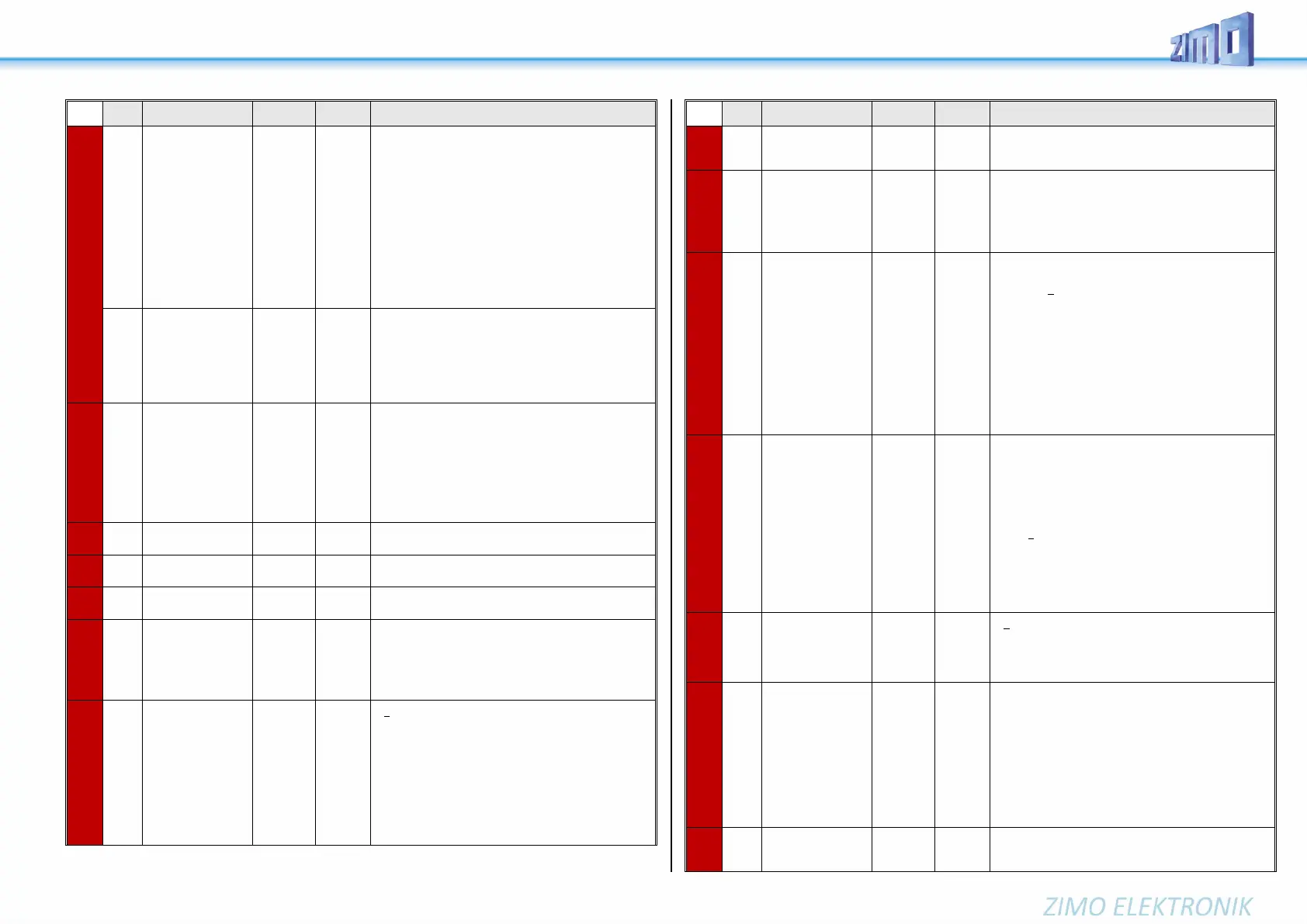
Distance controlled
stopping -
Constant Braking Dis-
tance
Selection of the
braking occasion
and the
braking behavior
Activation of distance-controlled stopping (Constant Brak-
ing Distance) as defined in CV #141 instead of time con-
trolled braking as defined in CV #4, for
= 1 automatic stop with ZIMO HLU ("signal-controlled
speed influence") or ABC (signal stop by "asymmetric
DCC signal").
= 2 manual stop by speed controller.
= 3 automatic and manual stopping.
In the above cases (= 1, 2, 3) braking from partial speeds
is delayed so that the train does not "creep" for an unnec-
essarily long time (this is the recommended choice). On
the other hand
= 11, 12, 13 as above, but braking is always initiated as
soon as the train is entering the stopping section.
Distance controlled
stopping -
Constant Braking Dis-
tance
The braking distance
The value in this CV defines the "Constant Braking Dis-
tance". The value suitable for the existing braking dis-
tances must be determined by trial and error; as a guide
can serve: CV #141 = 255 means approx. 500 m in the
prototype (i.e. 6 m in H0), CV #141 = 50 is approx. 100 m
(i.e. 1.2 m for H0).
see also: CV #831 - #833
Braking distance for-
ward High Byte
Extended definition of the Constant Braking Distance:
With CV #830 - #833 a more precise and direction depend-
ent braking distance can now be set. The factor compared
to CV #141 is 1 to 16.
The braking distance to be defined is calculated from:
(256 * High Byte) + Low Byte.
CVs #830 - #833 are only effective if CV #141 = 0.
Braking distance for-
ward Low Byte
Braking distance
backward High Byte
Braking distance
backward Low Byte
Distance controlled
stopping -
Constant Braking Dis-
tance
Compensation for
HLU method
Since HLU is more error-resistant than ABC, no detection
delay is usually necessary; therefore default 0.
Compensation for
gear backlash during
direction changes in
order to prevent
start-up jolt.
= 0: no effect
=1 to 255: in ase the driving direction was changed be-
forehand, the motor spins at minimum rpm for a defined
timespan (according to CV #2) for a specific time and
only starts to accelerate after this time has elapsed.
The time of these “idle rotations” can only be tried; typical
values:
= 100: the motor turns about 1 revolution or a
maximum of 1 second at the minimum speed.
= 50: about ½ a turn or max. ½ second.
= 200: about 2 turns or max. 2 seconds.
Important: The minimum speed in CV #2 must be config-
ured correctly, so that the train moves perfectly at the
lowest speed step (1).
Fine adjustment of
the
PID parameters
NOTE: are adjusted
automatically with
CV #56!
Integral value of the PID-motor regulation,
recommended for „modern“ powertrain: CV #147 = 65
Differential value of the PID-motor regulation,
recommended for „modern“ powertrain: CV #148 = 45
Proportional value of the PID-motor regulation,
recommended for „modern“ powertrain: CV #149 = 65
Reduction of motor
control in consist op-
eration
or
motor brake
(if address NOT in
consist)
The tens digit reduces the motor compensation to 10 % –
90 % according to the value in CV #58.
= 0: brake not active
= 1 - 9: In case of “zero power supply to the motor”
(Motor PWM = 0) the speed to the desired speed step is
still not reached (speed is still too high), the motor brake is
slowly activated (distributed to 1, 2, ... 8 seconds until the
full effect by short circuit on the motor through the power
amplifier). The higher the value, the stronger the brake is
applied.
= tens digit (1-9): Reduction of the motor regulation if con-
sist-key is active. The values 1 - 9 in the tens digits in
CV #151 reduce the control to 10 % - 90 % of the value
set in CV #58.
Dim Mask 2
Excludes specific
function outputs
from dimming
Addition to
CV #114
and
FO3, FO4 as
Direction outputs
Bits
0 - 5
and
Bit 6,
Bit 7
... Addition to CV #114.
Bit 0 - function output FO7,
Bit 1 - function output FO8,
Bit 2 - function output FO9,
Bit 3 - function output FO10,
Bit 4 - function output FO11,
Bit 5 - function output FO12.
Bit 6 = 0: “normal“
= 1: Direction bits on FO3, FO4, i.e.
FO3 is switched on when driving backwards,
FO4 is switched on when driving forward.
(for Märklin switch type C)
Bit 7 = 1: direction bit for FO9 when driving forward
Time limit for
continued driving
without rail signal
= 0 (default): Continued driving as long as energy is
available.
= 1 - 255 (tenths of a second): Stopping time if the rail
signal is not received (although supply from energy stor-
age)
Bit 1 = 1: DIESEL, ELECTRO Drive off immediately even
if playback of idle sound has not yet finished.
Bit 2 = 1: DIESEL, ELECTRO After short stops, wait for
idle sound before driving off.
Bit 4 = 1: STEAM: Two stage compressor (Z1 for fast re-
fill after coming to a stop, Z2 for slow pressure loss
compensation during longer stops).
Bit 7 = 1: Delay start until playback of start-up whistle has
finished.
Other bits: OEM special applications (i.e. Panto control
etc.)
to be preferred for
new projects
In extension of the settings of CV #124, if the selection
there (half speed on F3 or F7) is not sufficient, because
another key is desired:


 To Next Page
 Loading...