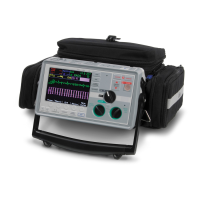
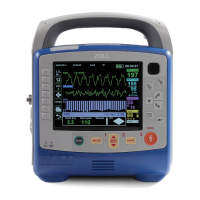
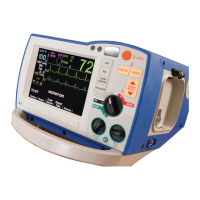
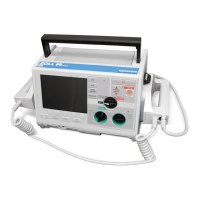
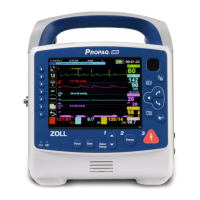
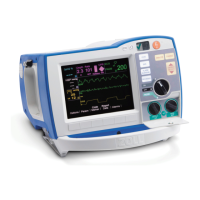
The ZOLL E Series End Tidal Carbon Dioxide (EtCO2) option provides continuous noninvasive monitoring of respiratory carbon dioxide (CO2) and respiration rate. It is designed for use with E Series units equipped with software revision 2.00.000 or higher, and supports both mainstream and sidestream CO2 monitoring methods. The device is intended for monitoring adult, pediatric, and neonatal patients requiring ventilator support, transport, or anesthesia.
Function Description:
The E Series EtCO2 option offers two primary monitoring methods:
-
Mainstream Monitoring: This method utilizes the CAPNOSTAT® 5 Mainstream CO2 Sensor. The sensor attaches to an airway adapter, which connects to an endotracheal (ET) tube or other airway. It measures gases flowing through the breathing circuit. For non-intubated patients, a disposable mouthpiece or a CAPNO2mask™ can be connected to the adapter, allowing for O2 delivery while monitoring expired CO2.
-
Sidestream Monitoring: This method employs the LoFlo™ CO2 Module. The LoFlo module contains a gas sampling pump that draws small gas samples from the patient's airway via a nasal/oral cannula or airway adapter. These samples are then passed through a solid-state infrared sensor (located away from the patient's airway) that measures CO2. While typically used for non-intubated patients, it can also be used for EtCO2 measurement on intubated infant, pediatric, and adult patients. However, it should not be used on patients who cannot tolerate the 50ml/min removal of sample gases from their breathing circuit. The sidestream module uses specialized cannulas and airway adapters with integrated sample cells and filters to protect the system from fluid and contaminant aspiration.
In both systems, the CO2 sensor generates infrared light that passes through the airway adapter or sample cell to a detector. CO2 from the patient's breath absorbs some of this infrared energy, and the E Series unit determines CO2 concentration by measuring the amount of light absorbed.
The E Series unit displays EtCO2 as a numerical value in millimeters of mercury (mmHg), percent (%), or kilopascals (kPa). It also displays respiration rate (RR) and can show a capnogram, which is a valuable clinical tool for assessing airway integrity and proper ET tube placement. The unit calculates respiration rate by measuring the time interval between detected CO2 waveform peaks, differentiating between waveforms caused by breathing, cardiogenic oscillations, and artifact.
Important Technical Specifications:
- Transducer Type: CAPNOSTAT 5® CO2 Sensor (Mainstream) and LoFlo™ (Sidestream).
- Principle of Operation: Non-Dispersive Infrared (NDIR) single beam optics, dual wavelength, no moving parts.
- Warm Up Time: Full specifications within 2 minutes at an ambient temperature of 25°C. Capnogram in 15 seconds.
- EtCO2 Measurement Range: 0-150 mmHg, 0-20%, 0-20 kPa.
- EtCO2 Accuracy (at 760 mmHg, 25°C):
- 0-40 mmHg: ±2 mmHg
- 41-70 mmHg: ±5% of actual
- 71-100 mmHg: ±8% of actual
- 101-150 mmHg: ±10% of reading
- (At respiration rates > 80 breaths per minute, all ranges are ±12% of actual.)
- EtCO2 Resolution: 0.1 mmHg (0-69 mmHg), 0.25 mmHg (70-150 mmHg).
- EtCO2 Stability: Short-Term Drift: ≤ 0.8 mmHg over four hours. Long-Term Drift: Accuracy maintained over a 120-hour period after zeroing.
- EtCO2 Noise: RMS noise of the sensor ≤ 0.25 mmHg at 7.5% CO2 (Mainstream) or ≤ 0.25 mmHg at 5% CO2 (Sidestream).
- EtCO2 Rise Time (10-90%): < 60 ms (Adult/pediatric adapters, Infant/pediatric adapters) for Mainstream; < 3 seconds (includes transport and rise time) for Sidestream.
- Respiration Rate Range: 2-150 breaths per minute.
- Respiration Rate Accuracy: ±1 breath per minute.
- Sample Flow Rate (Sidestream): 50 ml/min ±10 ml/min.
- Compensations: Barometric pressure 400-850 mmHg (automatic). Operator selectable O2/N2O compensation.
- EtCO2 Alarm Limits: User selectable, High 5-100 mmHg, Low 0-95 mmHg, OFF.
- Respiration Rate (RR) Alarm Limits: User selectable, High 5-150 respirations per minute, Low 0-100 respirations per minute, OFF.
- Halogenated Agents: Specification allows for halogenated anesthetic agents at normal clinical levels. Desflurane beyond normal values (5-6%) may positively bias CO2 values by up to an additional 2-3 mmHg.
- Airway Adapter Deadspace: Adult < 5 cc, Infant < 1.0 cc (Mainstream); Adult < 7.3 cc Maximum, Pediatric/Infant < 1.0 cc (Sidestream).
- Environmental Operating Temperature: 0°C to 45°C (0°C to 40°C for LoFlo Module).
- Storage and Shipping Temperature: -40°C to 70°C.
- Electromagnetic Immunity: AAMI DF-80:2003, IEC 60601-1-2, 10 V/m.
- Operating Time (with new, fully charged PD4410 battery pack at 20°C):
- CAPNOSTAT 5® CO2 Sensor: 35 defibrillator discharges at maximum energy (200 J), or 1.5 hours minimum of continuous ECG monitoring, or 1.0 hour of continuous ECG monitoring/pacing at 60 mA, 70 beats per minute.
- LoFlo™: 90 defibrillator discharges at maximum energy (200 J), or 3.0 hours minimum of continuous ECG monitoring, or 2.5 hours of continuous ECG monitoring/pacing at 60 mA, 70 beats per minute.
Usage Features:
- Setup:
- Mainstream EtCO2: Involves attaching the CAPNOSTAT 5 CO2 sensor cable to the yellow CO2 connector on the E Series unit, selecting an appropriate airway adapter based on patient size and ET tube diameter, attaching the adapter to the sensor (ensuring clean, dry windows), zeroing the sensor/airway adapter, and then attaching the assembly to the airway circuit (between the elbow and ventilator circuit wye, with windows in a vertical position). For non-intubated patients, a mouthpiece can be used with the airway adapter, ensuring a complete seal around the mouth.
- Sidestream EtCO2: Involves attaching the LoFlo module cable to the yellow CO2 connector, selecting a sidestream airway adapter kit or cannula based on patient size and ET tube diameter, inserting the sample cell into the LoFlo module receptacle, zeroing the module/sample cell, and then applying the airway adapter kit or nasal/oral cannula to the patient. The exhaust tube should vent gases away from the module environment. For intubated patients, the airway adapter assembly is placed at the proximal end of the airway circuit. For non-intubated patients, nasal/oral cannulas are used, with oral/nasal cannulas recommended for mouth breathers.
- Zeroing: Essential for both mainstream and sidestream systems to compensate for optical differences or module characteristics. It should be performed after changing adapter types, when connecting a sensor/module for the first time, or if a "CHECK CO2 ADAPTER" or "ZERO CO2 MODULE" message appears. Zeroing should be done away from CO2 sources and not within 20 seconds of removing the adapter/cannula from the patient's airway.
- Display: EtCO2 values and respiration rate are displayed numerically. A capnogram waveform can be displayed, with scaling adjustable via the Zoom softkey. The unit provides 8 seconds of capnogram data at half the ECG display speed.
- Physiological Monitoring Menu: Accessed via the Param softkey, allowing selection of EtCO2 parameters. Options include Zero, Disable/Enable EtCO2 (for power-saving sleep mode), Zoom, Average (1 breath, 10 seconds, 20 seconds), and Compensation (O2, N2O, or O2&N2O).
- RR Filter: Available for LoFlo modules to improve respiration rate counting accuracy in the presence of artifact. Can be enabled or disabled.
- Alarms: User-programmable "out-of-range" alarms for both EtCO2 and respiration rate. Alarms can be enabled, disabled, or suspended. Auto alarm limits are set based on the patient's current CO2 value and breath rate.
- Recorder Operation: Pressing the RECORDER button prints a stripchart with date, time, ECG lead/size, heart rate, EtCO2 value, and respiration rate. The capnogram is also printed at a fixed scale.
- AED Operation: In semi-automatic mode, EtCO2 monitoring parameters can be changed, but the capnogram waveform is not displayed, and alarm limits are fixed to defaults. In manual mode, the capnogram can be displayed, and both heart rate and EtCO2 alarms are operational with adjustable limits.
Maintenance Features:
- Cleaning and Disinfection:
- Sensor/Module: The outside of the sensor or module can be cleaned and disinfected by wiping with 70% isopropyl alcohol, a 10% bleach solution, or mild soap, followed by rinsing with a water-dampened cloth and drying.
- Reusable Airway Adapters: Can be cleaned by rinsing in warm soapy solution, followed by soaking in a liquid disinfectant (e.g., 70% isopropyl alcohol, 10% bleach solution, Cidex®, or System 1®). They should then be rinsed with sterile water and dried. Reusable adapters can also be pasteurized or autoclaved at 121°C (250°F) for 20 minutes, unwrapped. Before reuse, ensure adapters are dry, residue-free, and undamaged.
- Disposable Components: Disposable airway adapters, mouthpieces, CAPNO2masks, nasal/oral sampling cannulas, and sidestream airway adapter kits are intended for single patient use only and should NOT be reused or sterilized, as this compromises system performance.
- Inspection: Periodically inspect sampling tubing for kinks.
- Troubleshooting: The manual provides a comprehensive list of messages and symptoms, possible causes, and recommended actions for issues such as "CHECK CO2 ADAPTER," "CHECK CO2 LINE," "CO2 COMM ERROR," and "WARM UP."
- Storage: Do NOT store sensors, modules, airway adapters, or cannula sets at temperatures less than -40°C or greater than 70°C.
- Servicing: Refer servicing to qualified personnel for hardware errors or persistent problems. Do not attempt to open the sensor due to electrical shock hazards.


 To Next Page
 General