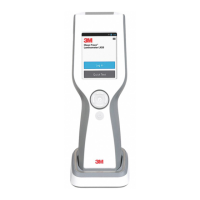
3M™ PROTÉGÉ PLUS
PORTABLE MULTI-GAS MONITOR
SENSOR K-FACTORS
8006569, Rev. C/June 2018
B-2
APPENDIX B.1. Gas Interferences
There are known gas interferences to a limited number of chemical compounds. 3M attempts to
identify possible gas interferences to which gas sensors may be exposed; however, not all chemical
compounds that presently exist have been tested. Table B-1: provides known toxic gas interfer-
ences.
Keys for Table B-1: Gas Interferences.
• Zero – Indicates tested and confirmed no interferences
• Blank – Indicates not tested
• Neg – Indicates gas produces a negative signal
• Two values in a cell – Indicates initial peak and finish offset (unstable or transition gas) and should
not be used for cross calibration
Table B-1: Gas Interferences
NOTE: Table B-1: Gas Interferences does not show, nor should it be implied, that no addi-
tional interferences may occur. These selectivity ratios are used as guides only. They
are not to be used as calibration factors. The gas species’ actual cross-sensitivities
may vary from the values shown.
INTERFERENCE GAS: Sensor Types (all values in ppm)
CO (Single)
CO (H
2
-Resistant)
CO (Dual-tox)
H
2
S (Dual-tox)
H
2
S (Single)
Hydrogen Cyanide
(HCN)
Acetylene (C
2
H
2
)
Ammonia (NH
3
)
0 <0.01
Arsine (AsH
3
)
Carbon Dioxide (CO
2
)
0
Carbon Monoxide (CO) 1 1 1 <0.02 <0.02 <0.05
Chlorine (Cl
2
)
0 <0.001 0 0
Chlorine Dioxide (ClO
2
)
Diborane (B
2
H
6
)
Ethylene (C
2
H
4
)
1 <0.01 <0.3
Germane (GeH
4
)
Hydrazine (N
2
H
4
)
Hydrogen (H
2
)
0.12 <0.05 0.2 <0.001 <0.001



 To Next Page